A rose by any other name…

I was recently looking through my family tree, trying to suss out surnames I haven’t spent any or much time with in my research, in an attempt to populate my blog with interesting stories about my ancestors.

Eventually one name popped out and screamed “Me, me!”

Philbrick.

Thomas Philbrick to be exact.

Why was his name doing all this screaming? Well, in performing a bit of an online background check on the gentleman, (one should always do a background check before meeting up with a new guy), I find that Philbrick can be found under many guises:

Felebruge
Fylbrigg
Felbrigge
Felbridge
Fellbridge
Felbrigge
Felbridg
Fellbrygge
Filbrick
Philbrok
Philbrucke
Philbrook
Filbrook
Filbrucke
Philbriek
Philbrock
Philbrooth

I believe that these variations only scratch the surface! (I thought the Shepard surname was bad.)

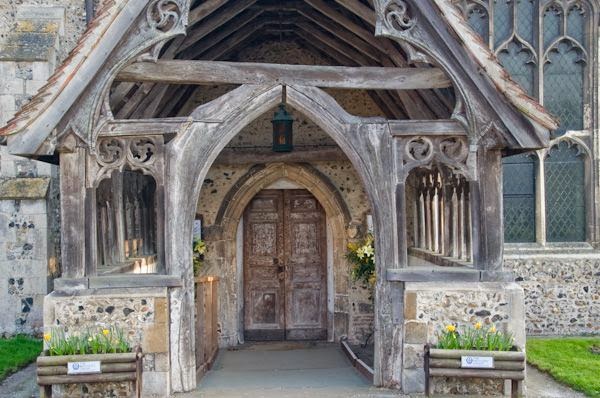
Stolen off the internets; photo from British Express of the front of Bures St. Mary’ church.

Thomas and his wife, Elizabeth, are believed to have hailed from the small village of Bures St. Mary’s in Suffolk, England. Bures St. Mary’s is located on the Stour River which borders Suffolk and Essex Counties. He arrived in Watertown, Massachusetts with his family, wife Elizabeth (Knop/Knapp) Philbrick  and a couple of children, around 1635. This line’s descendants eventually married into the Hatch family.

Oh, by the way, the family in America spelled the name Philbrook or Philbrick. I guess it depended on their mood that day.

But I was framed….

Years ago, I received a copy of Abram and Joseph Rosa’s pension files regarding their service in the Civil War. I distinctly remember a comment made by the gentleman taking depositions and accumulating evidence to prove service in order for either gentleman to receive any money. He said that, to paraphrase, “the Rosa’s in the past were not well regarded by the community, but in these later years had improved their behavior.”

My eyebrows had raised at reading the comment, but I was not terribly surprised. Jennie Rosa had left her husband, Abram, during the war, with their two daughters. Never to go back to Michigan again. My belief was that she left him because of possible abuse. Of course, it is doubtful we will ever truly know.

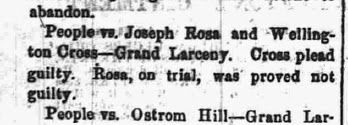
Now Joseph is Abram’s older brother, by about only a year or two. He never married dying a bachelor  about 5 years before his brother. But apparently he spent a bit of his life more on the nefarious side, as can be seen from this little tidbit from the May 22, 1867 issue of the Kalamazoo paper:

Found in the In Court section on page 5.

Joseph would have been 35 when this occurred. The Wellington Cross mentioned in the article was his sister Sophia’s 22 year old son, his nephew. I have a hard time believing that Joseph had nothing to do with the larceny, he was much older than his nephew and was probably a very bad influence. Further investigation into Wellington shows him in court over the years for burglary and larceny at various times. It appears he had light fingers. I can find no evidence of Joseph in court again, but that could mean he just wasn’t caught or I don’t have access to all the newspapers.

So now we have a better idea to why the community was leery of the Rosa’s and their kin. Abram was possibly abusive and his nephew and brother were crooks.

Who says genealogy ain’t fun. Now I need to see those court records.

A family tragedy…

Yesterday, while doing research on Mary, Elzy George’s wife, I decided to try and find information on her through their children. So I started with the newspapers, hoping to find obituaries that might be of assistance.

Elzy and Mary had at least six children that we know of, Amos was their eldest son, and the second child after Rachel. This is an obituary of sorts, but not the one I was hoping for:

Sad Death of Two Boys at Freeport, The Wheeling Register; Date: 04-13-1883; Vol.19; Issue: 297; pg[4]

These two boys were the sons of Amos and his second wife, Lydia Jane Glover, the boys were both 13 or less in age.

Something about Mary…

Rachel Hays Shepard

My great grandmother, Rachel Hays, was named after her grandmother Rachel George Hays, who had died around 1900. My mission for the past couple of years has been to find out what I can about Rachel George’s family.

It has been a very interesting journey so far. Using land records and online trees, that are of course not sourced, I have been able to piece together some parts of the puzzle. In fact one recent re-discovery, helped fill in more of the missing spots.

The current belief is that Rachel George is the daughter of Elzy George and Mary (possibly Baker).

Elzy was the son of William Absalom, jr., and Margaret and the grandson of William, sr. and Debra Ankrom.

The Ankrom’s are of Scottish descent. The Georges were probably Welsh quakers, I am still working on that.

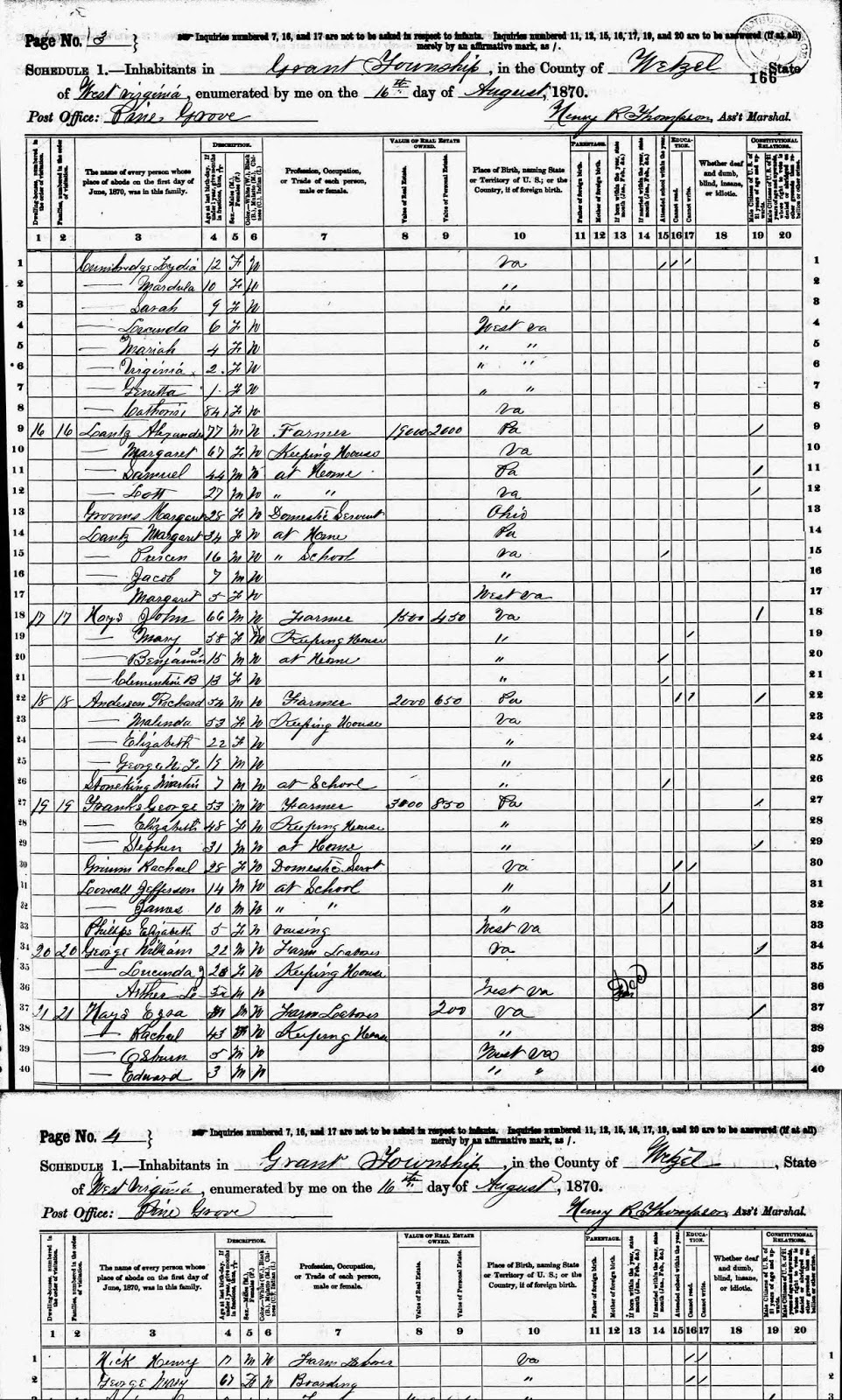
I know most of this through my own research into the census records and land records and a few printed genealogies. But the big find for me, was a better confirmation that Rachel’s mother’s name was Mary. This happened when I was going over an 1870 census, a record I have had for several years, but until only recently understood the significance of.

When I transcribed the census record into Ezra Hays record in my genealogy file, I had a Mary George age 16 living with Ezra and Rachel Hays along with their two sons, Edmund and Ausborn, and a farm helper. I thought that Mary was probably a niece of Rachel’s living with the family.

However, while doing some recent census research for Mary, up popped this same census record which I didn’t remember I had. Only now I am looking at the actual image, and I see that the Mary listed, who I though might be a niece, was a 67 year old lady. Oh my goodness, this was probably Rachel’s mother. Which would make sense because she was a widow in the 1840s and had never remarried. So I had either transcribed the census record incorrectly, had a typo, or the earlier image had been hard to read.

This is an excellent re-discovery and swings the consensus of Rachel’s parents being Elzy and Mary more into the yes category. Earlier census records for the Elzy George family also indicate a connection because there is a daughter of an age of Rachel in the both the 1830 and 1840 censuses.

1870 Census records from Ancestry.com from Grant, Wetzel County, West Virginia. It covers two pages and Mary George is on the second page.

When Rachel was about 20 years of age she had an out of wedlock son, William George. We don’t know who his father is, as he is never named in any of William’s official records. This son lived by his mother and her new husband and sons, married, and had children of his own.

It is like pulling teeth on this family, but that is what makes research so interesting. I will be doing more GEORGE research in June when I head over to Salt Lake City again. Here’s hoping.

Germans everywhere…

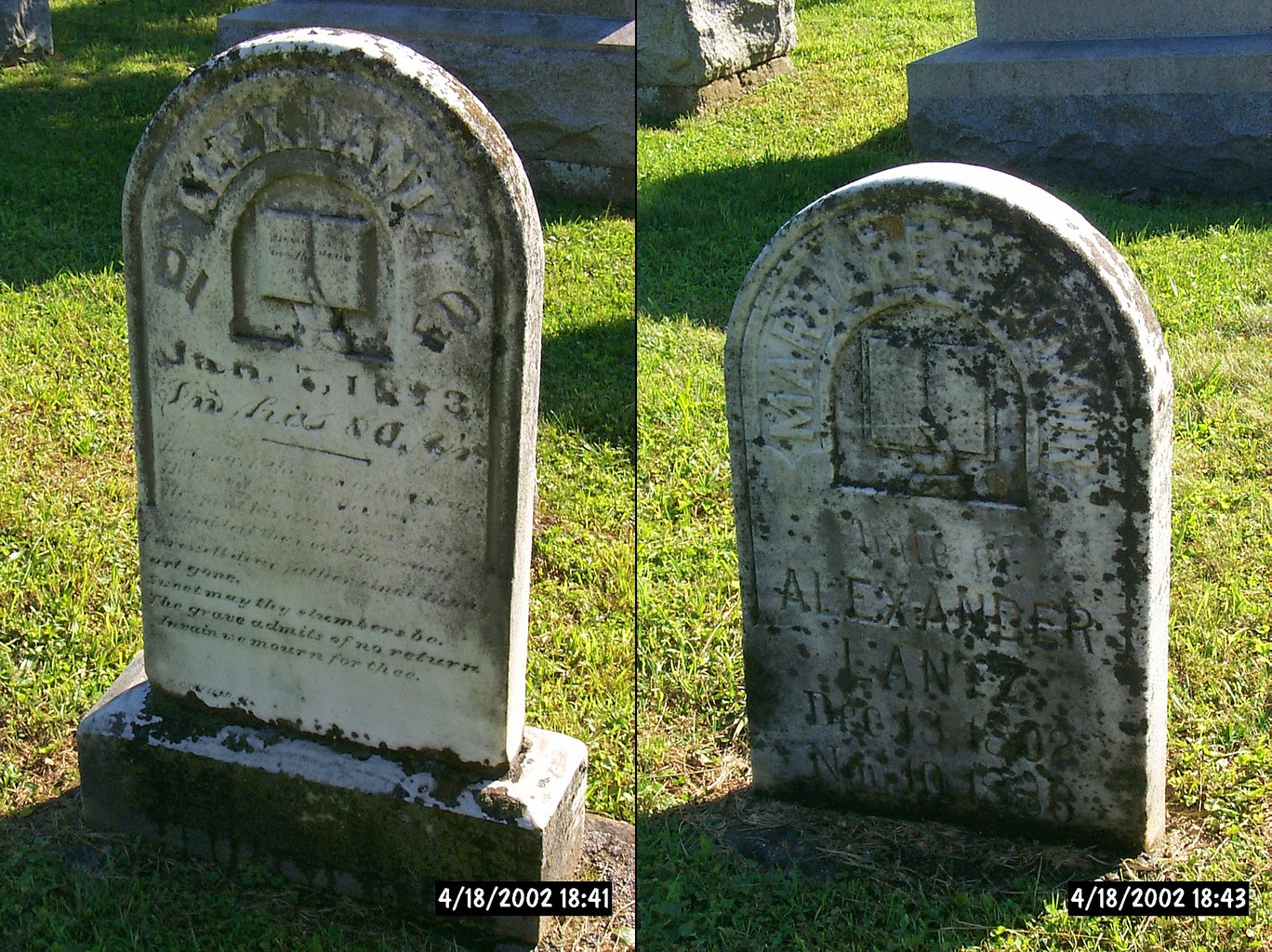
Alexander and Margaret (Minor) Lantz headstones in Jacksonburg, West Virginia cemetery.

I bet you thought all our German ancestry came from our John side of the family. Well, surprise, you would be wrong.

Susanna Lantz was born on the 18th of April 1820 in Pennsylvania. She was the daughter of Alexander Lantz and Margaret Minor. At the tender age of 16 she married Edmund Hays in Virginia.

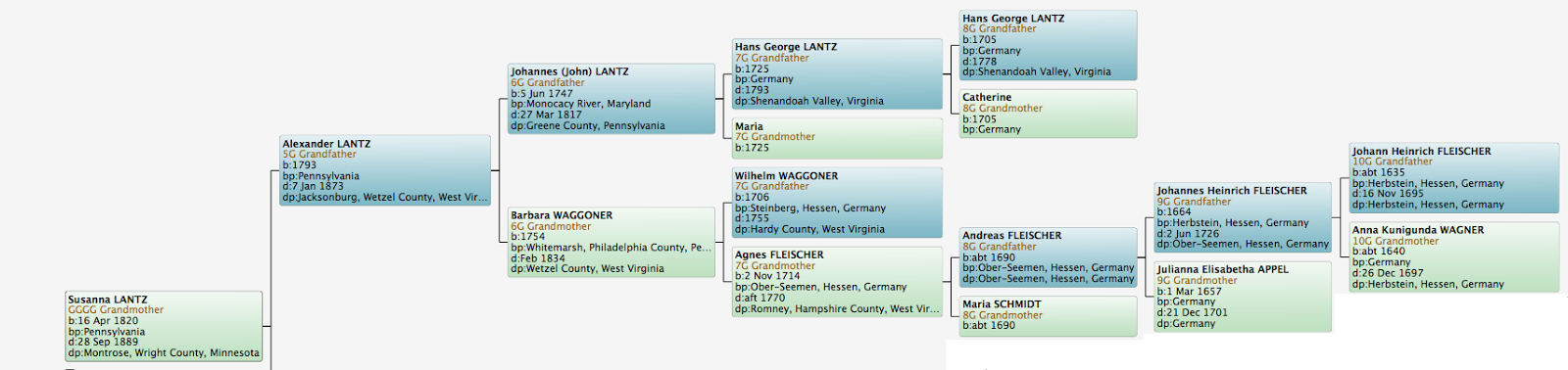
Susanna’s father’s family was all German. Her maternal great-grandparents came to America about 1748 and her paternal great-grandparents arrived about 1747.

Susanna Lantz’s family tree, showing her father’s German heritage.

The Lantz surname is found quite a bit among the Amish in Pennsylvania, I do not know if our Lantz’s were Amish, but if they were, they didn’t stay that way, as later generations didn’t appear to be so inclined.
Alexander’s parents were Johannes(John) Lantz and Barbara Waggoner, which was Wagner in Germany. John served in the revolutionary war, in Capt. Henry Rush’s company of the Bedford County Militia. His name appears as John Lance in the official records.
Alexander’s mother, Barbara, lost her father when she was 7, to what was believed to be a Delaware/Lenai Lenape raiding party. Her father Wilhelm Waggoner, was out in the field when he was caught and scalped. Barbara’s sister Mary, was kidnapped along with her brother Peter. However, Mary was killed by her fiancé during a very inept rescue attempt. Peter disappeared around the Great Lakes area for years, but eventually made it back to his family from Canada and took up shoemaking.
Barbara’s widowed mother, Agnes (Fleisher) Waggoner married again to a Conrad Lutts.
The George Lantz family first settled in Maryland around the Monococy River and then moved to the Shenandoah Valley. This is the first generation of Lantz’s in America. George and his wife Catherine were both born around 1707 in Germany. They had emigrated together along with a few of their children.
This is the only bit of German that I have found so far on the Shepard side of the family, but that doesn’t mean there isn’t more. 

Crazy Esther…

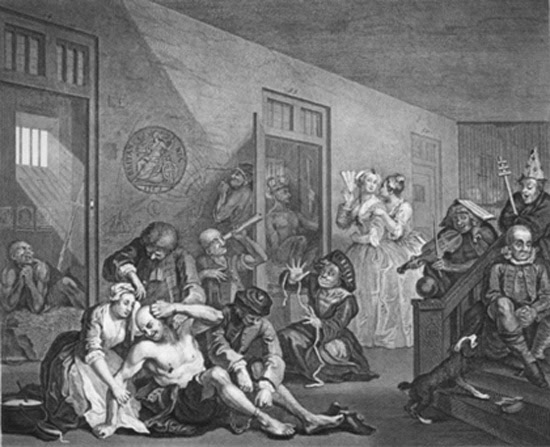
Bedlam

Esther Newell was dealt a double whammy in the world of history and genealogy. She was a women and she was crazy. Both of these issues made her doubly sure of not being relevant when it came to her descendants.

One can tell how irrelevant she was by the dismissive mentions made of her in biographies about her husband, Asa Lyon.

Esther was from Charlotte, Chittendon County, Vermont. She is said to have been born about 1762, although I have found no records that confirm this yet. She was the daughter of Rev. Abel Newell (a 1751 Yale graduate) and Abigail Smith (daughter of John Smith).1 She married Asa Lyon in 1796. They probably met in South Hero, Vermont, as he was employed there by 1794.

Asa was a 1790 Dartmouth graduate. He spent many years as a pastor of the Congregational Church in South Hero. Among his other accomplishments he was a member of Congress from 1815-1817 and served 13 years in the Vermont Legislature. He was also a Judge of Grand Isle County. Apparently he was regarded by many of his peers as one of the most talented men in the State.2

I have found many mentions of him in various books published about the history of Vermont and South Hero.  A great many accolades are heaped on him, but the only thing ever mentioned about his wife Esther, who birthed his children, is she was crazy.

In researching the history of the insane in the later 1700s to early 1800s, I found out that there were only two institutions built around that time period in America, one in Virginia the other in New England. But from what I have been able to glean from various published biographies, Asa kept his wife at home in his own care. There weren’t really any other options at the time. And even if he could put her in an insane asylum, she wouldn’t have been any better off. The treatment of the insane was pretty barbaric at the time. The reason for the institutions in the first place, was merely a place to put the crazy people who were dangerous, so they wouldn’t interfere with the ‘sane’ people out in the world. Those deemed insane, but harmless, were left to their own devices. They ended up beggars, the homeless of their time.

So poor Esther is treated with distain. It wasn’t like she had any choice in the matter when it came to being crazy, and we have no idea what kind of crazy she was. But she has been pretty much ignored even by those researching the Lyon family. Meanwhile her husband has had accolades piled on him by his peers, I am sure they were reasonable. Although one does get tired of the poor suffering husband routine. After all I do believe the vows were, ‘until death do us part’. He was merely doing his duty.

I have to say that for me it is refreshing to have an ancestress who is a bit more interesting than the run of the mill housewife, which is 100% of the lot. I greatly wish more of them had broken out of the mould, even a little bit.  Although I guess when I think about it, maybe they didn’t write a great novel or march for suffrage, but they did travel great distances across this country through the wilderness and help to carve out lives for their family. They crossed oceans in small ships leaving all they knew behind, in some cases not even speaking the language of the country they moved to, and suffered hardships beyond my comprehension or experience.

I guess more of them must have been just a little bit crazy.

1 New England Families, Genealogical and Memorial: A Record of the Achievements of Her People in the Making
of Commonwealths and the Founding of a Nation, Volume 1: p300

2 Bibliography of Vermont, p157

Amund Amundson

Ah yes, the second half of my Norwegian ancestral origins. Because official records can be wrong,  or memory can be elusive, Amund has proven to be a worthy opponent in this genealogical quest. You see some ancestors just don’t want to be found.

In the case of Amund, he was very closed mouthed and had an incredibly bad memory. He is first found in 1875 in the Minnesota State census with Jorgina, his wife and their eldest daughter Christine, who was just a few months old. In it his age is noted as 23, which means he was born in 1852 or 1853. In each successive censes after that he is born later and later until finally, the 1900 census. In this census one must provide month and year born, his entry has April 1852. Excellent. In 1905 he also continues to say born 1852. So now I am pretty sure of the year and I have a month.

Next I tried to find a naturalization record for him. The only Amund found close to the year born in the records for the State of Minnesota was an Amund born 1853 declaring his intent in Polk County. He had arrived at the port of Heuron in 1871.

I had issues with this record, birth year ‘wrong’. Year of immigration in the 1900 census indicated 1872, not 1871. And Polk County? Huh, what would my Amund be doing way up in Polk County. They lived in Goodhue County, Dodge County and then Carlton County, all way south and East in the State. Polk County is up north.

But, between 1880 and 1885 the Amundsons appear to have moved around a bit so maybe they headed up to Polk for work in that time period. In 1882 he applied for his intent.  So…possibly his, but so many dates off.

Thankfully, in 1902 Amund did apply for his final papers in Carlton County. They confirmed that the declaration I had previously obtained was the correct one for my Amund.  The 1900 census also confirms the naturalization papers as his because he indicated his papers were applied for and two years later he is a citizen. Census says he arrived in 1872, but final papers say June of 1871.

See my confusion.

Okay so now I have Amund Amundson arrived in US 1871, through Canada. Born in April of 1852 in Norway.

Ta da:

Parish register entry from Ullensvang, Hordaland, Norway

Here is a birth and baptismal record for an Ommund Ommundson, born April 20, 1852 baptized June 7. Parents Ommund Ommundson Maakestad and Kristi Larsdatter Aakre.

Well, sure you say, but there were probably lots of Amunds born in the country in the same year and month.  Ah yes, but this one’s father is Amund Amundson, which matches our Amund’s records. The mother is wrong according to our records, but I am not at all concerned about that, Jorgina’s mother was wrong in her US records too. So I would say this is a good match.

So the second thing I looked for was a ‘hey I am leaving Norway’ record. Yes they have those in Norway.

Ta da:

Here is the same Amund leaving Norway in April of 1871 for Quebec at the age of 19. Hmmm, quite a coincidence huh?

I have to say that I am fairly convinced by these records that our Amund hails from Hordaland, Norway, which is located right on top of Telemark.

With this information I have been able to go back only another generation or two for his line, the records in the parishes in Hordaland are not as thorough as those in Telemark.

It is not a done deal, but I am quite convinced that I have found the right Amund, and I will continue to pursue this line of questioning. An official church record of his marriage might clear the matter up. So anyway its back to the trenches.

Martin you naughty, naughty boy…maybe

Well seeing as today is St. Patrick’s day, I have decided to stick to the Irish theme I started last week as regards Martin Cain. So here is a real doozy for you.

On August 31, 1874 after 3:00 in the afternoon the examination of Owen Keogh and Martin Kane was commenced, they were charged with assaulting Charles Tourtellot and Samuel Hicks on the night of August 24th. The room was stuffed to the rafters with excited spectators.

“Tourtellot swore that the two respondents, with one other, came out of Owen’s place and approached himself and Hicks on Plainfield street. They stood on the corner of the streets near Owen’s shop when the three men came out. He and Hicks walked down toward the railroad and the men followed them. Kane has a pistol and fired at the witness, a ball passing through his coat. At the same time his companion, Hicks, was struck with a slung shot, or something similar, which he held in his hand. Hicks was quite badly hurt, went to the Sixth Police Station for help, and returned to Owen’s place, when Kane was arrested. This was the gist of Tourtellot’s testimony, as elicited by State Constable Wilson, who conducted the case for the prosecution. He was closely cross-examined by Mr. Mowry, for the defense.

Samuel Hicks swore that he was with Tourtellot on the night of August 24th; was followed by three men near Owen’s place; heard a pistol fired, and at the same instant fell to the ground hit by a slung-shot; heard someone say, “Keough, you’ve hit him in a good place;” witness thought so, too; saw the flash of a pistol, and thought I was shot when I was struck at first; jumped up in about five seconds and ran to Dr. Eldy’s [sp.?] office; didn’t wait to see who was there when I jumped up; doctor told me it was only a blow from a slung-shot, and I’d better go and put my head in a watering trough.

Officer Bowen testified to arresting Kane in Owen’s shop; was trying to escape by the door through which two or three others had already escaped; Officer Southwick and myself arrested him; Officer Conway, of the Johnston force, came in at the front door afterwards.

Mrs. Mary McLaughlin testified that she heard a noise on the Johnston road, about a quarter past ten; looked out of her window and saw a man lying the road; he got up, and ran away; saw two other men running in the another direction; heard a pistol fired and the cry of “MURDER!”

This closed the evidence for the prosecution. Mr. Mowry observed that his defense was that the respondents were not at the place when the assault is alleged at the time in question, and knew nothing about it.

Martin Kane swore that he was at John Grady’s house, on or near Sampson street; got him to write a letter for him; was there an hour; came out with him; stopped at one or two places; stopped at a tavern; himself, John Grady and Peter Flynn went to Thomas Owen’s place; saw no disturbance; never owned or fired a pistol; never had or owned a slung-shot; never knew Owen Keogh; was arrested at Owen’s place; didn’t know that anyone had been assaulted.

To Mr. Wilson.–Have had no particular reason for keeping the letter a week after it was written before mailing it; got to Mr. Grady’s about half-mast seven; left there about nine; was in Owen’s place about fifteen minutes before the officers came; took his pocketbook out in Owen’ place to hand over the bar, but put it back in his pocket.

Jon Grady swore that Kane, whom he had known twenty-five years, came to his house in the Tenth Ward, Aug. 24th, went to Owen’s place after writing a letter; met Owen Keough there; never saw either Hicks or Tourtellot till after the row; saw no pistol or slung shot that night; told officer Conway they had got the wrong man.

To Mr. Wilson.–Didn’t know there had been a fight; didn’t see any one run from Owen’s place.

 Michael Leonard, Owen’t bartender, swore that Hicks and Tourtellot passed by Owen’s place on the night of Aug. 24, and in a few minuted the city police rushed in, “and tha’t all I know about it.” Owen Keogh was not in the sop that night; the shop is two or three rods from the railroad’ didn’t hear any pistol fired or any cry of murder; was no three men in the saloon at the time; saw no one in the shop but Kane, Grady and Flynn.

To Mr. Wilson.–Am sure I can tell the time within three minutes; Kane said then he came in, “We’ve walked all the way from North Providence to have a glass of hop beer.”

Thomas Owen swore that Kane, Grady and Flynn came to his shop between ten and eleven; had been in but a few minutes when the officers came; heard no pistol and knew of no disturbance till the officers rushed in; saw no pistol.

To Mr. Wilson.–Tink it was near eleven when Kane and the others came in; Kane seemed to have a little down, but was not drunk; I can give a pretty food guess about that.

Owen Keogh swore that he was “round Olneyville” on the evening of Aug. 24; was with Michael McDonough all the evening; had no slung shot that evening; never saw Hicks before to-day; was not on the Johnston road that night; didn’t hear any one say “Owen Keough has given Hicks a good one, now give Tourtellott a good one.”

Here the evidence was concluded.

The counsel on both sides spoke with ability, but not at such length as in the previous case, for human nature is not invulnerable, and the appeals of an empty stomach are not to be entirely disregarded. It was after five o’clock, and beads of perspiration stood thickly on the foreheads of the weary group. There remarks of the counsel for the prosecution were commendable for their pointed character and brevity.

The Court found the respondents not probably guilty, and they were discharged.”1

So the question still remains. Was he guilty or not guilty? I’m thinking he and his pals got lucky in court that day.


Crusade Of The State Constables. A Camp Meeting Visited–A Liquor Case in a Johnston; Paper: Providence Evening Press Date: 09-01-1874; Volume: XXXI; Issue: 146; Page: [1]; Location: Providence, Rhode Island  

Ingeborg Johnsdatter Einertson

Ingeborg was Jorgina (Johnsdatter) Amundson’s elder sister, and the first of the family to emigrate to America, which her, her husband and children did sometime around 1852. We know this because of census records.

First they settled in Dane County, Wisconsin1. This is not surprising as many Norwegians from Telemark were making their way to this part of the country at this time. Which is why today you find a large community of Norwegian descendants there, and in many other towns in Dane County.

But, Wisconsin didn’t suit them very well and in June of 1855 they headed out to Minnesota. Goodhue County being their final destination, Holden Township to be exact. Ingeborg and her husband settled on section 27, and Thorjborn Einertson, probably a brother of Halvor, settled on section 35. Others soon followed.

…Some of these pioneers erected cabins and roofed them over, others erected walls but did not take time to finish the roofs, some lived in their covered immigrant wagons, others had even less shelter, the main object being to raise a crop during the summer months, leaving the question of permanent and comfortable abode until the autumn time, when the harvest would be garnered in and there would be more time for home building. 

The supply of provisions which the settlers had brought with them was soon gone, and from time to time one of the colony was delegated to go to Red Wing or Hastings to procure the necessities of life. This journey of over thirty miles was long and tedious, and even dangerous, especially in winter, and even after trading points were reached the prices were so high as to be almost prohibitive. 

During the summer of 1855 many new claims were staked out. The first settlers of the township were Norwegians, and their sturdy character has since remained the predominating influence in the township. It is believed that Thorjborn and his wife had the first white child born in Holden, although there is some dispute about this.2

This image was taken at Mt. Horeb in Wisconsin another Norwegian community. Just a nice old image to set the mood.
It wasn’t until the early 1870s that the rest of the family started heading over to join the Einertsons in America. Probably because the patriarch of the Johnson family had handed over the Aase farm to his eldest son; maybe he and his wife wanted a little adventure before they passed on.
1 They are found in the 1855 census for Dane County, Wisconsin.
Taken from: History of Goodhue County; Chicago, H. C. Cooper, Jr., & Co.: 1909: p186-187 Holden 

Something about Martin…

Years ago, after coming into contact with a Connelly cousin, I heard mention of Winifred (Nolan) Connelly, the matriarch of the family, having to travel out to Rhode Island a couple of times, after they had settled in Chilton, Wisconsin, to take care of one of her daughters, who’s husband was causing problems.

There was never any mention of who’s husband that might be, but I always had my suspicions.

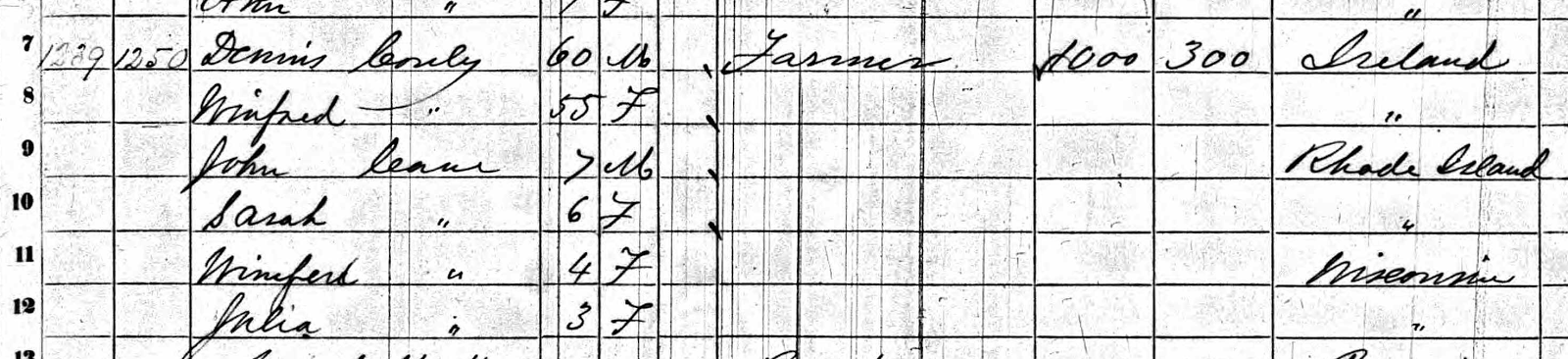
In the 1860 US Federal census for Chilton, Calumet County, Wisconsin there is an entry for Winifred and Dennis Connelly:

1860 census entry from Ancestry.com image

 Living with them are 4 of their grandchildren: John, Sarah, Winifred and Julia Cane. Winifred and Julia had been born in Wisconsin. Dennis and Anne were still in Rhode Island with their parents. So the question is why were their grandchildren living with them? I can understand why two of them were born in Wisconsin, their daughter Winifred probably travelled out to Wisconsin to have her children with the help of her mother.

Here is the entry from the 1870 US Federal census for the same:

1870 census entry from Ancestry.com image

Now two Cain children, Dennis and Anne, are living with their grandparents and attending school. John the eldest is 17 and already living in Oconto working at one of the lumber companies. We do not know what happened to Sarah, Winifred, or Julia.

Winifred Cain had died by 1863. Martin Cain had married his second wife in 1864, Bridget Nolan, and is still living in Rhode Island working in the mills there (it does not appear that they ever actually lived in Wisconsin). But somewhere along the line Martin had picked up a few bad habits, none of which would bode well for a happy household:

Providence Evening Press; Date: 06-14-1865; Volume: XIII; Issue: 78; Page: [2]; Location: Providence, Rhode Island

There is never mention of abuse from rumor or in the papers, but Martin most likely was a typical Irishman who loved his drink a bit too much. He married young and had no other family around, that we are aware of, so probably took his cue on husbandly duties from those around him. And they were very poor examples.

I haven’t found any other evidence in the papers of Martin’s shameful lack of support for his family, but I do not know how thorough the digitized paper collections are online.