Goodbye Dad

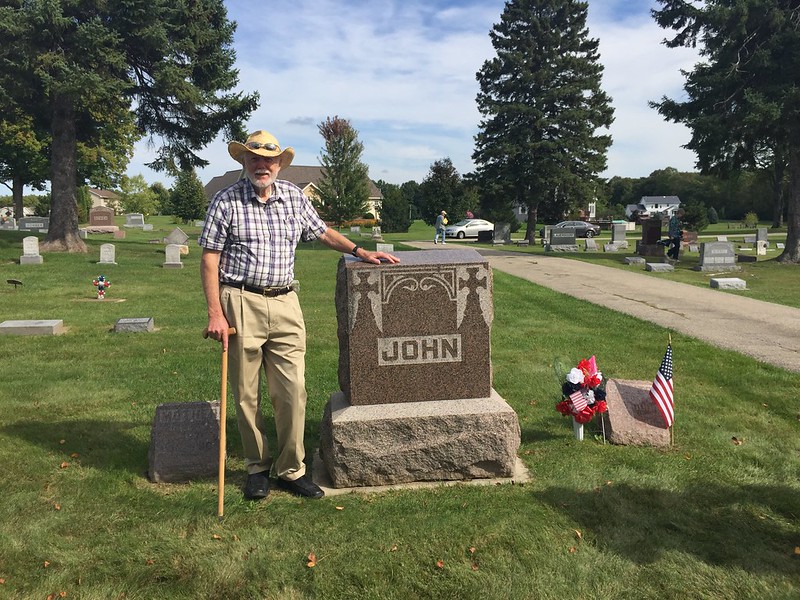
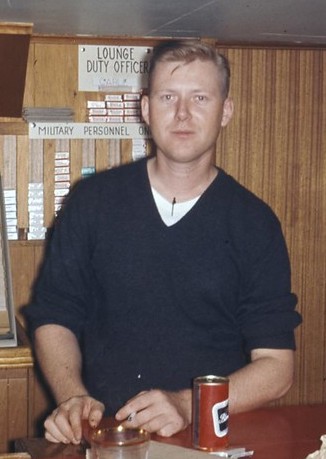
We lost our dad Victor Fredrick John, last month. Sometime in the night of the 25th of October dad breathed his last breath. I am very thankful that I had finally been able to visit him on that day. He had actually been in the area since Saturday, having flown in from Oregon with my brother. Ill health had kept him in Oregon, and unable to follow my mother to their new home, where she had been for a few weeks.

It wasn’t until I was able to visit him Wednesday that I saw how badly off he was.

He was a force to be reckoned with during his life. (Being 6’4″ didn’t hurt either.)

He was born on December 7, 1935 in Gillett, Wisconsin. He died at the age of 87. He is and will continue to be greatly missed.

Below is a bio he wrote himself for a Military reunion book in 1996/1997.)


Every once in a while I have a flash back and recall that a long, long time ago in a land far, far away I had some connection with an organization that was associated with the military establishment. Since I have left that clouded world and collected my due severance’s for longer than I was there, I do upon occasion need contact from that past, either spiritual or otherwise, to remind me how the money gets into my checking account faithfully each and every month, year after year.

I still don’t know what happened in that room back in 1956 when someone said, “the next sixteen people on the list will be retained as Instructors in Harlingen”. I would not have landed in Harlingen for five years if I had stayed off that category one sign-up list. But all in all it was a decent tour and I met some lasting friends. Unfortunately two of my good friends Atis lielmantis, my roommate for over two years and Ted Nura, my skin diving partner, were later killed in Viet Nam.

I thought that the closing of Harlingen was my salvation, but then they cancelled my assignment as a Missile Launch Officer to Bitberg, Germany and sent me to SAGE is ADC. It was then I knew that all my credits, markers, chits, and hard work had added up to “Just fill the squares and get these guys out of here”, Also turning down Regular while at Harlingen was something I was to later regret. Maybe I should have discussed in more detail with my supervisor this concept of being a Regular guy in the USAF. I also sometimes look back at the turning down of my appointment to the first class at the Air Force Academy. Can you believe it came from Sen. Joe McCathy, the anti-Christ of Communism from Wisconsin. My dad died prior to my entering the Service and he was a state employee, thereupon the appointment. First graduate from the Academy and with my year of commissioned service, the ranking officer. WOW – if I could just be young and foolish one more time.

After Weapons Controller Training at Eglin AFB I found myself in Topshan AFS Maine. OK, I’ll tell you generally where it’s at, not too far southwest of Newfoundland or somewhere around there. If you really want to know where it is, ask D.R. Willis. He must have insulted the same guy I did because he went there too. In Maine summer was part of June and most of July, fall was six weeks long the rest was winter. Can you picture Willis in his parka standing in a snow bank slaving over his Weber grill with snow blowing around and barbecuing chicken in January. BELIEVE IT! Yvonne had said, “No D.R., you’re not going to grill chicken in the house.”

We had to get our flying pay by flying in P2V’s with the Navy. Flying in the EC-121 later was a breeze after flying in these puppies. After flying long five hour mission at Harlingen I was in for a surprise when my first mission in a P2V was 19 hours. I thought the world had come to an end. I watched the sun go down and come up again and we still had eight ours to go. An airplane with props and jets. I guess they couldn’t decide what they wanted it to be. But on the up side we did carry a cook on board who actually cooked all three of our meals.

The crews were real glad to see us navigators because now they could go out on patrol and actually know where they were. Normal procedure for returning home was to head west, drop low under US radar and once in a while pop up to see if their radar could tell them how far they were out from land, then when they recognized the coastline they would either turn right or left and fly a landfall until they got back to Brunswick NAS. In the navy you can revise your flight plan up to three minutes before your IP.

The one good thing about this assignment was that I met my wife to be. She was in Ramstein, Munich and Wiesbaden for over four years with her folks, prior to her stateside return. Her dad was in TAC EVAL in Germany and returned to serve as the Electronics/Communications Officer at the SAGE Division HQs at Topshan AFS. We met at a dance at the Officers Club. I was married in Maine and the Air Force sent me remote to Alaska as a wedding gift. I did have a two month old as the first addition to my family before I was sent to the boonies.

I remember meeting Gorden Schieman at a bar in Seattle while on my way to Alaska. He was drowning his sorrows and was also on his way to Alaska with the JAG office at Elmendorf AFB. But for me, out to Middleton Island AFS in the Gulf of Alaska as a Operations Officer/Weapons Controller. Two miles long one-half mile wide, three trees (the Middleton Island National Forest), sixty-seven hairy legged men and 2000 rabbits.

After seven months they closed up the site and shipped all the equipment to a place I never heard of called Can Tuo, Viet Nam. So the rest of my stint was spent on Fire Island AFS, Alaska in the Bay of Anchorage where you could see the lights of the International AP at night and normally spent Friday happy hour at the Officers club at Elmendorf, AFB. We took the General out to shoot his moose, held it for him so he wouldn’t miss, raided salmon from the fisherman’s nets and drank until we got the short timer ribbon given to the guy with the least days to go before rotation. At Fire Island I was the Dispatch and Recovery Officer, so worked three hours in the morning and three hours in the afternoon on a regular five day schedule. I was also in charge of the chow hall and officers lounges – both jobs had their benefits.

After a pretty decent quick remote assignment I was sent to McClellan AFB in Sacrament, California attached to the 552 AEW&C Wing. By this time it was 1962 and the Viet Nam War was scaling up. The Wing started to send crews over to Viet Nam on four month rotations and I joined that crowd. After one tour over there I was sent back as the Radar Staff Officer and spent a year on staff in Saigon, Ubon, Udorn, and Korat. They just kept moving us around every few months. I still can’t figure it out, were we just not wanted or was our mission so secret they had to keep us on the move.  It’s interesting when I think back — the first American soldiers were sent to Viet Nam in 1955 the same year I entered the service and the last Americans left in 1975 the year I left the service.

I looked at Viet Nam as the place to go because I had been trained to go there. I did not have time for indifference, this was my job and I was confident I would do it well. I did have the opportunity to meet and know some very interesting people – BG Benjamin O. Davis the first black Air Force General and a tremendous individual, Col. Robin Olds – 4 proven kills and I saw gun films of several missile malfunction misses that would of made him an Ace, and Col. ‘Chappie’ James (we all called Olds and James the dynamic duo ‘Blackman and Robin’) Col. Pete Knutty – my boss in Nam and later my boss again in Florida, and last but not least, three fingered Jack Ryan who said to me once “Hi Vic, glad to see you on this mission with me.” Needless to say the crew was very impressed (not knowing I had briefed him several times before) I like those Generals that remember names.

As an individual and someone who liked their job, the training and preparation would have been lost if I had not had this experience in Viet Nam. My father-in-law spent 28 years flying jets in the Air Force and never got to the opportunity to get into the real thing – to this day he regrets it and respects me for my commitment. It was my fulfillment in my career, but unfortunately not for those I know who did not come back or the ones who came back under adverse circumstances. I was proud to be in the “BIG EYE” Task Force. Our unit received two Presidential Unit Citations and the “V” for valor. I flew 118 missions and loaded up an Air Medal along with the accompanying standard package. Looked good on the USAF Uniform or Mess Dress at any occasions. A proud Unit to have served in.

I had a new addition to my family in California and enjoyed the tour. While not in Nam I flew the line, I was the Assistant Wing Training Officer and the Wing Disaster Preparedness Officer – both very interesting jobs.

I also had the good fortune to qualify for a special task group which flew missions for two years with the Atomic Energy Commission Contingent from Sandia, NM. We flew out of Kirkland AFB, NM and Hawaii, the deployment base for the Johnson Island drop site. The EC-121 crews controlled the complete aircraft array for atomic test drops made at selected locations over the ocean. We deployed once from each site each year – great experience and deployment especially the six week in Hawaii. Blue ascots and orange flight suits with special hats – God were were a sharp group. Those monkeys with their heads taped to the window got a hell of a view- sorry AAPCA.

I enjoyed flying and spending time in San Francisco and Lake Tahoe. Since life is over after you spent a full tour in Viet Nam it was my turn to move on, so-off to McCoy AFB in Orland, Florida. Once you get that ADC brand on your forehead you just wear it forever. (Sidebar: I have since had it surgically removed.)

Can you believe I was sent to Florida as a Navigator? Talk about a massive retraining project in the works – what a boring job after Viet Nam. Screwing holes through the sky in a EC-121 off the coast of Cuba was not much fun. It was also during that time that I began to realize that you could get killed flying those piles of junk. We caged so many engines on missions we might as well have been flying three engine planes. This really started to take the fun out of flying and I was not enjoy it one bit. I had a family to think about and I was still in my mid-thirties.

I spent four years at McCoy AFB with plenty of time to add one more to the family. That was it for us; time to try to have some fun. The only problem with that was that the SAC wives that had husbands on deployment keep hanging around the house. I boot-strapped my Collage degree, my one salvation from this tour. I took the family to the opening of Disneyland in Orlando and life was over for the kids. Since I was enjoying flying less and less I called personnel at Colorado Springs and told them they had an opportunity to save a life – “If you don’t get me out of here I am going to kill myself.” They took pity on me and offered me a one year remote hilltop in Korea or a two year accompanied tour in the Philippines. So off to Manila as a liaison officer with the Philippine Air Force attached to the American Embassy in Manila and working for the 13th Air Force in Clark. Of course there is always a down side to these paradises. Six months of heat and six months of rain. Most of our work consisted of planning Joint Allied exercises with the USAF, USN and Philippines AF and training Philippine officers and NCO’s at their division Headquarters.

We had Marshall Law, Typhoons, and Amelia Marcos with her 2000 pair of shoes. There were very relaxing times at the US resort in the mountains at Baguio a varied array of experiences for the family. Clark AFB was 70 miles away and no one bothered us much in Manila. It was a good tour. My one shining moment was when I left I was presented with the Philippine Weapons Controller Badge and received approval from the US Air Force to wear is on my uniform over my right pocket. This was the first time that this honor was ever extended to anyone outside the Philippine Air Force. I received it for my work as Secretary of the Joint Allied Air Defense Working Group.

My last assignment was an exit assignment to Duluth AFB in Minnesota. I went there because it was close to central Wisconsin where I planned to retire. The Duluth tour was as a Senior Director in SAGE, ADC. I did have the opportunity to get some graduate work done on my MBA. A year goes fast in the perpetual winter climate of Minnesota. Then out to greet the new world of civilian life.

So what is the Navigator/Weapons Controller going to do in civilian life. I could find no work in this field in central Wisconsin. My 15 minute career out briefing was really paying off at this point. I just relaxed and thought something would just appear out of nowhere. When you retire at half pay it’s really one-third pay, that doesn’t take care of a family of five. Well, I spent a year waiting around and then said to the wife, “We’ve tried poverty for year now, what do you think of it?” she said, “I don’t really care for it”, so I started to look for work in earnest. My degree in business was put to use as an Executive Office for the local board of realtors, cost accountant for an architectural/construction company and later as a real estate broker. The money wasn’t rolling in, I still could not find my niche.

We lived in the country on ten acres of beautiful woods and did the country thing. I had 35 sheep (over 100 when the lambs came in); an angora goat named Dwight H. Pipestone; two pigs to raise each year, bartered from my neighbor for rent on my 110 sugar maple trees; a black Angus named Sir Loin, who was replaced on an 18 month basis; 50 chickens for the freezer and chickens for egg production; and a large garden. This enterprise was a matter of survival. You remember about the food thing, teenagers never pass the refrigerator without opening the door. Cut over five cords of fire wood each year and continued to finish building my house in the trees. Sue had a spinning and weaving studio/shop in the house and was starting to build her business. Who said living poor isn’t fun.

While sitting at my desk in the real estate office one day with nothing to do, which seemed to be the extent of my activity. I calculated, with lunch and gas to work, it was costing me about $.65 per hour to go to work and I wasn’t clearing that much. So enter the GI bill and off to graduate school again. Two years later and I was back unemployed. My graduate work in Natural Resource Management at the University of Wisconsin did not help. The one redeeming factor was that GI bill also helped Sue finish her degree in Communications.

Well just before going back to school I had had a mild heart attack and my hair turned gray in six months. Well at least I still had it. Looking for work after school exhausting. I had grown older and the world was staying young. There was so much younger talent out there looking for work. I was beginning to see the impact of job-discrimination in the market place.

But, what goes around comes around. During the farm crisis in the early 1980s I worked as a volunteer with the farm advocate group connected to the State Department of Agriculture. We helped farmers having debt troubles. It was a real heartrending experience with few successes for the farmers. In the latter part of 1986 I obtained a job with the Farm Credit Bank of St. Paul in their Risk Management Division – Special Accounts Unit. Being in a unit again was fun, sounded like the military. The Bank was also beginning to feel the pinch of farm  failures. After a year and a half I took a better position with the Farm Credit Bank of Louisville working in southwestern Ohio. By 1992 the crisis situation was winding down and the fun and excitement of bankruptcy, foreclosure, and debt restructuring was gone, So instead of transferring to the Regular Accounts Division I decided to retire again. I had had an operation for colon cancer and it was time to take a rest. The radiation and chemo were tough but I still had my hair, D.R.

Currently I have my own Farm Management Consultant Firm. I am the Chairman of the Board, CEO, President and only employee. Its great being your own boss. If you want a pay raise you just give it to yourself. If you don’t want to work for a while you tell future clients you’re tied up. Also its easy being a consultant because you are considered an expert in your field as long as you are over 20 miles from home. I still work in the financial end with the State Department of Agriculture Farm Center as a representative Farm Financial Credit Advisor. I work mostly with farmers preparing to go into mediation with creditors. I am also a State Farm Mediator for the Farm Center. I just left the Wisconsin Rural Development Center where I was on the Board of Directors. As a volunteer group we worked on rural farm problems. I am still working on a National Committee, at the state level, for an organization called ‘Pathways from Poverty’. This group focuses on regional and local issues on rural poverty throughout the nation.

I live in Mineral Point, a small town of 2500 people in southwest Wisconsin. It’s just 50 minutes from Madison the state capital. The University of Wisconsin is also there. Madison was chosen by People Magazine as their 1996 and 1997 “The best city to live in, in America.” You must remember Wisconsin, the Packers, the Badgers. They win something big every twenty or thirty years.

It’s like the suburbs out here in small town USA without the hassle or those ugly shopping centers and strip malls. My children are out of college and seeing what the real world is like. Sue and I did a good job. The kids are as well adjusted as they can be, considering their parents, and ready for the world of experience. Let’s just hope they make less mistakes than us.

My oldest is married and living in Appleton, Wisconsin. She works for a printing company and her mate is head of Production Central at HAYES Manufacturing, Container Division (they make paper cylinders – (Kraft cheese, Pringles, etc.) My son is project analyst for Kaiser Permanente (Kaiser Hospitals) In Portland, OR, and his wife is a freelance publicist. Our youngest is at her new job as Director of Technical Services at Utica College Library in Utica, NY. Our one grandchild at 4 years old is my son’s addition on our side of the family. My eldest daughter has just decided to have grand kitties and grand puppies.

My wife Sue has her art gallery/studio downtown in Mineral Point – it’s called “Studio on High” and of course it’s situated on High Street. She continues to weave and operate the gallery. We have the oldest commercial stone building in town, built in 1847. I know you people on the east coast consider that a new building. Mineral Point is a historical lead and zinc mining town and has more historical buildings than any town or city in Wisconsin. Over 28 artists live and work here year-round. Many have working studios open to the public. Sue has many local artists work in her gallery.

As the potato farmer said to his crop “I’ll dig you later” Cheers – It will be good to hear from all of you – I look forward to it. –Vic

This is by no means dad’s whole life in this short bio. That would take a lot longer to write and put together. But at least we have this nice bit that he wrote himself.
Gert And Vic Go West!

Buck Lucas on Light Foot American Legion Stampede, Casper, Wyo (Doubleday). (Postcard in the John family collection.) These postcards are probably from the 1920s.

–Coincidentally Victor’s birthday is the 13th of this month, so I guess you could say in honor of his birthday…–

It was May 11 (or 18)* of 1908, a day filled with excitement tinged with a bit of sadness for the family of Gertrude and Victor John. Sadness, because just over a week or so ago they had said good bye to the matriarch of the John family. Johanna (Dedrich) John, Victor’s mother had died on April 30th and the funeral had been on May 3rd. But there was great excitement too, especially for their boys Clarence, Lincoln and Victor, junior, because they were taking a trip to the great unknown. The Wild West! Wyoming.

The Wyoming and North Western Railroad (aka Chicago & North Western) had finished a new line from Casper to Lander in 1906, part of what was known as the “Cowboy Line”, and Vic was going to be a station agent there. This expansion was part of C&NW’s plan to build a line all the way to the Pacific coast. (Spoiler alert: the railroad company ran out of money, so never achieved that dream.)

In 1906, the government announced that 2,285 square miles of Shoshone reservation would be open to settlement. At the time, there was railroad service from the eastern border of Wyoming to Casper. The Chicago and North Western Railroad (then Wyoming and North Western Railroad) extended the tracks from Casper to Lander to transport the settlers and their belongings to the land, located north and west of Lander.1

V. H. JOHN TO LEAVE
Station agent V. H. John has resigned his position and will leave Monday with his family for Casper, Wyoming to accept a position as cashier [station agent] for the Wyoming & North-Western Ry.

LOCAL AND PERSONAL–Mr. and Mrs. V. H. John and children left Wednesday [13th] for Gillett where they will visit a few days before leaving for their new home at Lander, Wyoming, where Mr. John will enter on a more lucrative position with the Wyoming & North-Western Ry. Mr. and Mrs. John were among the pioneers of Wabeno, Vic having been station agent here for nearly eleven years, ever since the road was built. He was also postmaster up to January 1, 1906. They have a host of friends here who sincerely regret their departure.

May 7, 1908, page 1, col. 6–; May 14, 1908, page 1, col. 5 [Thursday]

Shortly before they left they sold some Wabeno property:

Real Estate Transfers.
V. H. Johns to John Bigglin, part of block, village of Wabeno. Consideration $100.

Forest Echo, Crandon, Wisconsin —Crandon Public library digital images
Friday, May 22 1908 p8c5; v2no39

I don’t know exactly how long the trip took, but I am guessing that they took the route to Chicago and then headed west from there. (The two places with a red dot next to them on the map are Casper and Lander.) Using the estimate of about 25 miles per hour, and approximately 1530 miles all told, they were looking at 3-4 days travel by train to their new home.

CNW Railways map from 1912. I am only guessing on the route. They could have taken a large variety of different ways to their final destination.

For the boys this would have been a grand adventure. They had never been anywhere more exotic than Oconto, or up north in the scary, largely unsettled woods of northern Wisconsin. Which could, in and of itself, be a grand adventure in those days. But now they were going west, the place of dime-novel adventure stories.

Their father, Victor, had been places. In fact he went to telegraph school in Valparaiso, Indiana for a couple of years. So he was not unfamiliar with Chicago and Milwaukee, or other similar big cities. But for the rest of the family this was all pretty new. Gertrude, does not appear to have traveled much further from home than the north woods either, at this point in time.

They arrived in Wyoming in the latter part of May. From newspaper articles in the Wyoming papers it looks like he was a station agent at Arapahoe, and not Lander. Maybe he had started at Lander, and then shifted to Arapahoe. (Arapahoe was actually part of the Reservation.)

I am very curious to know what they thought when they arrived at their new home. Looking at Arapahoe using current satellite maps, it looks like maybe 100 people live there, (although the 2000 census indicated close to 1800). What was it like in 1908? If it was as desolate of humans as it appears now, I don’t wonder that the family would have been quite happy to move, about 5 months later, to Casper.

The local newspaper tells us that one way the family enjoyed their new home was by bringing their love of the outdoors and hunting from Wisconsin. The articles also tell us when the family moved to Casper. A helpful bit of information we would never have otherwise been aware of.

V. H. Johns and wife of Arapahoe, and eastern friends [possibly the Howell family] left for home Saturday morning after spending several days in this locality fishing and hunting and taking in the fine scenery in this section. Mr. Johns has been transferred to Casper, where he is now the agent.

October 08, 1908, page 2 Wind River Mountaineer no. 49 (Lander, WY https://newspapers.wyo.gov)

V. H. John lately station agent at Arapahoe, Wyoming has been transferred to Casper. Mr. John is a very obliging agent and the press hopes he has come to stay.

October 09, 1908, page 5, col. 2 Casper Press no. 22 (Casper, WY https://newspapers.wyo.gov)

One can get a sense of how popular the John family was back in Wisconsin by looking in the Wabeno newspapers:

LOCAL AND PERSONAL
The following items from Wyoming papers regarding Mr. and Mrs. V. H. John, former residents of Wabeno, will be of interest to our readers:

W. H. Howell and wife Lovington, Ills., who have been visiting with Mr. and Mrs. V. H. John returned home Wednesday.

J. H. Howe, who has been station agent at this point for several months, left the first of the week … V. H. John, who has been agent at Arapahoe, takes his place in the depot here.—Casper, Wyo., Tribune.

Best display in Class 19, first, Mrs. V. H. John, Arapahoe…Special prize, Best Double Collection, Mrs. V. H. John, Arapahoe. (Display was fancy work at the Fremont County Fair, Wyo.)

October 29, 1908, page 1, col. 6

In October they started selling off some household items. This might have been to lessen the load for the move to Casper. Or, was the thrill of being in the Wild West starting to fade?

If you want some cheap second hand household goods see V. H. John at the depot.

October 16, 1908, page 5 col. 2 Casper Press no. 23 (Casper, WY https://newspapers.wyo.gov)

And in November they tried to sell even more goods. This looks serious!

For Sale
1 bed room set
1 book case
1 large leather rocker
Dishes and two carpets
Enquire at the depot of V. H. Johns [Casper, WY]

November 11, 1908, page 5, col. 5 Natrona County Tribune

By the 21st of December, a mere 7 months after their grand adventure started, the John family was back in Wisconsin. To stay.

V. H. John and family of Casper, Wyoming, are visiting Mrs. John’s mother, Mrs. John Cain, and calling on old friends in the city.

LOCAL AND PERSONAL
Mr. and Mrs. V. H John and children arrived at Gillett Monday from Casper, Wyo.

ADDITIONAL ITEMS
Mr. and Mrs. V. H. John were in town a few hours yesterday visiting friends. They recently returned from Casper, Wyo. and are making Gillett their home for the present.

Oconto County Reporters, Wisconsin —ocnews.co.conto,wi.us digital images
Thursday, Dec 21, 1908 v38 issue 9, p7c2; December 24, 1908, page 1, col. 3; January 7, 1909, page 2, col. 2

Family tradition says that Gertrude was missing her family, friends and life in Wisconsin too much to want to stay in Wyoming anymore. So Victor quit his job and they packed back up and left for good. We don’t actually know why they moved back. Gertrude’s unhappiness might have been the catalyst, or it could have been something else altogether. The town of Casper had been trying to clean up its image to attract a more respectable residential population. But maybe there was still too much unlawfulness, drinking, and prostitution in full view of the kids. I guess it will forever be a mystery.

By 1910 Victor and the family were living in Hackley, Vilas County, Wisconsin where he was again working as a station agent. Six years later he started his new career in banking.

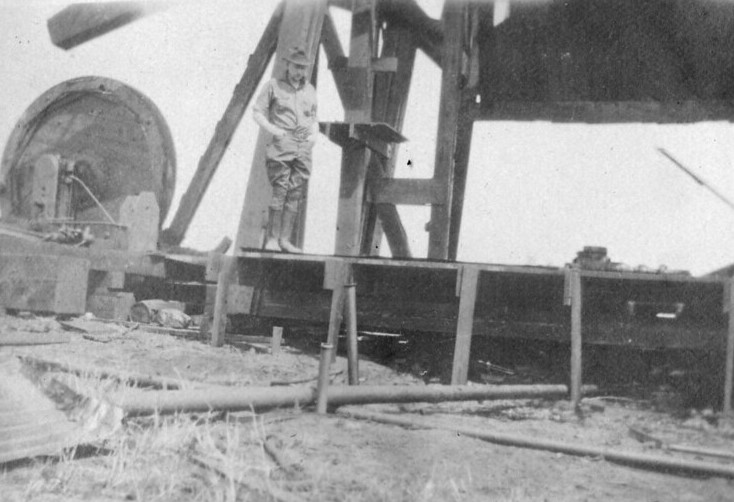
Both Clarence and his brother Lincoln must have retained good memories of their time out West because years later, as adults, they returned to Casper. Lincoln lived there in 1918, and then, after a couple of years break, was back by the 1920s-’30s. He was living in Casper and working as a fireman on the railroad line. Clarence went out to visit him in the ’20s, and he might have done some work on the oil rigs when he was there.

The short time that they had spent in Wyoming as boys had left enough of an impression that they had to return. At least for a little while.**

Clarence at an oil rig.

*It is difficult to tell from the newspaper articles exactly what day they left, it appears to have definitely been on a Monday, so, it was either the 11th or the 18th of May.
**I do not know if their brother Vic, jr. ever went back.

—————————————-
SOURCES:

  1. https://trib.com/news/local/casper/answergirl/answer-girl-casper-lander-train-history/article_a8a6717a-4ea4-5079-a7e5-d8a0072db900.html.
  2. Visit the two following links to see lots of images from Lander and Casper, in the general time period that the John family was there. Both have more than one page of pictures to look at, along with town histories. I could find nothing on Arapahoe. http://www.wyomingtalesandtrails.com/lander.html
  3. http://www.wyomingtalesandtrails.com/nplatte3.html

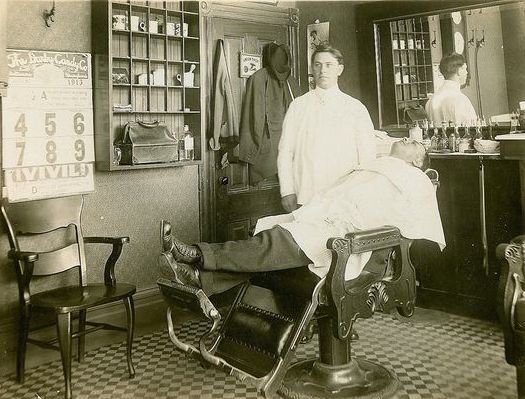
Barber John

A barbershop in the 1910s, image found on Pinterest.

Apparently we have a barber in the John family.

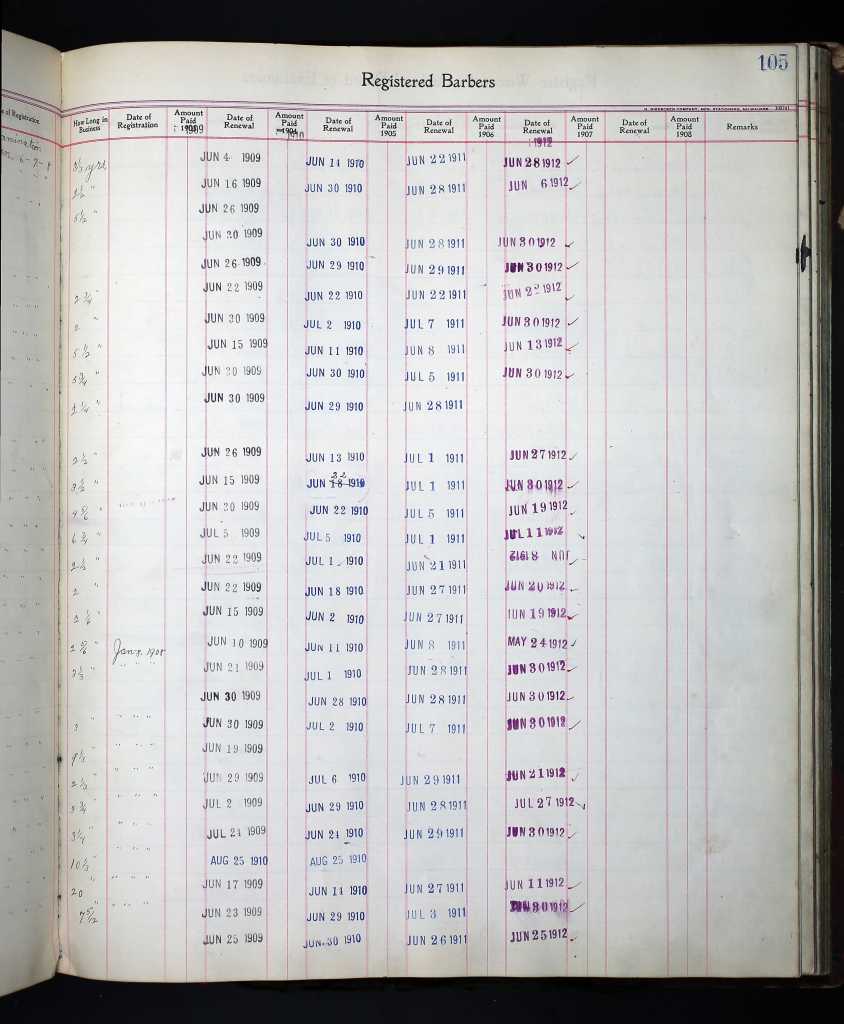
I happened to notice that Ancestry had added a database regarding Wisconsin employment records, which is a collection of records of individuals who needed a license to work, and included occupations such as: teachers, boxers, barbers and watchmakers. So I thought I would check to see if Lydia Hamm was in there as a teacher.

Well I didn’t find Lydia, or any other Hamm of interest, but when I tried searching for Johns two names showed up that I recognized: Eric and Elmer W. John. These two men are both sons of William John, jr., the, sort of, middle son of F.W. and Johanna John.

Eric John is 4172, on lower half of page.
Elmer W. Johns is 738, or second on page.

Eric is already a barber in the register and is merely keeping up with his professional paperwork. Elmer on the other hand is actually registering as an apprentice. I guess he had a year or so to go before he could call himself a professional.

I did a quick search for Eric at Ancestry and found him working in a barbershop in Rock County in the 1910 census. Eventually he moved the family to Gillett and continued as a barber probably his whole life. (His son Keith had a daughter whom we met at the Gillett Cemetery Walk a few years ago.)

Elmer eventually moved to Milwaukee and was employed as an electrician by 1940. I guess the barbering profession wasn’t for him.

Just a fun fact to share. Its nice to know what our cousins were doing with their lives.


  • Barber register, 1903-1913; Wisconsin. Barbers Examining Board; Series 880, box 1 flat, Wisconsin Historical Society, Madison Wisconsin. [Ancestry.com. Wisconsin, Employment Records, 1903-1988 [database on-line]. Lehi, UT, USA: Ancestry.com Operations, Inc., 2018. digital image 638-639 of 770]
  • Apprentice register, 1907-1913; Wisconsin. Barbers Examining Board; Series 882, box 1, Wisconsin Historical Society, Madison Wisconsin. [Ancestry.com. Wisconsin, Employment Records, 1903-1988 [database on-line]. Lehi, UT, USA: Ancestry.com Operations, Inc., 2018, digital image 520 of 735.]

Nurse John

Myrtle (Hamm) John’s nursing graduation picture 1927. Medford, Wisconsin.

I was doing some more newspaper research recently, (have I ever mentioned that I love newspaper research), and I found a couple of interesting ads in the Gillett Times newspaper:

Thursday, February 2, 1933
Want Ads
REGISTERED GRADUATE NURSE
Eight years experience.
Very reasonable rates.
Mrs. C. F. John, R.N.

Then another, slightly different, ad a few months later:

Thursday, April 27, 1933
Want Ads
Mrs. C. F. John, R.N. For Professional Services,$3.
Day or night.

At this time Clarence and Myrtle had no children, (their first wasn’t to be born until 1934), so no doubt Myrtle was bored to death sitting at home with nothing to do, except wait for Clarence to get home from work. Heck, I got bored just writing that sentence!

Of course, I have no idea if she got any work that way. I’m hoping something came up for her sake. But then, by November of that year she was pregnant, and waiting to welcome their first bundle of joy, who was born mid-summer of the next year. Her focus was now raising kids.

She got back into nursing after Clarence died in the 1950s. After all she was alone now and had to support herself. No more ads though.

Calvin & Agnes John

My spouse and I do not have children. It was a choice that we made when we were first married. And we have been quite content with that choice of thirty plus years ago.

I bring this up because I have noticed that one of the ways that choice we made so long ago has influenced my genealogy research, is that I find I like to focus on those ancestral relatives that also didn’t have children, or never married, or even lost the children they did have, before they could have any family of their own. There is no one around who cares to pass on their life story, and many times that is a great loss.

So here I introduce Calvin John and his wife Agnes McDonnell, of Gillett.

Agnes McDonell & Calvin John Wedding Picture 27 April 1904, Oconto Falls, Oconto County, Wisconsin. Courtesy of a cousin.

Calvin is the son of Alfred John and his wife Hattie. I wrote a post, not too long ago, about Calvin and his father having some kind of tiff that ended up in court. But I know nothing of his relationship with his father.

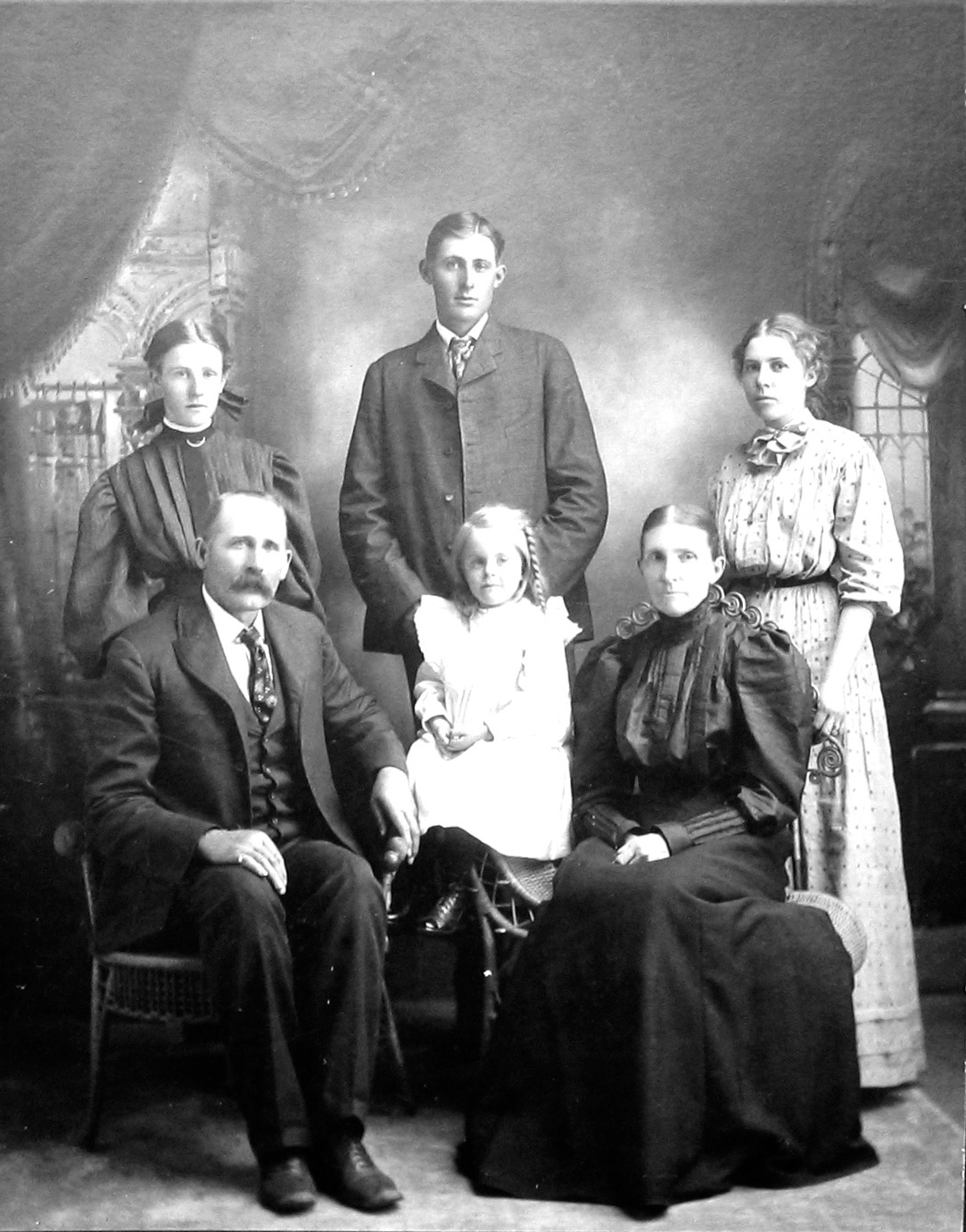
Abt. 1904: Eva, Calvin, Hattie, Alfred, Mildred, and Harriet John family photo.

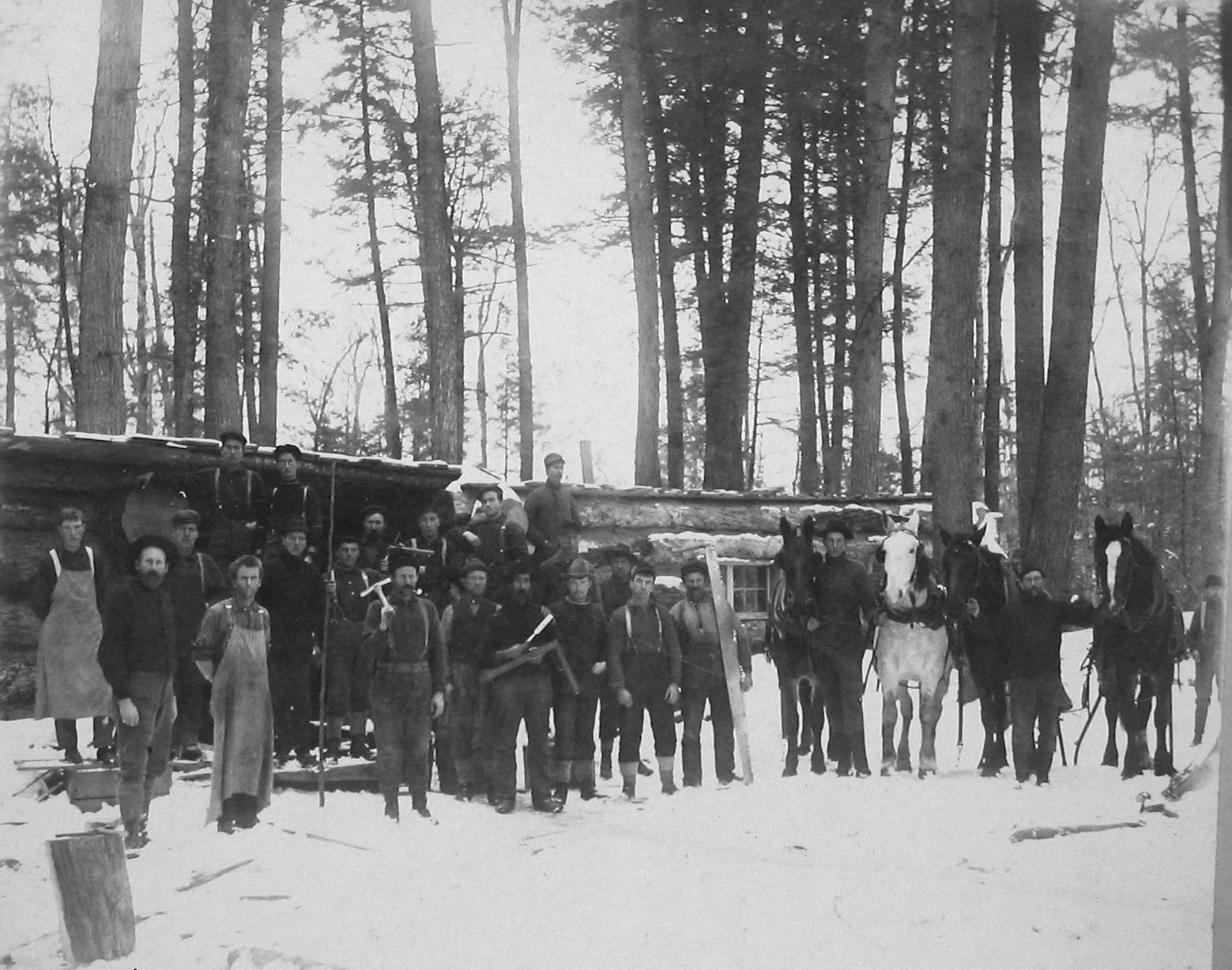
Calvin was very, very tall. In any picture you see of him he is towering over every other person in it. Can you guess which one is Calvin, in the picture below, without looking at the caption?

Front left-Alfred John; 3rd from right-Calvin John (the tall one!)

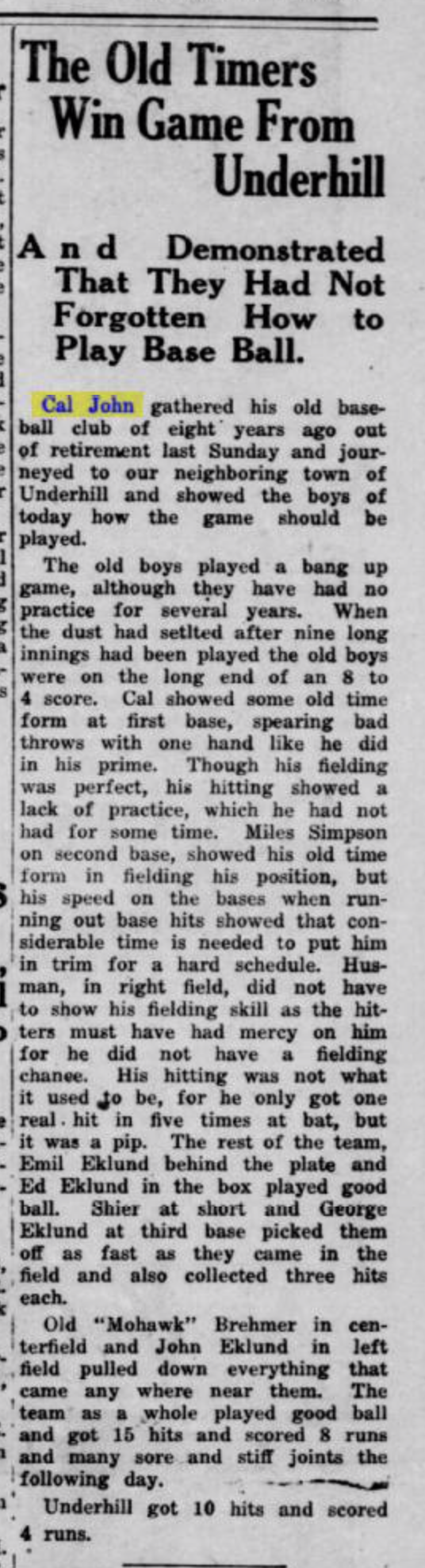
Calvin worked in lumber camps his whole life, running, owning, or laboring at them. But Cal wasn’t all work, he could be found in the local paper often as part of the local baseball team, or other types of play.

Calvin was 23 when he married Agnes McDonnell, a local school teacher (who was two years older than him), in 1904. They have a lovely marriage photo (see top). Agnes was the daughter of Daniel and Mary McDonnell, both of whom were from English Canada. Agnes was born in Wisconsin, and had three brothers and one sister that I know about, although admittedly, I haven’t researched her family at all.

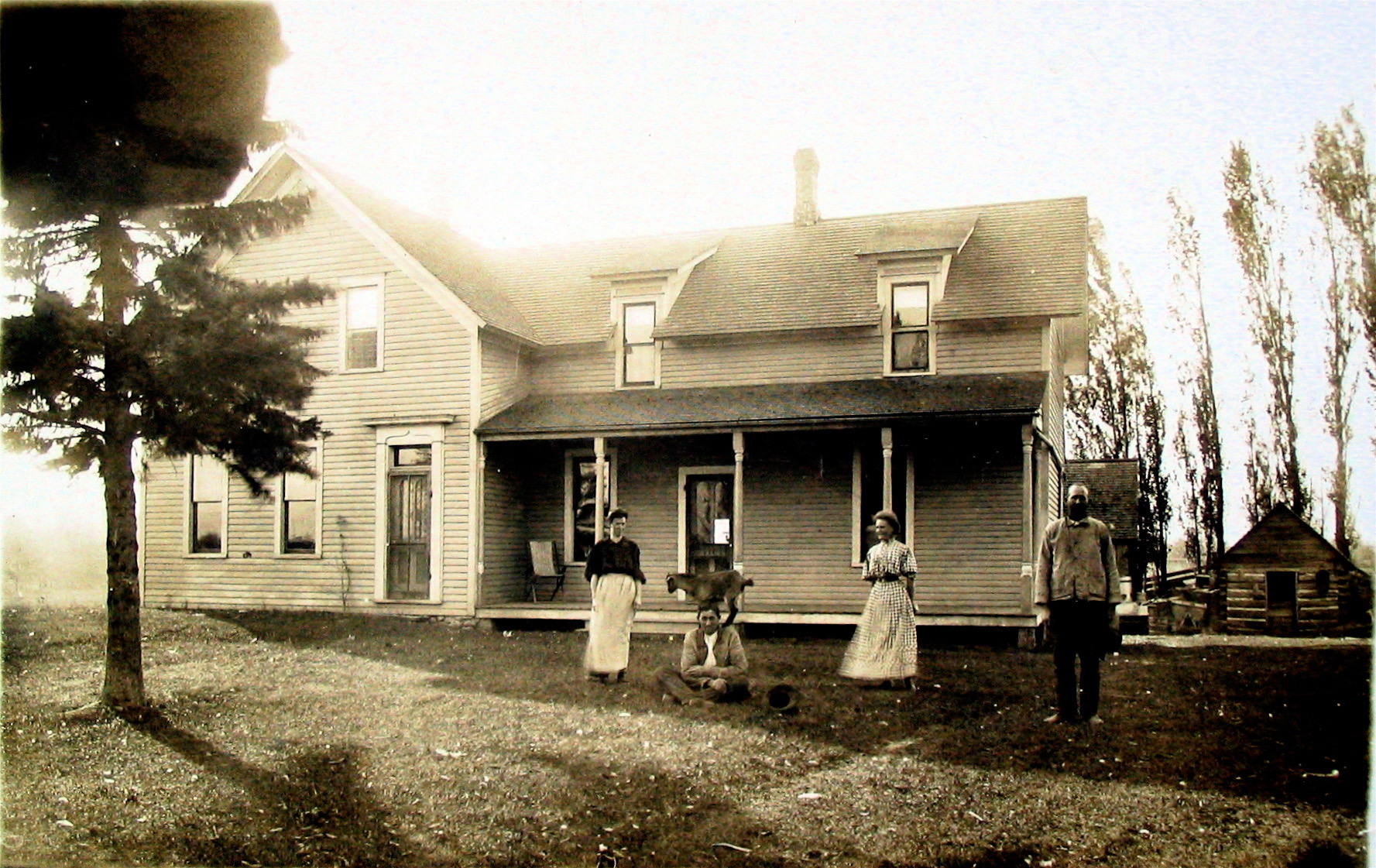
They also had a pretty good sized farm. (You can click on the images to see them better.)

We don’t know if, or how much, Agnes, as an Irish Catholic girl, regretted that they had no children, or Calvin either. They would probably have been great parents.

In March of 1958 a tragic accident put an end to both of their lives. I found the following Milwaukee Journal newspaper article, which gives few details about the event that occurred on the 28th. Not much can be gleaned from this except that they were just another statistic for the state to compile.

But thankfully, it wasn’t long after that a local woman wrote a lovely tribute to the pair for the local Gillett newspaper. ‘This article is found in the Gillett Times, Gillett In Milwaukee, by M. Burse:

And now a small tribute to two near and very dear friends, Mr. and Mrs. Calvin John “Calvin and Ag”, as they were known to the entire community, and far beyond. 

The writer has known them as long as she can remember and that’s a long, long time. Their parents and my parents having been pioneers of Oconto County. 

No Gillett then, no trains. There was a stage that turned northward at North Branch (the old McDonald Farm). Oconto was the nearest city, to which they thought nothing of making the trip on foot. But they settled there, in small log houses and carved their homes out of the vast wilderness. Grandpa John was a Civil War Veteran, and thus we younger ones grew up together —Agnes and Aunt Mary, one half mile between our homes, and one week’s difference in our ages. We grew up together, went to school together, and began teaching school at the same time. She was a brilliant student, and in fact could do just about everything. She was a wonderful person-and good kind was her equal in everything —ambitious, energetic, honest and true. 

They were an ideal couple. Lacking one month, their married life’ counted up to fifty four years. — fifty four very happy years. It was such a beautiful home to go to, they were so kind and good to each other and those around them. The home atmosphere was so happy and peaceful. The both worked hard and always together. 

They died as they lived — close together, which, tho sudden, and tragical’ (sp), almost had a beautiful side to it —they went together. 

As long as the writer can remember, Calvin owned a good driving horse and buggy. He was a prize winning horseback rider and always on July 4th, when the entire community turned out for the celebration  in “Helmke’s Grove” one of the features of entertainment was the horseback riders race, which Calvin always entered, and always won first place. Agnes was an expert rider also, and one year, later on—long after Calvin and Agnes were married, and the celebration, July 4th. was in the Gillett Park — ‘The Harvest Festival’ it was —for some reason Calvin was not riding, so his racer was without a rider, until Agnes stepped forward and took over. She went down that race track like a streak —winning first place, and keeping Calvin’s record still at the top. 

When we were still in grade school, and played baseball during recess, and at noon, boys and girls together, Agnes was always the first one chosen. They would always choose sides and place the players before we started. She could hit surer, drive father, and go around that diamond like the wind. 

Calvin’s baseball days are well remembered. One year his Gillett team were straight winners throughout the season. Nearing the end of the season, they were challenged for a game with Green Bay, to be played at Green Bay. An excursion train was put on to run from Gillett to Green Bay —and it was filled to capacity. During the game Calvin made a spectacular play, putting out his man—by catching an extra high ball. Comments could be heard from the Green Bay team, about his being too tall. One man said “He could be stuck into the ground up to his knees and he’d still be tall enough to play”. Agnes quickly answered him’ “Yes, put him in up to his armpits and he could still defeat you”. Calvin’s team did win that game too. 

Their charity was unlimited. No needy one was ever turned away from their door—if it was work they sought, Calvin would find something for them to do, it” not with his’ crew then something on the farm — and Agnes, with a good meal for anyone who was hungry. 

I’m sure our Divine Lord had their record books balanced highly in their favor when they were called Home. They were truly good kind people, with friends everywhere, for —

None knew them but to love them,
None named them, but to praise 

Gillett will not be the same without them. Their going leaves an awful vacancy, but the Good Lord was ready for them—and took them together. “Tho their sudden deaths were a great shock to their near and dear ones, and their hosts of friends, it was comforting to know they were together, and we feel that Our Good Lord had an extra special place for them, and that He met them with this kindly greeting’ —“Well done, my good and faithful servants, come to your home of eternal bliss, that I have prepared for you.”

Then funeral arrangements were beautiful. Everything being done as near as possible to what “Ag and Calvin’” would want, by their near and dear loved ones. It just seemed nothing was left undone. Calvin’s services were conducted in their home by Rev. Simon, whose words were most comforting with soft music, and beautiful singing by three ladies, Mrs. Stanley Korotev was the only familiar face in the trio. Then the funeral procession wended its way to St. John’s Catholic church, where Rev. Father Bablitch offered up the mass for Agnes, and spoke in kindly glowing terms of them both. One came away from both services with such a good feeling of Godliness and understanding. 

My farewell to you both dear Agnes and Calvin…Floral offerings were immense, and spiritual bouquets were piled high.

They were in their late 70s when they died. I am glad that at least they had themselves a goodly amount of years together.

The Johns Own a Hotel

3272969592_2e033c7c83_o
Mary Schaal and August C. Johns in Minneapolis. About 1900.

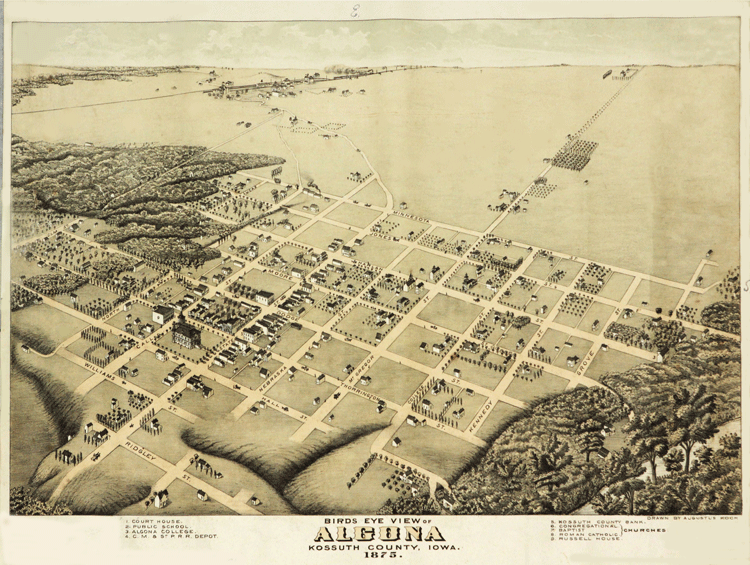
August C. Johns*, FW John’s younger brother, moved to Iowa about 1884 from Dodge County, Wisconsin. Once there, August and his wife Mary bought themselves the Milwaukee Depot Hotel in Algona, Kossuth County.

The John families had a history of owning boarding houses and small hotels, but I do not know if that was the reason for this move. Mary and August were definitely very invested in their business, because over time they: shored up the building’s foundation, added on — to make more room, and made major improvements in the interior, as can be read in the following newspaper article transcriptions…

—A.C. Johns, proprietor of the eating house at the Milwaukee depot, finding his present building too small to accommodate his trade, has an addition well under way which, when completed, will be 22×32 feet on the ground, and the front half of it 16 feet high.1

Mr. Johns is putting his Milwaukee eating house on a new stone foundation and fitting it up for the winter.2

The Johns hotel at the Milwaukee depot has undergone a general overhauling this spring. The finishing touches were put on by Painter Orr last Friday. The inside and outside are painted throughout, new paper, and other changes have added to the beauty and convenience and our popular Milwaukee landlord has one of the finest eating houses along the line.3

1875-map-copy
Way up at the top left to middle you can see a trail of smoke coming out of a train smoke stack – that area is about where their hotel was located. Image provided by Kossuth County researcher.

They ran this hotel for 15 years eventually trading it for farm land nearby. No doubt because they were getting on in years, and found the business of hoteliers to be too difficult. Also, all their children, (who happened to be daughters), were married and had moved away from home, so were no longer around to help out.

In their 15 years of running the hotel there were no doubt many an interesting tale they could tell. One of those interesting tales I mentioned in a post a while ago: regarding a counterfeiter in town. Here is another I found that was told in two different local newspapers:


Below is a transcription, if you find the articles too difficult to read.

TOOK MIKE FOR A TARGET
Midnight Marauders Shoot at Hubbard, but Without Producing Serious Results…
Mike Hubbard experienced an unpleasant sensation yesterday morning about 2 o’clock. He had been cleaning some vaults and had just got home with his team. As he had finished un-harnessing and was turning towards the house he saw two men in the alley running from Mr. Johns’ hotel. The men did not see him till quite close, and then he called out to them. Both turned off to the north and one of them whipped out a revolver and fired at Mike, coming uncomfortably close to him. They then ran away and were lost sight of.

It turned out in the morning that they had tried to break in at Mr. Johns’ and had just been scared away. They opened the cellar door first and took out some fruit, etc., and ate it. Then they began to remove a pane of glass with a big chisel. Mr. Johns heard the noise and thought at first it was mice, which the girls had been complaining of for some days. But after a while he made up his mind that it could not be, and got up. When the burglar saw him he dropped his chisel and ran, it was thus that they came on Mike and scared him out of a good night’s sleep.4

TRAMPS AT WORK.
The N.W. Depot and John’s Place Both Entered.
Last Monday night tramps or sneak thieves entered the ticket office at the Northwestern depot, drilled two big holes in the safe, but did not succeed in getting the door open and if they had would not have got anything for their work as there is not money left there. Nothing else was molested and the thieves were undoubtedly frightened away before the job was completed.

The same evening A. C. Johns at the Milwaukee depot drove two sneak thieves out of his cellar. They were loading up in great shape when Mr. Johns happened to hear a racket in the cellar and proceeded to investigate matters, armed with an ugly-looking gun. He would have peppered their skins for them had they not escaped just as they did. Mike Hubbard attempted to run the fellows down with a pichfork as a weapon but one of the two would-be-thieves fired a couple shots at Mike and he let up on the chase pretty quick. He was pretty badly scared and told Mr. Johns that he had been shot at but didn’t know just where he had been hit. After examining himself he found that a bullet had plowed a furrow through his coat-tail. It was a close call for Mike.5

Very exciting stuff. August and Mary moved to Minneapolis in 1899. Their age and ill health made it more convenient for them to be closer to family. When they died though, they were both buried in Algona.6, 7 It must have been their home of the heart.

*NOTE: August/us spelled his John surname with an ‘s’. Our family spelled it without. German records show the name as Jahn — no one in the family spelled it that way once they arrived in America.

Here are more newspaper articles regarding the hotel and the Johns:
1895-10-23, Wednesday Page 8, col. 3, of Algona Upper Des Moines, Algona, Iowa — [algona.advantage-preservation.com]: Walter Stebbins has leased the Johns hotel at the Milwaukee depot and has taken possession. Mr. and Mrs. Johns, we understand, will visit in Minneapolis and take a well earned vacation. Walter will make a number one landlord and keep up the excellent reputation the hotel has enjoyed.

1896-1-31, Friday Page 5, col. 2, of Algona Courier, Algona, Iowa — [algona.advantage-preservation.com]: Mr. and Mrs. Jas. Ryan will take hold and run the Johns’ hotel, at the Milwaukee depot. Mrs. Stebbins who has been running it for some time has taken his old position in the Wilson Mill.

1896-5-8, Friday Page 5, col. 5, of Algona Courier, Algona, Iowa — [algona.advantage-preservation.com]: Mr. A. C. Johns has traded his hotel property for a farm near Hartley. The new owner will take possession of the hotel soon. For some time past it was quite successfully run by Mrs. James Ryan.

1896–5-13, Wednesday Page 4, col. 5, of Algona Upper Des Moines, Algona, Iowa — [algona.advantage-preservation.com]: J. L. McNamee of Hartley has bought the Johns hotel at the Milwaukee depot and is now in charge. He traded a farm near Hartley for the property. Mrs. Ryan and son, who have been running the hotel, have rejoined Mr. Ryan. Mr. Johns will not leave Algona.

1917-4-19, Thursday page 7, col. 2 of Algona Courier, Algona, Iowa — [algona.advantage-preservation.com]: Mr. E. J. Murtagh went to Minneapolis last Friday to see his old friends, Mr. and Mrs. A. C. Johns, the former being very enfeebled with age, he being now 88 years old. Mr. and Mrs. Johns lived in this town for many years, and Mr. Johns served on the council as a member for the Third Ward for several terms…

1923-6-7, Thursday, Page 1, col. 2 of Kossuth County Advance, Algona, Iowa — [algona.advantage-preservation.com]: PIONEER ALGONA LANDLADY VISITS OLD FRIENDS HERE Mrs. Mary A. Johns, of Minneapolis, has been a guest at the E. J. Murtagh home for some days. Forty years ago Mr. and Mrs. Johns conducted the “Johns Hotel” at the Milwaukee depot. The house did a big business for passenger trains then stopped here for meals, and all the railroad men were patrons of the house.

The hotel, which stood on the north side of  the track, was burned down some years after Mr. and Mrs. Johns left Algona…[they left in 1900]

Those were the boom days at the Milwaukee depot….The Dehnert hotel, now north of the courthouse, at that early day was also serving the public, but stood just south of the Milwaukee depot. It was moved to its present location 35 years ago…

1925-2-19, Thursday, Page 1, col. 6, of Kossuth County Advance, Algona, Iowa — [algona.advantage-resercationcom]: MRS. MARY A. JOHNS DIES; TO BE BURIED HERE TOMORROW… She and her husband the late A. C. Johns, ran the Milwaukee hotel here in 1884, when it was thought that the main part of the city would be located near the Milwaukee depot…

Thanks to organizations that are digitizing local newspapers, and making them available to search on-line we now have a wonderful timeline and history of Mary and August’s time in Algona.


Sources:

  1. 1885-5-13 Wednesday Page 4, col. 3, of Algona Upper Des Moines, Algona, Iowa — [algona.advantage-preservation.com]
  2. 1889-10-16, Wednesday Page 4, col. 1, of Algona Upper Des Moines, Algona, Iowa — [algona.advantage-preservation.com]
  3. 1890-5-21, Wednesday Page 4, col. 3, of Algona Upper Des Moines, Algona, Iowa — [algona.advantage-preservation.com]
  4. 1894-6-20, Wednesday Page 4, col. 6 of Algona Upper Des Moines, Algona, Iowa — [algona.advantage-preservation.com]
  5. 1894-6-22, Friday Page 4, col. 6 of Algona Courier, Algona, Iowa — [algona.advantage-preservation.com]
  6. https://www.findagrave.com/memorial/66278024/augustus-c.-johns
  7. https://www.findagrave.com/memorial/66278025/mary-a.-johns

Death and a Strange Dream

My great great grandfather John Cain moved to Wisconsin when he was a young boy. He lived with his mother’s parents Winifred and Denis Conely in Chilton for a few years, but, by the time he was about 17 years old he was on his own, employed with a logging mill in Oconto.

He spent most of his life working as a river driver, also known as a “river pig,” one of the men who worked the cut logs down the river.

Then one day, while going about his job something unexpected happened.

newspaper_cainjohn_bodyfoundinlogs copy

Eerie coincidence? Hmmmm. Happy Halloween!


Source:
Oconto County Reporter; Volume: 34 Issue: 29 Date: 1905-05-26 p1c3; http://ocnews.co.oconto.wi.us/

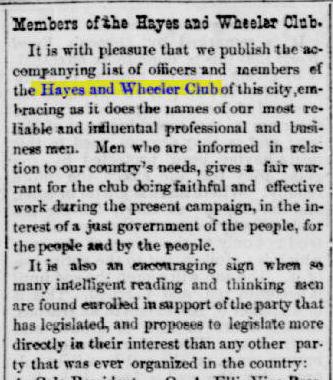
Hayes and Wheeler

Another recent scouring of Oconto newspapers brought this interesting tidbit to my attention just in time for mid-term elections:

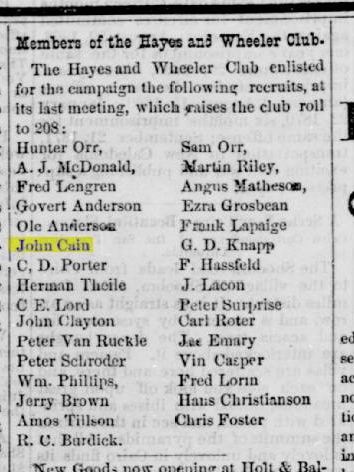
newspaper_cainjohn_HayesandWheelerClub

So what was the Hayes and Wheeler Club and why was gramps John Cain a member?

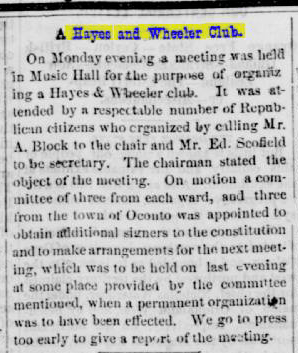
newspaper_cain_hayeswheelerstartsnewspaper_cain_hayesandwheelermembers.png

From what little I have been able to find about this club, it looks like it was patriotic in nature and organized in many states across the country, for the purpose of “securing re-nomination and re- election of President Rutherford B. Hayes.”

John appears to have been republican in beliefs, and was enthusiastic enough for Hayes to be elected that he joined the club to help rouse the populace to vote for his favorite ticket.

Here is a small bit of biography on Hayes from his Wikipedia entry:

Hayes was a lawyer and staunch abolitionist who defended refugee slaves in court proceedings in the antebellum years.

He was nominated as the Republican candidate for the presidency in 1876 and elected through the Compromise of 1877 that officially ended the Reconstruction Era by leaving the South to govern itself. In office he withdrew military troops from the South, ending Army support for Republican state governments in the South and the efforts of African-American freedmen to establish their families as free citizens. He promoted civil service reform, and attempted to reconcile the divisions left over from the Civil War and Reconstruction.

John did not enlist in the Civil War. Having been born in 1852, he was too young to have enlisted. (I am very thankful he was too young, because he might have died and I wouldn’t be here now talking about him.) Even though he was not in the war, he was a peripheral part of it, and was affected by the aftermath, as was the whole nation. His support for Hayes gives me a sense of his political leanings and beliefs, something he left no clue about to his descendants, until this article was found.

I’ll end this post with a friendly reminder. VOTE!


Sources:
Oconto County Reporter, 1876-07-22; v5issue38p3col4
Oconto County Reporter, 1876-08-19; v5issue42p3col4
Oconto County Reporter, 1876-09-02; v5issue44

Clarence Goes To Court

On October 30, 1931 Clarence John was driving home from a long day at work at his bowling alley in Oconto. It was 11:30ish at night and pouring rain.

img104
This is the road Clarence was driving on, Hwy 22 going west.

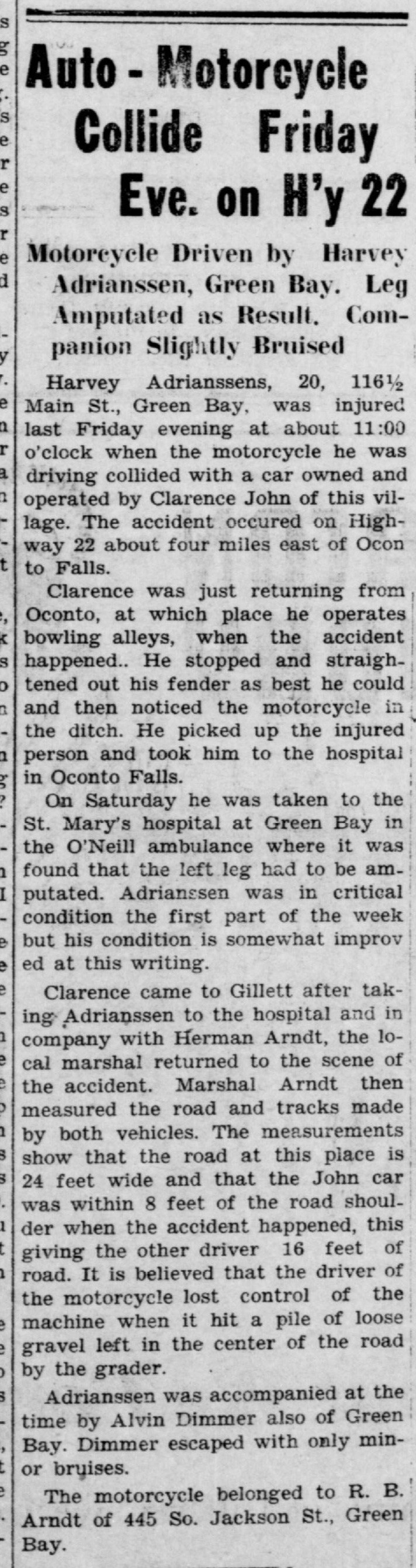
newspaper_johnclarence_motorcycleaccident1931 copy

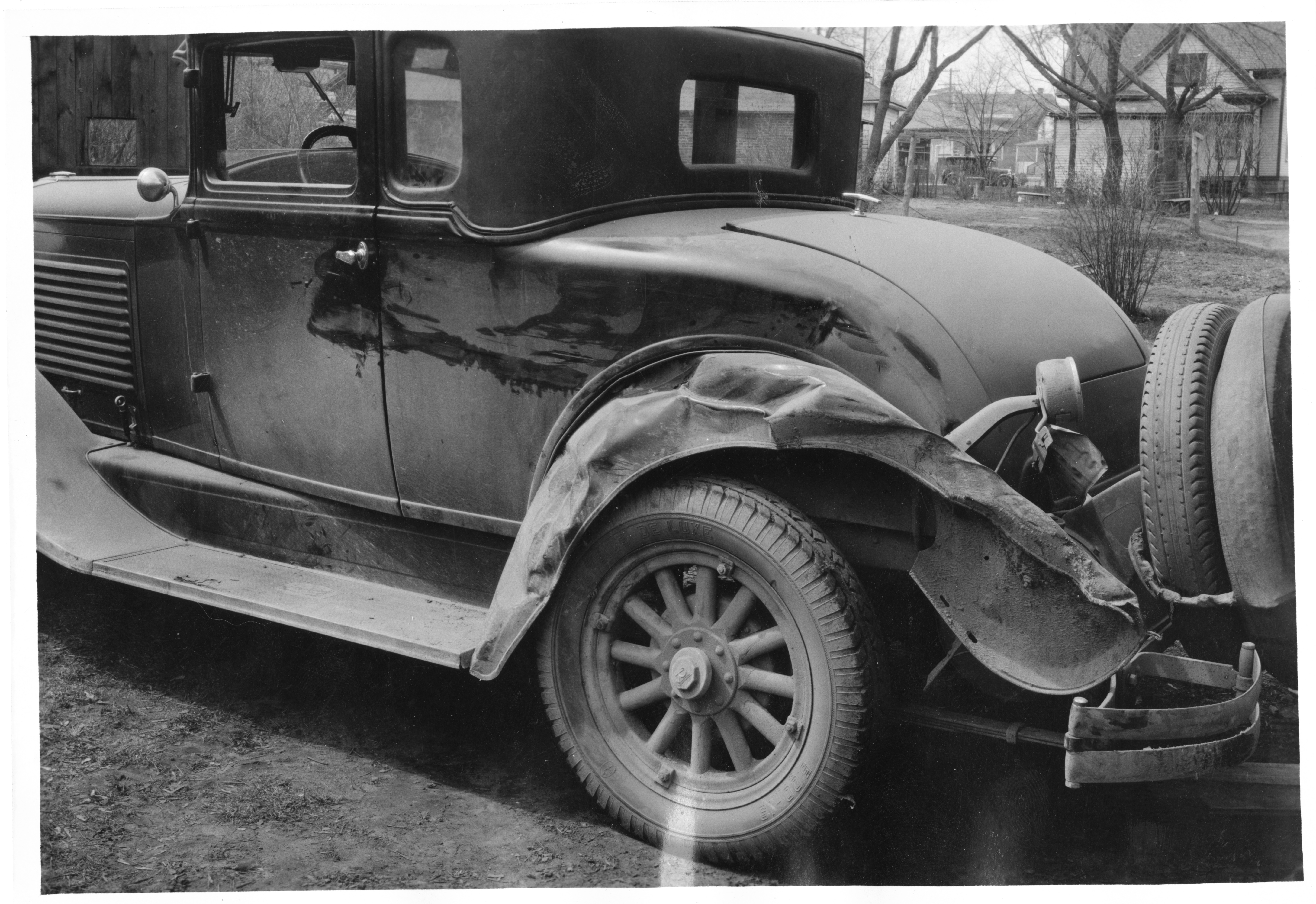
img103
Here is a photograph of the damage done to Clarence’s 1929 Roosevelt Coupe (the photos were in the court case file).

The driver of the motorcycle was Harvey, a 20-year-old, who was accompanied by a friend. Harvey lost a leg due to the severity of his injury. His father, acting as his guardian, sued Clarence for damages and the case was brought to Brown County Court in March of 1932, however there was a request to change the venue to Oconto County, which was consented to.

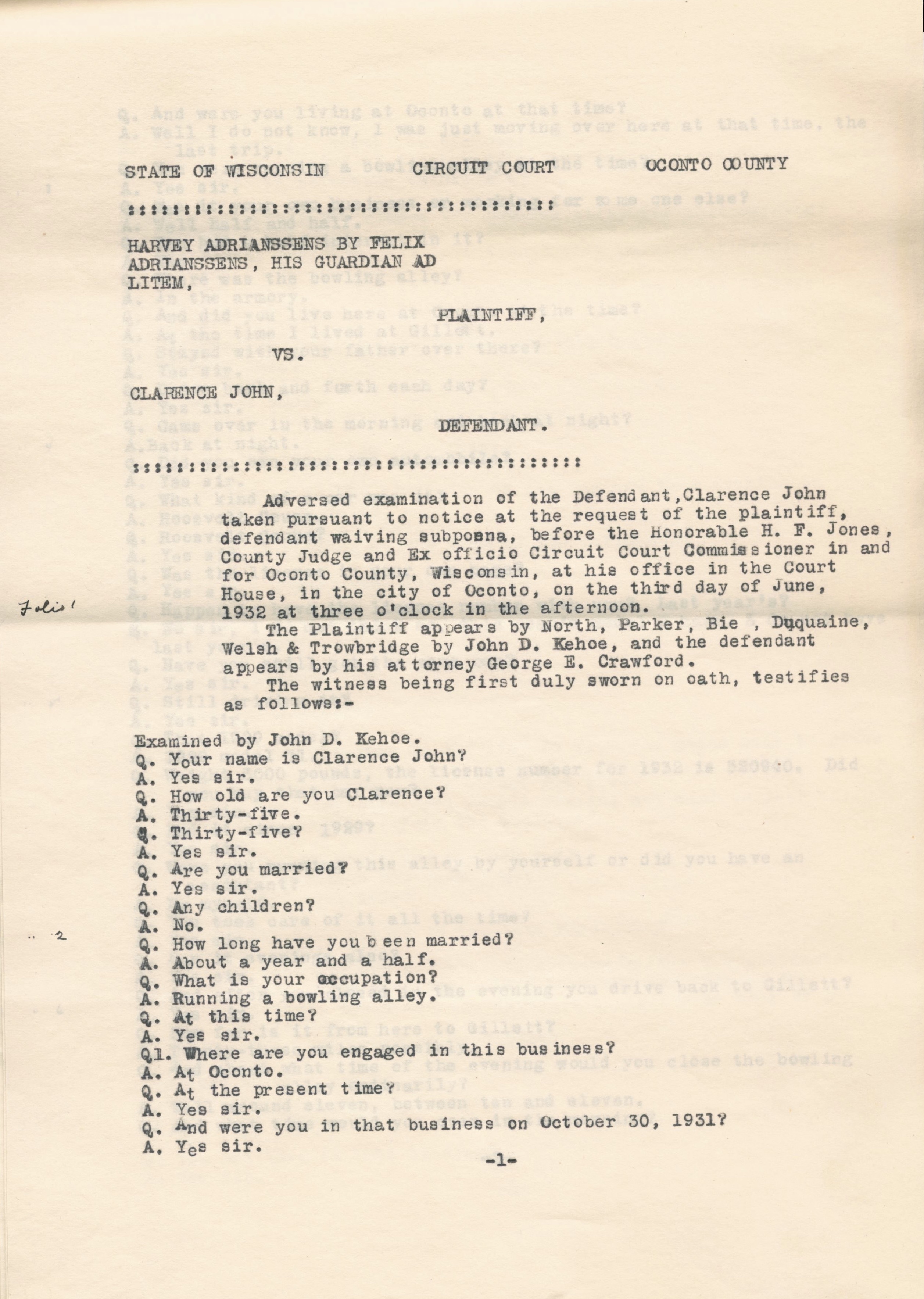
There were no witnesses to the accident other than the three people involved. The only testimony in the case is from Clarence. Below is a scan of the first page from the testimony.

court_johncf_127471

According to his testimony, he had half interest in a bowling alley in Oconto, at the armory, which he ran all by himself. He was living in Gillett with his wife, Myrtle, and his parents. They had no children at that time.
Clarence answered the suit against him with a definite ‘not my fault’, stating that the driver of the motorcycle was driving too fast for the conditions and lost control. Harvey’s lawyers and guardian denied the fault was his.

The damage that is visible on Clarence’s car does look like the other driver hit him, not the other way around. But in the end, we only have Clarence’s testimony, none from Harvey.

And, of course, no matter what we conclude seeing the evidence and reading the testimony, the jury’s opinion is the only one that matters. They found Clarence at fault, and ruled in favor of him paying damages of around $5100 for personal injuries sustained by the plaintiff. (If payment was for reparation for the loss of Harvey’s leg, it seems a bit cheap to me.)
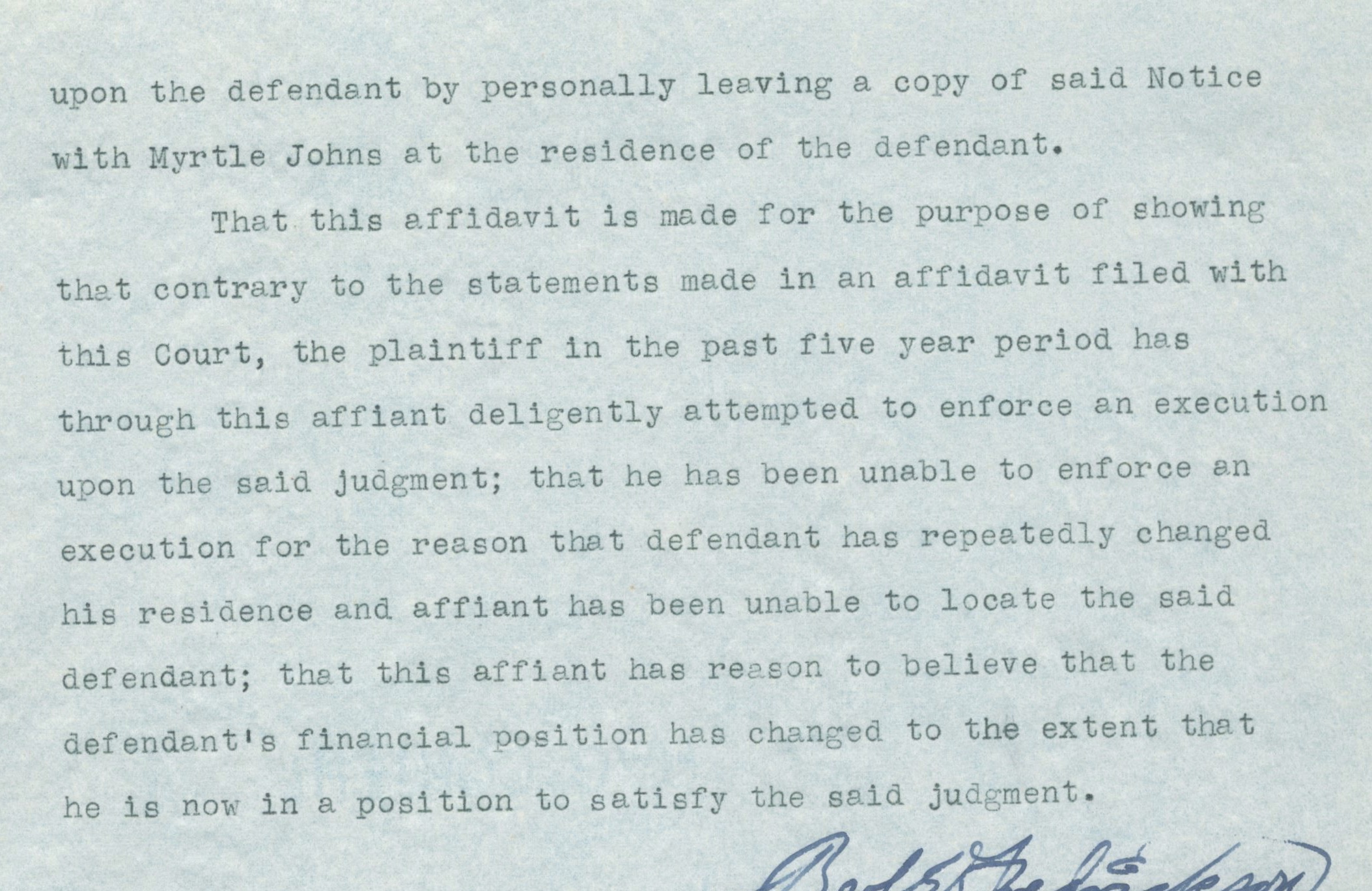
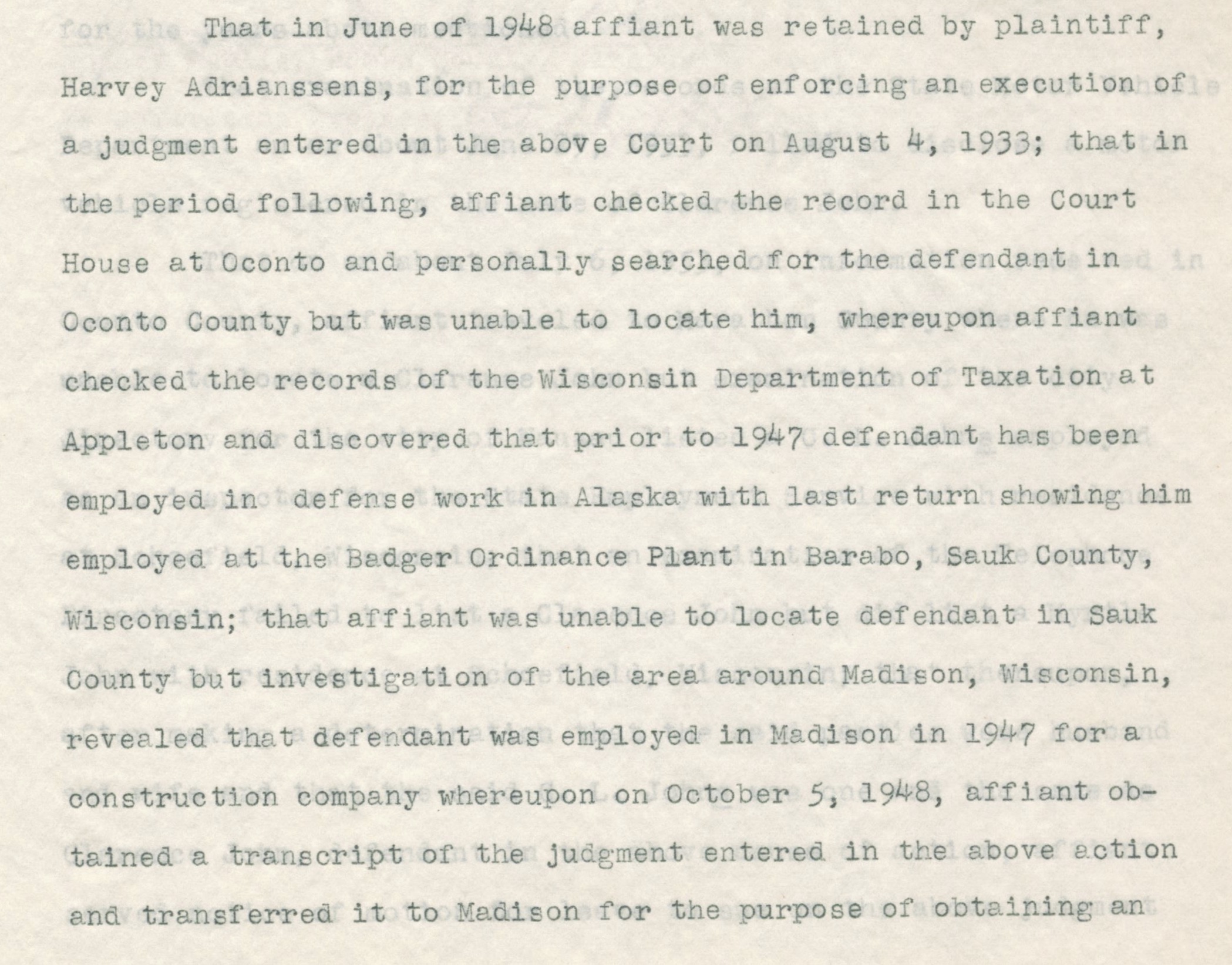
In 1948, 15 years later, we find the case continued, because Clarence had yet to pay the $5100 he owed to the plaintiff.
The record, which consists of sworn affidavits of attorneys and the defendant, and the statements of counsel made in the record on this application, raises a serious question as to the truth of the allegations of the defendant in his affidavit. The plaintiff’s attorney at the time of the trial…swears that after the rendition of the judgment and for about nine years thereafter he industriously attempted to ascertain the financial condition of the defendant in Oconto and Forest Counties and that his investigation disclosed to his satisfaction that the defendant during that period was judgment-proof.*

From 1942-1948 no action or activity appeared to be going on regarding the collection of the debt. Until Harvey got impatient, and in 1948 started pushing for his money. Here is an excerpt from a letter from one lawyer to another regarding the matter, dated October 21, 1948:

I have checked with Findorff and they tell me that John terminated his employment with them sometime during the spring of this year. However, the motor vehicle dept. informs me that he has an automobile registered in his name – – -1936 Plymouth coach…residence being Crandon, Wisconsin.

Under the circumstances , there is no point in my filing the certified copy of the judgment, inasmuch as there is absolutely no chance of my garnisheeing his salary or having execution issued. In the event he is traced to Madison again, I will be happy to grab him by his pants. There may be a chance for you to have his car picked up if he has returned to Crandon.

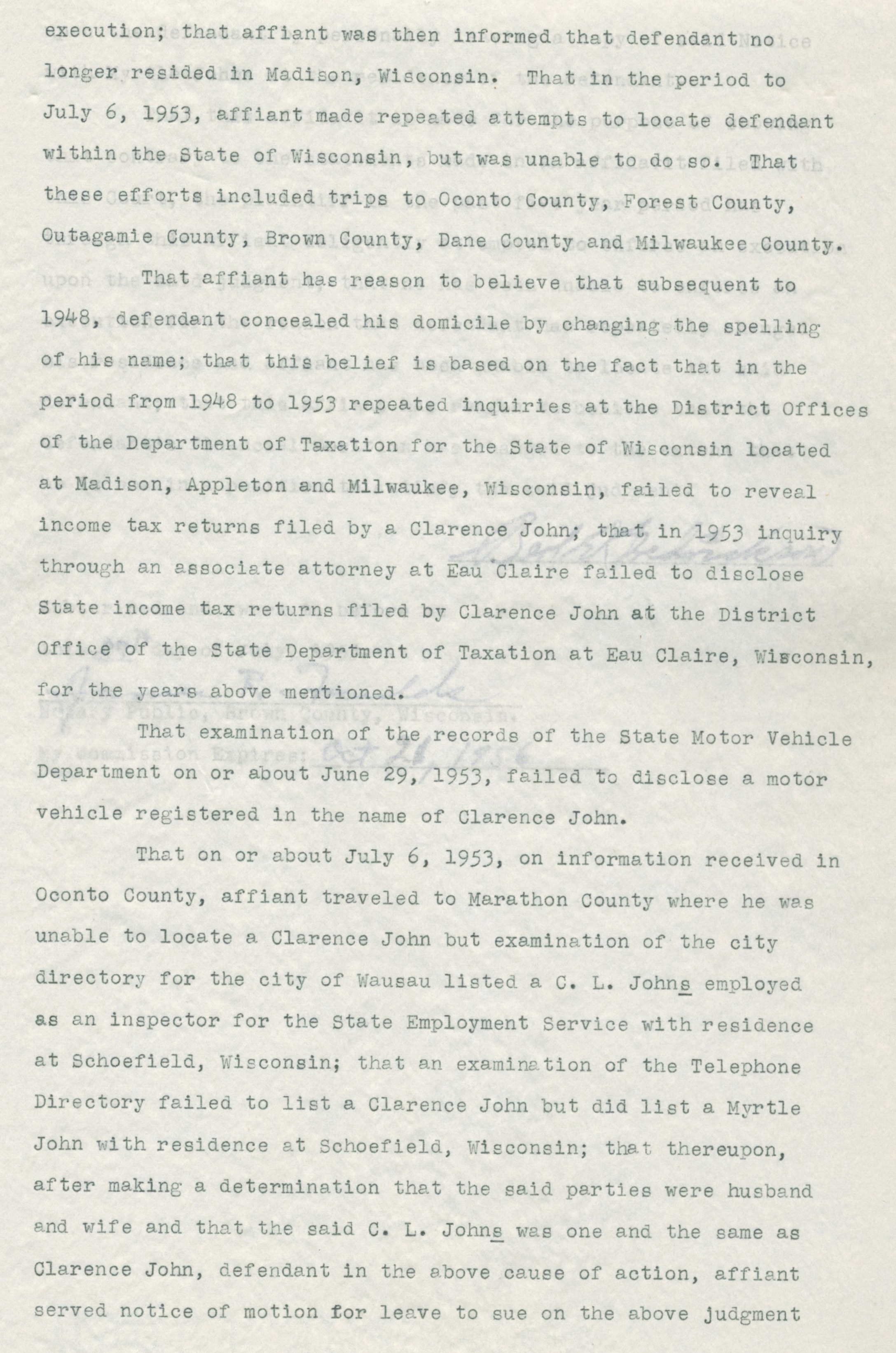
This process continued until July of 1953. At this time Clarence was finally found in Wausau, and served, Harvey had made action to start the process of suing him, he was worried because the judgment would lapse in August of that year.

Clarence refused to show up in court, instead sending his attorney to file one paper which stated that since the judgment, he and his family had resided in Wisconsin all that time. They never received papers regarding the execution of the judgment, or even an attempt at communication, and that such in-action in all this time negates the ‘good cause’ requirements of the judgment. Basically, making it null and void.

But the lawyers for the plaintiff had this to say:

court_johncf_12741 (dragged)court_johncf_12741 (dragged) 2court_johncf_12741 (dragged) 3

It looks like Clarence really didn’t want to pay this debt. But he never asked for an appeal to the judgment, which kind of makes his excuse a bit thin.

In the end all this work that Harvey put into getting his money came to nothing. My grandfather, Clarence, died in February of the next year, (1954). On his father’s birthday.

*Wikipedia definition of judgment-proof: In the context of debt collection and civil litigation, the term judgment proof is commonly used to refer to defendants  who are financially insolvent, or whose income and assets cannot be obtained in satisfaction of a judgment.
     Being “judgment proof” is not a defense to a lawsuit. If sued, the defendant cannot claim being “judgment proof” as an affirmative defense. The term “judgment proof” instead refers to the inability of the judgment holder to obtain satisfaction of the judgment.
     If a plaintiff were to secure a legal judgment against an insolvent defendant, the defendant’s lack of funds would make the satisfaction of that judgment difficult, if not impossible, to secure.


Sources:

  1. Auto-Motorcycle Collide Friday Eve. on H’y 22, The Gillett Times, Gillet, Wisconsin, Thursday, November 5, 1931; No. 11, page 1, column 2. 
  2. Harvey Andrianssen vs. Clarence John, Circuit Court case #12741, Oconto Series 36, Green Bay ARC, UW Green Bay, Green Bay, WI. (Photographs from the accident taken from case file.)   If interested in case just ask me for a copy.

Clarence goes a courtin’

3215370619_83f9e115f3_oCourting Under Difficulties
Clarence John went to Cloma Sunday night, to sit up with a young lady friend. For the benefit of our readers who do not know where Cloma is located, we will state that it lies “somewhere near Nashville” and that S. W. Beggs is mayor of the village. Clarence evidently had some time, for in relating his trip he says, “I had heard it was hard to get there so I put on my bathing suit and started out at about eight bells. I walked two miles, swam a large creek, waded through mud up to my suspenders for a mile, jumped here and there on a wet corduroy road like a grasshopper and finally reached Siding Three at about twelve bells. Here I borrowed a horse from a gent and rode another mile, then a flock of large mosquitoes carried me a mile further, and at last I followed a cow into town just as Daddy Ison was getting up to feed his hog. The young lady was waiting for me so I sat down and rested a few minutes and then took a morning train back home. Talk about hard luck—I sure had it. I don’t see why girls want to move way out in the suburbs for anyway.”1

I have been having fun finding more digitizied newspapers available online. The Oconto County papers have been exceptionally good, and now I am finding some from Crandon.

This amusing tale was in the paper when Clarence, my grandfather, was 19 years old.


Source:
1. Friday, Jul 19, 1918, p1c1, No. 46, 32nd year; Forest Republican, Crandon, WI —Crandon Public library digital images.