I was going through my ‘address book’ making sure that I sent out holiday cards to everyone and I ran across Cecil’s entry in my book. Cecil is a Stackpole cousin whom mother and I met when we went out to West Virginia for a Hays reunion many years ago. He helped us find a couple of cemeteries in the area, as he and his family had lived there all their lives.
I thought I would check up on him to see how he was doing. Not so well as a matter of fact. He passed away this last August. So I thought I would post his obituary as entered in this online memorial:
Obituary for Cecil N. “Diddy” Stackpole
Stackpole, Cecil N. “Diddy”, age 81, of Postlethwait Ridge Road, Littleton, WV, formerly of Pine Grove, WV, went to be with the Lord on Monday, August 10, 2015 at his home.
He was born April 27, 1934 at Pine Grove, the son of the late Cecil Earl and Eva Morgan Stackpole.
He was a retired heavy equipment operator and a member of Wetzel Lodge #39 where he was a Past Master. He was a loving husband, father and Grandpa.
In addition to his parents, he was preceded in death by a brother, Wallace Stackpole; a sister, Mary Martha Stackpole; and a grandson, Brendan Mathew, who was waiting on his Grandpa.
Survivors include his wife of 54 years, Sue Stackpole; two sons, Rob Stackpole of Postlethwait Ridge and Pat (Sharmion) Stackpole of Hastings; four grandchildren, Patrick Neil Stackpole, Jr. “PJ”, Tiffany Lenay Stackpole, Krysta Stackpole and Keera Stackpole; two sisters, Patricia Howell and Janet Goodwin; and a sister-in-law, Glenda Stackpole.
My condolences and sympathies to the family.
‘Diddy’ and I had a good time comparing notes when I first started researching the Stackpole line. Including chortling over a Stackpole researcher who keeps putting up totally incorrect information about Thomas Stackpole, no matter how many times we told him he was wrong.
While we celebrate our thanksgiving and feel all proud and smug about being American’s, well maybe not so much these days, most folks try to forget that the country we live in today came at a very great cost to those who had settled here long before the first European arrived.
I can claim many ancestors on my mother’s side of the family, and a few on my father’s, who were what we considers ‘frontiers folk.’ They hacked, literally and figuratively, their way across this country building new lives for themselves many times over in the wilderness that once was. Along the way they also hacked down a few of the first settlers who were in their way.
One of those frontier families were the McQueens, who in the course of their years as settlers had developed a keen and decisive hatred for the indigenous people who were living on the land they wanted. This hatred no doubt was fueled by all the killing that occurred on both sides of the fence – as one wanted to keep the land that was theirs to begin with, and the other wanted to take it from them, rightly or wrongly, the large majority of frontier folk didn’t much care.
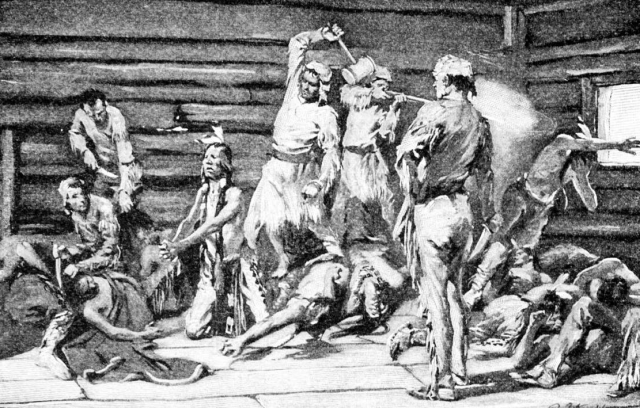
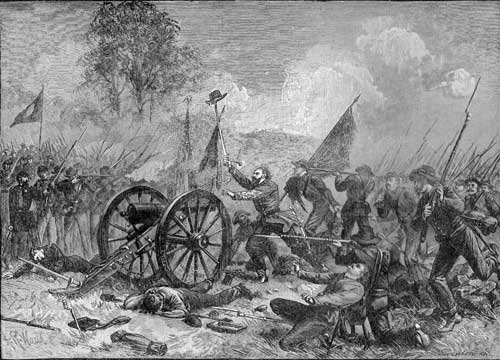
In March of 1782, a group of Pennsylvania militiamen under the command of Captain David Williamson attacked the Moravian Church mission at Gnadenhutten consisting of Christian Indians. Because of ‘evidence’ that was most likely planted by the Shawnee, they believed that they were revenging for the deaths and kidnappings of several white settlers that had occurred in the area earlier. However, the Delaware had only recently arrived back at their village to forage for food and had had nothing whatsoever to do with the earlier killings and kidnappings.
Accusing the Delaware of the attack on the Pennsylvania settlements, the soldiers rounded them up and placed the men and women in separate buildings in the abandoned village overnight. There was a council of war held by the militiamen, with a few voicing their distress at the idea of murdering all the prisoners as punishment, but their voices were not heard as the majority vote was to execute their captives the following morning. One of the men who was not keen on the idea was my ancestor George Brown, a brother-in-law to Thomas McQueen (an ancestral uncle) who was all for the decision to put them to death. George, a minster at the time, had more compassion and did not feel that death to all the Delaware prisoners was a proper punishment for their supposed crime.
Informed of their impending deaths, the accused spent the night praying and singing hymns. The next morning the soldiers dragged the prisoners in pairs by the ropes around their necks to a slaughter house where they were knocked down with a cooper’s mallet and then scalped and murdered all 28 men, 29 women, and 39 children. There were only two survivors left to tell the story.
Folks who didn’t live in the frontier were appalled and horrified at the massacre, those living on the frontier mostly felt the Indians got what they deserved, and there was even talk of mounting another invasion against the Indians. The result of this massacre was more Indian reprisals and raids, fueling more hatred of the ‘red-skinned’ enemies. Eventually all this activity led to Crawford’s campaign. (Both George Brown and all the McQueen boys were involved in the Crawford campaign, in fact George had his own company. More on this in another installment.)
This is not the first occurrence of ancestors of mine murdering Indians, although it is probably close to the last. Of course the Indians got their licks in, as I have surprising number of ancestors who died under the blade, arrow or bullet of ‘the enemy’ too. I harbor no resentment. Even though it was never officially declared, the European invaders were always at war in one way or another with the people who were on this continent first, and sadly we won. Too bad we couldn’t have shown our better quality.
This image is from a scanned newspaper image, so it is not the greatest.
When Abram Rosa came back from his time in prison after the Civil War, he came back to an empty home. His wife, Jennie, had left him, taking their two daughters with her. At this time we are not aware of an actual divorce having taken place between the two of them, but they both did marry to other people a few years later.
Abram’s second wife was a woman by the name of Harriet Emerson. They married in October of 1869. Over the 4oish years of their marriage they had two known children, both boys, Alby and John Nelson. So now my gg grandmother Carrie had two half brothers, both of whom she never met or knew about, as far as we know.
John Nelson did marry, at least 3 times, but never had children. His brother Alby married several times also, but he did manage to have two daughters with his first wife Dora Ritter, Erma and Loral. Erma never married. Loral married a gentleman by the name of Willis C. Servis in 1921 in Benton Harbor, Michigan. They had one son Dean C. Servis before they divorced, Loral married again to Ethemer Emery in 1932 and together they had about 6 children.
So what does all this have to do with speed?
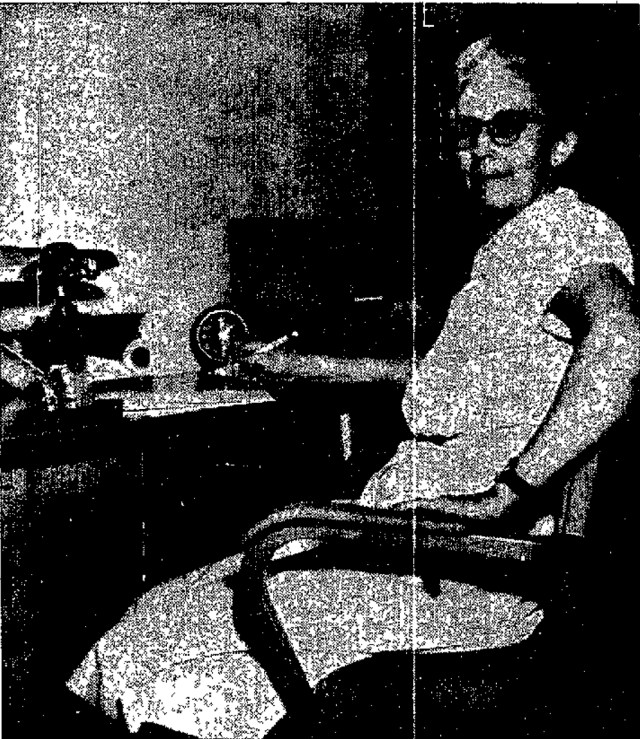
Loral, the actual subject of this post and pictured above, was not your usual grandmother type. Somewhere in her genes was a speed demon waiting to come out.
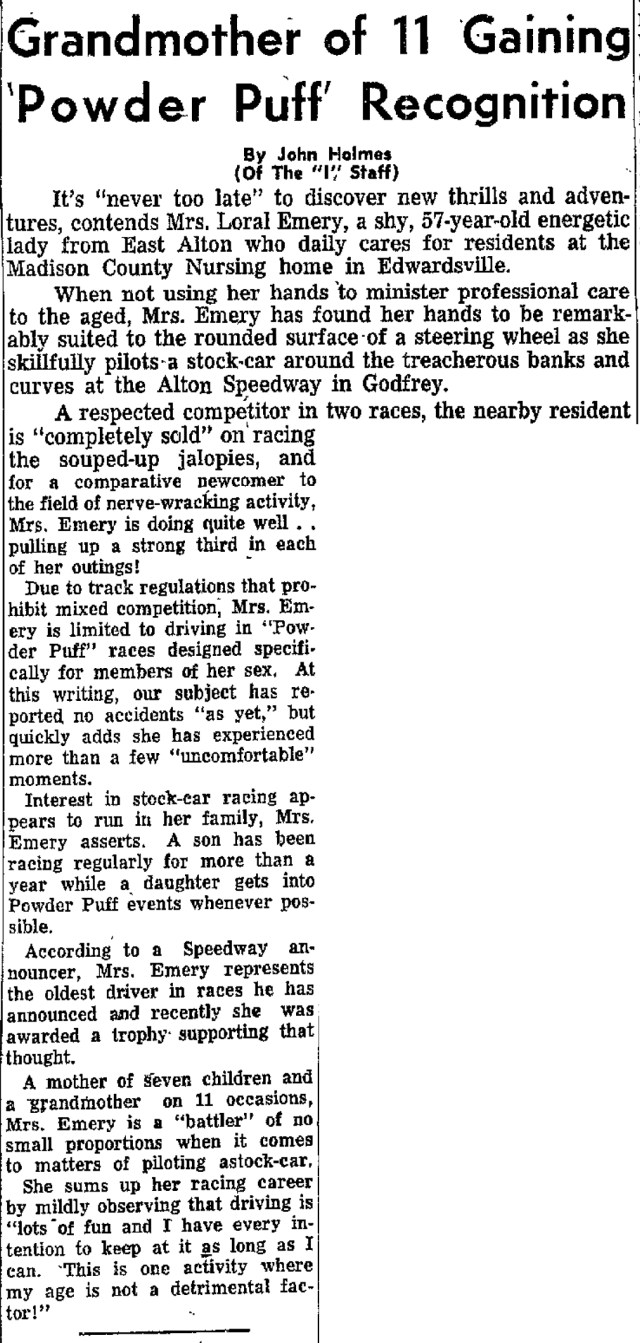
While trying to find out more about the Abram’s second family and his descendants, I found this awesome newspaper article:
Edwardsville Intelligencer August 2, 1958 page 6.
The caption that is with her picture above reads:
Equally at ease in matter pertaining to ministering professional care for the aged at the Madison County Nursing home in Edwardsville or when behind the wheel in stock-car racing is Mrs. Loral Emery a resident of East Alton who contends she is “completely sold” in piloting jalopies at the Alton Speedway in Godfrey.” The 57 year old grandmother of 11 was recently presented a trophy symbolic of being the eldest driver at the nearby oval.
I wonder if her interest in racing was influenced by her first husband, Willis, who was a garage mechanic? She definitely had cool written all over her.
Racing, like all sports where men are involved, was a vey sexist sport. In the 1940s, when racing clubs were first starting in the U.S., a woman’s role was as either ‘eye-candy’ or ‘sandwich and coffee provider’ for all the manly men doing the racing, or working in the pits. This continued into the 1950s, although now there were a few women starting to get their game on and competing in their own right. So when Loral was heading out to the track to satisfy her speed need, she was doing it at the time women were coming out of the woodwork and showing the men they had what it took to race, contrary to popular belief. (Although, there are still plenty of dumb bunnies out there today who are satisfied being nothing but eye candy.)
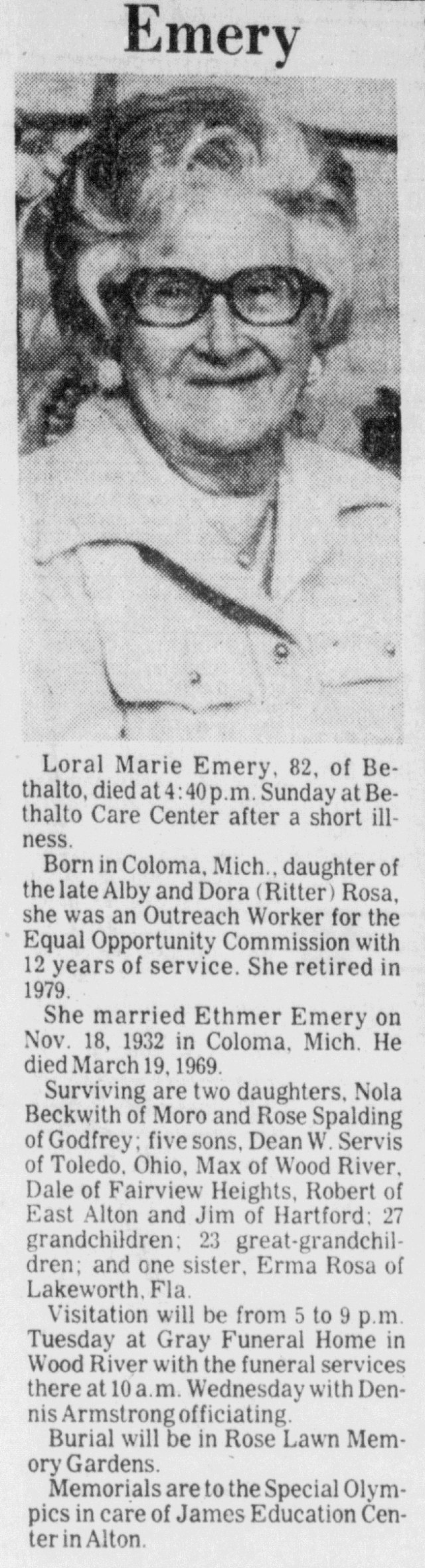
After this article was published in 1958, Loral went on to live another 25 years. She passed away in 1985:
Loral appears to have been a pretty interesting lady. (She was my half 1st cousin 3 times removed.)
Henrietta Völks1 is not a relative of mine, although if the fates hadn’t been so cruel she might’ve been. She was my gg grandfather’s first wife whose life was cut quickly short by cholera.
Now fill your glasses to the brim, And drink with steady eyes, Here’s to those already dead And here’s to the next who dies!2
When the ship Eleanore docked at the port of New York on June 23rd of 1852, on board was the married couple Friedrich Wilhelm Jahn and his wife of several years Henrietta. There were no children with them on the passenger list, and we do not know if they ever had any together.
F.W. and Henrietta’s final intended destination was Wisconsin. It is unknown exactly how they eventually made their way there, although, it was probably by steamboat across lake Michigan which was quite a popular route at the time. They most likely arrived in Milwaukee sometime in late July, early August and stayed either with relatives, friends or at one of the many boarding houses that took in the large numbers of recent immigrants.
Milwaukee was becoming quite the large metropolis at this time in Wisconsin’s history. Immigrants were flocking in by the thousands weekly from England, Germany, Ireland. This huge influx of people along with the crowded conditions of the city, poor sanitation and bad water, helped to spread the disease that was part of the worldwide cholera epidemic of 1849, which continued in several outbreaks until 1854.
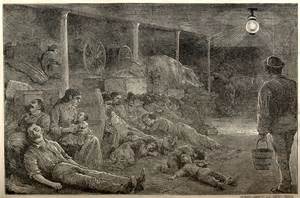
Image of cholera victims.
The 1849 Cholera epidemic is believed to have arrived in the United States from the German ships arriving in New York and New Orleans, and by the next spring it began its steady spread through out the interior of the country.
The scariest part about cholera for folks at this time was: not understanding how it spread, and the swiftness with which it struck. You could be talking to a friend one day and they would appear to be in the best of health, and the next day you find out they are dead. One of the symptoms of the fear people experienced, was that they fled like rampaging cattle from the disease, in effect making sure of its spread to unaffected areas. If you were a victim of the disease you can be sure that many a family member or friend would abandon you in a heartbeat and leave you to your fate, in the hopes that they won’t catch the disease.
Doctors still didn’t really know what caused it, or how it spread. Newspapers and rumors were quick to use the immigrants as scapegoats. While part of the blame could be placed on these folks who brought it over from Europe, general lack of knowledge about its cause helped it along.
The epidemic re-emerged several times until about 1854. The 1852 epidemic while not nearly as virulent still managed to kill Henrietta. According to family stories, by September (only a few months after she arrived at her new home) she was dead.
At death, the cholera victim was wrapped in a white garment and then put in a wood box, after which the group of men hired to take care of the dead were called upon. They would haul the body off to the sand trenches where all the other bodies were buried. In some cases when a whole family had died, the neighbors would just torch the house with the bodies in it. It is believed that some folks were so desperate to dispose of the victims that there were cases of people being buried while not quite dead.
There is no known headstone or burial place for Henrietta, maybe she is one of the many unnamed victims buried in a potters field in Milwaukee.
So this year, I give thanks for the advances we have made in modern medicine, science, and our understanding of the world around us. I will also raise a glass in honor of Henrietta, whose life was cut brutally and abruptly short.
———- 1 Henrietta’s last name has been seen spelled many different ways including, Voaks, Voeks, Voöks.
The Civil War in the United States was a tragedy of huge proportions for the citizens of this country. So many lives lost because of misplaced southern pride in outdated and appalling views on ownership, ‘states rights’ and slavery.
James Shaw, born Ohio in 1808, was an older brother of my ggg grandfather the Hon. John Shaw. By the early 1830s James decided to try his fortunes in Texas and moved his family to what is now Milam County. He had married one of the Riggs girls and had several children with her. One of those children was a son, Frank Shaw.
James embraced being a Texian wholeheartedly, even joining the military when they were fighting Santa Anna. He was in the decisive battle of San Jacinto that was one of the determining factors in the future of Texas as a state.
Sometime after the civil war started James’ son Frank, feeling the fever of youthful righteousness in a cause, joined up. On the side of the South. This decision had the unfortunate effect of ending Frank’s young life quite abruptly. His father wrote this letter to the paper, mostly likely as a way to help himself work through his grief:
A PIECE OF SAVAGE BARBARISM
Editor Gazette:
Permit me through the columns of your weekly paper, to make known to the civilized world and to Texian soldiers in particular, the death of my unfortunate son, Frank Shaw, a native Texian, who was brutally murdered by Federal troops in Louisiana, on the 3d day of November last. The circumstances are substantially as follows: My son was Orderly Sergeant in Captain Waterhouse’s Company, Lane’s Regiment, Majors’ Brigade of Cavalry. In the morning of the Borbeaux battle, his (Waterhouse’s) and Johnston’s companies, who had been on picket, a mile from the Federals encampment, marched up to a bridge on Bayou Borbeaux fronting the Federals, and were ordered to dismount and take trees. My son with two or three others, seeing a good position across the bayou, some eight or ten steps in advance of our line, ran to it, and after having fired three or four rounds each, the order was given to fall back to their horses, who having further to run by being in advance, they were captured before they got back.
At this critical moment Gen. Green and Majors came dashing up at the head of their victorious columns from the right, and repulsed the enemy, who after having taken my son some four hundred yards, fearing his recapture, brutally and inhumanly murdered him by shooting him in the head with a pistol!
I have not written this account hastily and from the impulse of the moment; but have waited patiently for the last four or five weeks hoping the first account of this sad affair which I received from my nephew, A. P. Perkins, might possibly prove incorrect as I could not believe, that there was a nation on the face of God’s habitable Globe, especially one professing to be foremost in civilization and Christianity, that would have acted so barbarously: notwithstanding the poet has long since said:
“But look for ruin when a coward wins, For fear and cruelty were ever twins.”
My son had met them honorably previously on many battle fields. Mr. James Holland, a member of the same company, has lately arrived at my house, with his horse and baggage. He was taken prisoner a short time previous to my son; but he saw while in New Orleans, before his escape, the prisoners who were captured with him, with whom he was well acquainted, and they informed him that they saw Frank shot in the cowardly manner described above, and for the only reason, that his feeble health would not permit him to keep up afoot, with their retreating cavalry.
I have been thus particular in detailing facts for this purpose of making it publicly known to our brave Texian troops in the field, that these same thieves and murderers under Gen. Banks, are now polluting our Southern borders with their unwelcome presence, and I now leave it with them to decide whether or not, so cowardly and dastardly an enemy deserved the treatment of a brave and magnanimous foe?
James Shaw
Lexington, Jan. 13, 1864.1
There is no getting around the fact that war is an ugly and violent affair no matter how you look at it and Frank was a casualty of that ugliness. The manner of his death, if accurately reported (remember we only have one version of what happened), is unfortunate and it is understandable that James’ view will be prejudiced. In my, admittedly prejudiced, mind his son was fighting to preserve slavery under the misguided guise of state’s rights. Where was the honor in that? But the fact is, one side had no more claim to honor and heroism than another, as both the North and the South committed acts of barbarism, compassion, and heroism at many times during the war.
1 Published in the [Texas] Galveston Gazette, January 13, 1864.
Stephen Porter Goble, Stephen, senior’s son with his first wife, Elizabeth Brown. (1832-1866).
Stephen Goble and his first wife Elizabeth had, according to online trees, seven children. Sadly only one, a son, lived to adulthood and had a family of his own, Stephen Porter Goble, who was born in 1832. When Stephen senior died in 1889 his will left all his property to his 5 daughters (whom he had with his second wife Alice), clearly indicating that none of his son Stephen’s heirs were to receive a farthing:
Item 2nd — It is now considered by me that my deceased son Stephen P. Goble, having in his lifetime received his full share and proportion of my estate and assets, It is my wish and will that his heirs viz; the heirs of the said Stephen Goble, deceased, shall not inherit or have any part or portion whatever of my said estate, or of any estate or assets of which I may die seized.1
As one can see in the reading of the will, there was actually nothing nefarious going on, Stephen had already given Stephen Porter his share of the estate, probably when he had married. The fact that Stephen Porter’s heirs are mentioned instead of Stephen Porter himself also clearly indicates that his son had died previous to 1889, so of course I was curious as to why he had died before his father. The possibility of it having happened during the civil war was pretty high as he was of an age to have enlisted.
I found one online tree that had this to say regarding his passing: ‘met his death in 1866, by a shot fired from the gun of a trespasser.’…and that was it. All I could think was – ‘Seriously, that’s all you wrote? Weren’t you curious about the details?’ But this did give me a clue that he probably wasn’t killed in the war. The Goble family website has the following entry for Stephen Porter:
“Stephen Porter Goble died May 30, 1866. He and a farm hand were going through his farm on the lane when they saw a stranger walking through the wheat field. This would cause the wheat to be mashed down so that it could not be harvested. They called to the stranger who turned and shot Stephen P. Goble. The farm hand took Stephen on the farm sled to the house and a doctor was sent for. Stephen P. Goble died, leaving a wife, Frances S. (Ashburn) Goble, and three young children and a farm.”
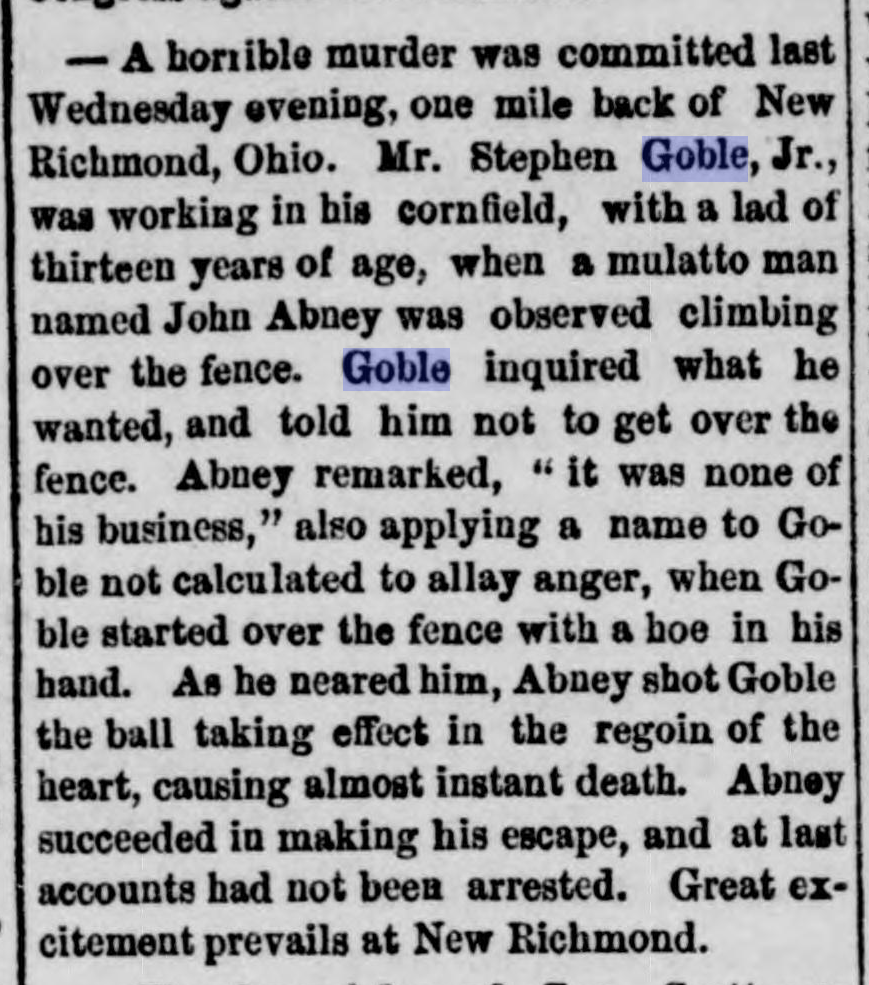
The above story being shared by a descendant of Stephen Porter had been passed down for several generations through the family. However, thanks to the good old internet, and those great folks who are digitizing newspapers as fast as they can, here is the story as found in a Minnesota newspaper just days after the event3:
At this time, I can find no record of the perpetrator of the crime having ever been caught.
This event is an interesting and excellent example of how family stories change over the years, where the basics of the story turn out to be mostly true, but the details get all muddied up at each telling.
The murder of his son and the loss of 6 children with his first wife, were not the only devastating things to happen to the family. I caught this horrible bit of news in an 1885 paper:
The house of Stephen Goble, near New Richmond, O., was destroyed by fire.4
Who knows what precious heirlooms were lost to the family. Thankfully no lives were. So, we can be relieved that this wasn’t a Goble doing the murdering, but a Goble getting murdered. Although I am sure Stephen Porter would have preferred to have not been the subject of this gruesome post.
Will probated April 10, 1889, Wills of Clermont County, Ohio, 1800-1915, Book P, p. 512-517 [image on FHL digital images of these wills is 303-305 of 669].
Told to Jean E. (Coddington) Bogart by her mother Marguerite (Frey) Coddington and her Aunt Dorothy E. (Frey) Lanter. Goble family website
A Horrible murder…, Taylors Falls Reporter, June 2, 1866, page 23, col. 4; Stillwater, Minnesota weekly.
Replica of the New Orleans, (built in 1911), the first steamboat that traveled on the Ohio in 1811.
The introduction of steamboats on the Ohio River in 1811 revolutionized river travel during the first half of the nineteenth century in America, and by the 1820s the Ohio was bustling with more boats than you could shake a stick at. Early travelers using the river for transportation spent much more time and energy getting from place to place because they had to power the boats themselves. This technology made travel on the water faster and more efficient. The only drawback was the steamboat’s tendency to explode, but this drawback was more than made up for with the speed they could achieve to meet tighter schedules, traveling against the current, and by being able to take more passengers and higher value cargo upstream.
Although most of the earlier steamboats came from Pittsburgh or Wheeling, it wasn’t long before Cincinnati also emerged as a significant player in the industry. “Cincinnati shipyards launched twenty-five steamboats between 1811 and 1825, and the number only increased after that period. The industry and the transportation system that it developed helped Cincinnati to become one of the most important cities in the West prior to the Civil War.”1
Stephen Goble, Senior, probably taken sometime in the 1880s.
One of those early pioneers of this revolution in river travel was my 3x great Grandfather Stephen Goble, Sr.. Stephen was born in 1804 in Clermont County, Ohio the son of William Goble and Ruth Beck. He was named after his paternal grandfather. The lure of the Ohio River called to him, and one can easily imagine the appeal to a young man of the early 1800s, watching the hustle and bustle of the steamboats traveling up and down the Ohio at all hours of the night and day, with many heading to St. Louis and New Orleans. It must have been quite a sight to see.
The thrill of adventure was so alluring to Stephen, that at the age of 15 he had left his family in Bethany and eventually ended up working on the steamboats running the river. By 1826, at about the age of 22, he had become an engineer on the first two lever engine boat that started in Cincinnati, the Wm. Tell.3 I found the following wonderful news articles in the Ohio papers. They give us a hint of his early adventures.
River News, Daily Port Register. Arrivals. Personal. Several weeks ago we noticed the death of Capt. Embree,…Capt. Embree was one of the earlierst steamboat captains in the west…In the year 1828 he built a boat at New Richmond, Ohio, on which such venerable steamboatmen as Captain John Conner, Robert Davis, and engineers James Temper and Stephen Goble, Sr. each served terms as youthful engineers.4
Shipping News: Miscellaneous — Stephen Goble probably the oldest river engineer living, was here Thursday. He was on the Wm. Penn[Tell], the first two lever engine boat that started from Cincinnati, and also on the Marion the second of the same class. He is now 84[78] years old, hale, hearty and in possession of every faculty. He lives up the river near New Richmond, and made the trip on the Bonanza as the guest of his old frine Mac Ketchum. He was greatly interested in the changes that have occurred since his day.3
River Intelligence: Personal. Stephen Goble, an old time engineer, was on the Wm. Penn, the first two lever engine boat, that started out from Cincinnati and also on the Marion, the second of the same class. He is now eighty-four years old, hale and hearty and in possession of every faculty. He lives up the river near New Richmond.5
River Intelligence: Personal. A correspondent at New Richmond writes us that the item in the Gazette a few days ago in regard to Stephen Goble was not altogether correct, he being in his seventy-eighth year. The Wm. Tell was the first steamboat he went out on as engineer from Cincinnati, in the year 1826.6
We don’t know exactly how long Stephen worked on the river as an engineer although one paper reporting his death indicated that he was involved with the river for over 40 years and other sources say until he retired, which could be at any time.7In the 1840 census he is listed as being engaged in agriculture, so he was probably involved with both occupations during his lifetime. He was now an adult and had settled down with his first wife with whom he had married in 1824, Elizabeth Brown. His second wife was Alice Brown (sister of Elizabeth), our ancestress, whom he married in 1841. She was about 14 years younger than him. Together they had five daughters of whom Sallie is my gg grandmother, and one son.
DIED.
Goble—March 24[1889], Stephen Goble, at New Richmond, O, aged 85 years.8
It is a pity that we can’t go back in time and relive Stephen’s river adventures with him. It must have been a thrilling time.
Wednesday, March 27, 1889; Evansville Courier and Press (Evansville, Indiana), page 3, col. 6. The article indicates that he was involved with the river for over 40 years, but I do not know how accurate the information is because they also state he left a widow. Alice had died a few years earlier. It is possible that he both farmed and still was involved with the river over the years.
I thought I would add a little more spice to Ezekiel Cheever’s connection to the Salem trials. This was found in an old Goble Family Newsletter while I was researching a different ancestor, (the reason they wrote an article regarding the trial was because of the Corey connection to the Goble line):
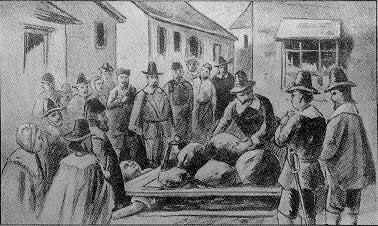
On 18 April Giles Cory was accused of witchcraft by John Putnam, Jr. and Ezekiel Cheever. On 19 April 1692 he was examined in Salem Village and on 19 September he was pressed to death under an old torture known as peine forte et dure, an ancient English procedure designed to force recalcitrant prisoners either to enter a plea (so their trials might proceed) or to die. Brown describes him as “Eighty-year-old Giles Corey, husband of the imprisoned Martha, was a powerful brute of a man and feared by many in the Village. Seventeen years before he had brutally murdered a servant (Jacob Goodale) on his farm and ever since had tangled repeatedly with the law.” Hansen tells us “Giles Corey had been ready very ready to testify against his wife, Martha, and to speak out against her out of court as well as in; he had told several people that he knew things that ‘do his wife’s business.’ Now he was admirably, if belatedly, protesting her innocence as well as his own. But he did it stupidly; he denied having said things which witnesses had heard him say and thus was several times caught lying. Since lying was a serious matter in Puritan Massachusetts and perjury is a serious matter in any age, Giles Corey must have made a very bad impression.”
Brown describes his death: “He was taken to a Salem field and there staked to the ground. A large wooden plank was placed over him. Upon it were piled stones one at a time. The authorities intended to change his mind with force. Tradition has it that Corey pleaded only for “more weight” so that he might die swiftly. ‘In pressing,’ a contemporary wrote, ‘his Tongue being prest out of his Mouth, the Sheriff (George Corwin) with his Cane forced it in again, when he was dying.’ His was a horrible death. Corey endured this punishment for two days before expiring.”
Well, it is that time of year again which means I can finally post this ghoulish story which has been sitting on the back burner for a few months.
So, the Salem Witch Trials. I never really thought that I would be posting anything related to this particular bit of American history, even though I have ancestors who I know were involved in a few witch trials, none had previously been a part of this particular one.
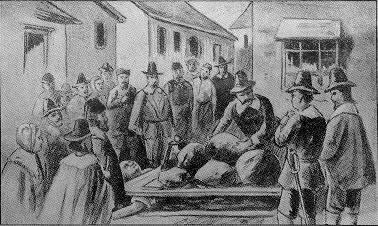
Giles Corey being pressed to death by the citizens of Salem. The image, of course, is in error, as he was stripped naked when the townsfolk decided on the day’s ‘pressing’ entertainment.
And, I have Esther Newell to thank for this excellent addition to the family archives. Esther’s mother was Abigail Smith, who’s line on her mother’s side goes back a few more generations to Mary Cheever, a daughter of Ezekiel Cheever.
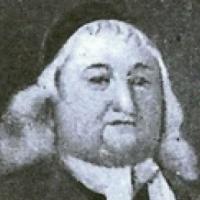
This is not a picture of Ezekiel junior, it is his father, senior.
Ezekiel is famously known as a Boston school master who wrote a latin textbook titled Accidence: A Short Introduction to the Latin Tongue. This publication was used for many generations in the schools of New England. (I am including his biography in this .pdf file, it makes for a pretty interesting, short, read.) Cotton Mather, in his eulogy about Ezekiel, remembered his great piety and “his untiring abjuration of the Devil.” Judge Sewall had this to say, “The welfare of the commonwealth was always upon the conscience of Ezekiel Cheever,”…”and he abominated periwigs.” Apparently he despised the wigs so much he was known to pluck the despised object off an offender’s head and fling it out the window. (Which if you ask me is pretty rude. I hate hoodies and baseball caps, but you don’t see me running up to folks to rip the ugly fashion wear off and fling the items out windows – although…I would really, really love to do that.)
Ezekiel and his wife Mary Margaret Culverwell came to New England in 1637, eventually settling in Boston where he became head master of the Latin school there. Ezekiel married twice and had a total of 11 children. Our ancestress Mary Cheever was a daughter with his first wife Mary Margaret. With his second wife he had a son Ezekiel, junior. It is this son who we have to thank for our Salem Witch Trial connection.
Junior and his siblings were brought up in a very Puritan household where his father was known for his “untiring abjuration of the Devil.” Eventually junior grew up, married, had children and settled the family in Salem. He earned his living as a respectable tailor. As he grew older he also became an official clerk of the court, due mostly to his knowledge of shorthand, and earned prominence in town, eventually taking the oath of fidelity and the freeman’s oath. The family outgrew their home in town, so in 1684 they purchased and moved to the Lathrop farm in Salem Town.
In 1689 he was promoted to a charter member of the Salem Village Church, eventually becoming a deacon, a position he held for many years.
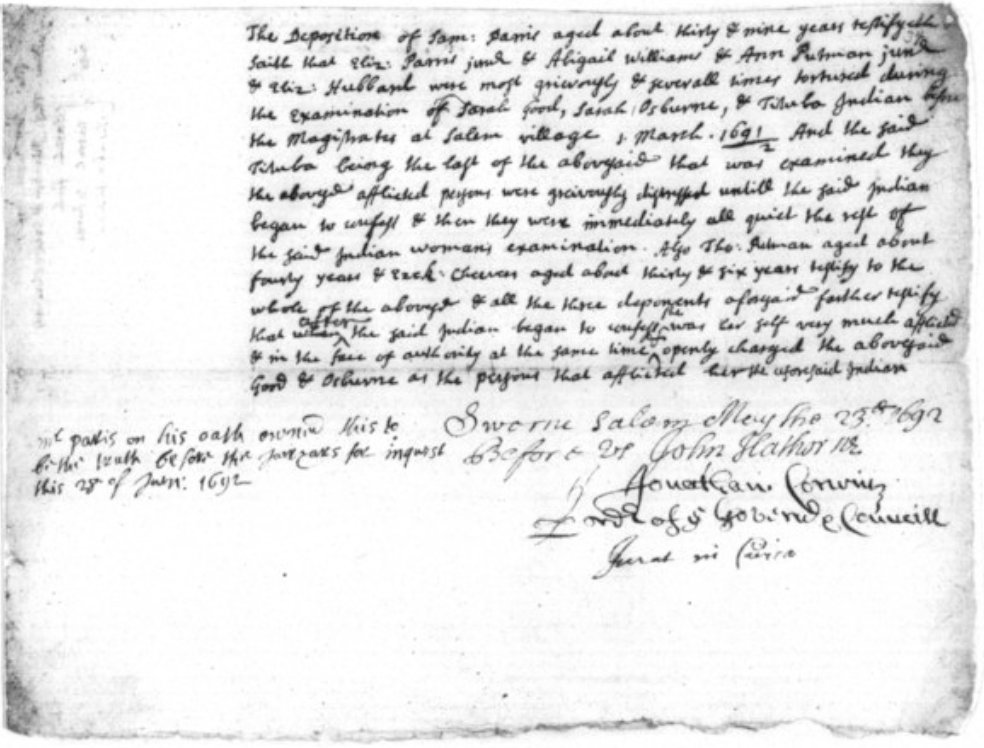
It was during the Salem Witch Trials that he was promoted as an official of the court, where he was called upon to present depositions and complaints. As church deacon he also made calls to the homes of the accused for questioning. His name is seen as the notetaker for a number of infamous witch trials at the time. In many of his notations he saw fit to incorporate his own views and opinions on the proceedings. In the case of Sarah Good he noted the accused behavior as being “in a very wicked, spiteful manner…with base and abusive words and many lies.”
Poor screen shot of poor online image from court documents of Salem Witch trials, this particular document has Ezekiel’s name about 2/3rds of the way down in the paragraph.
In fact, Junior was also an accuser, filing accusations and complaints against accused – Bridget Bishop, Giles Corey*, Abigail Hobbs, and Mary Warren, after witnessing a number of the, supposedly, afflicted and tormented girls being harassed by their, conveniently invisible, tormentors. He also accused Martha Corey, at her questioning, of afflicting Ann Putnam, Jr. and Mercy Lewis, based upon testimony he had heard from others and his own observations, protesting that Corey was lying before the court. His view of the proceedings was no doubt colored and distorted by his upbringing, and his father’s views on the devil and evil in the world.
It was a dark and evil time in American history, unfortunately merely one of many. Ezekiel remained heavily immersed in Salem Church affairs after the trials. There is no indication in the records, or history, that he suffered guilt or remorse over his part in the murder of innocent victims of this mass hysteria. It is quite possible the rest of his family was cheering him on. I can only hope that his sister Mary, who was living in Farmington, Massachusetts at the time of the trials, with her husband William Lewis and their children, was appalled at her brother’s involvement.
There were public calls for justice, by others, starting to occur by at least 1695 when Thomas Maule, a noted Quaker, publicly criticized the way the court proceedings were handled. There was also a group of jurors from the trial who asked a local Reverend to read aloud a public apology and their pleas for forgiveness. One minister admitted, “Such was the darkness of that day, the tortures and lamentations of the afflicted, and the power of former presidents, that we walked in the clouds, and could not see our way.” Even the Salem Village church began to seek repentance at they voted to reverse the excommunication of Martha Corey, Giles’ wife. Other church goers publicly asked for forgiveness from their fellow parishioners for their part, claiming that they had been deluded by Satan into denouncing innocent people.
Over time all of the accused were eventually pardoned by the State and the church. (Gee, that was mighty nice of them.)
Ezekiel Cheever, junior died in December of 1731.
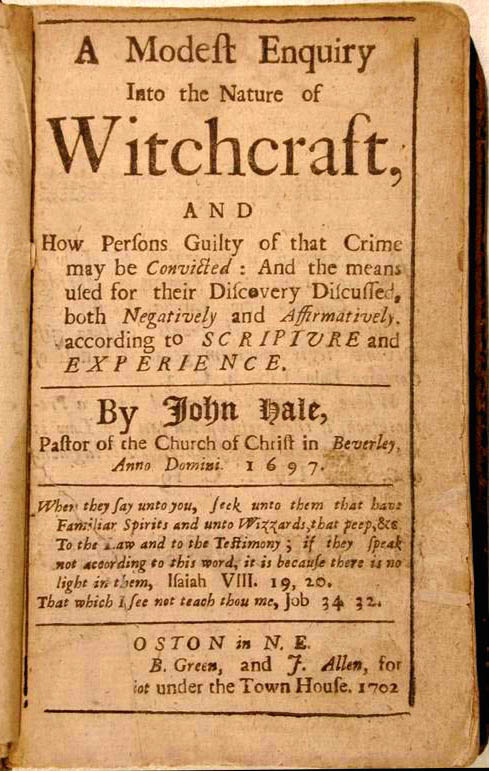
Imagined scene of the questioning of the accused.
——-
*Giles Corey – This poor man was the only lucky person to be pressed to death in this country. He might also be a relative of mine, not direct, but a cousin of some kind, as we also have Coreys in our ancestry. I haven’t found the connection yet though.
Sources:
1. http://salem.lib.virginia.edu/home.html – trial documents and other interesting items found at this site. 2. New York Times article, By BLAKE BAILEY: Published: March 13, 2009
On my several trips to the Family History Library in Salt Lake City in the last few years, the collections that I seem to spend a lot of time going through are the land records. Most deeds are pretty run of the mill, but sometimes you find a few gems.
I have posted a few examples of great land records from various surname searches in previous posts, and today I thought I would share another one.
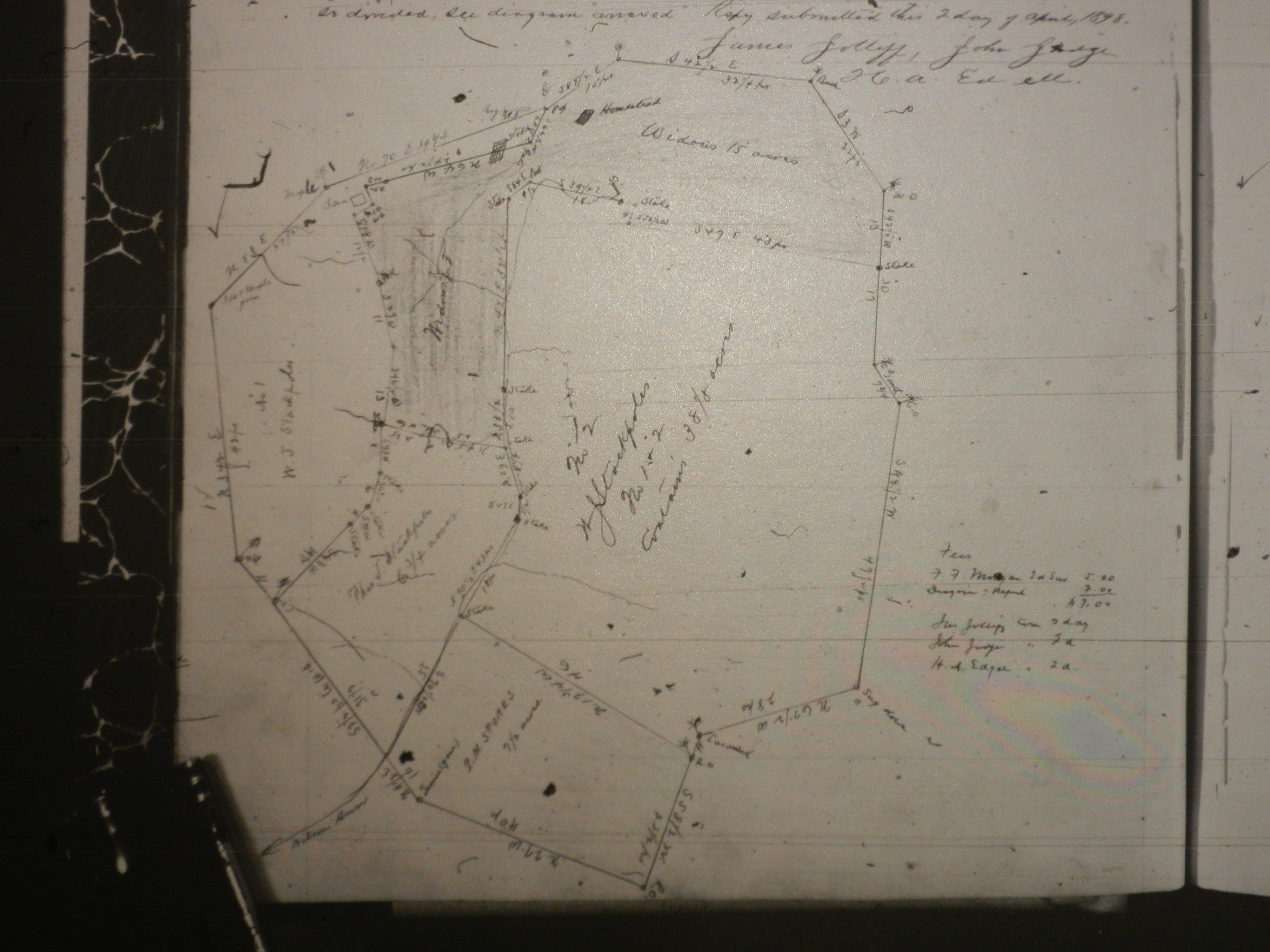
This particular deed regards Thomas Stockpole’s estate. When Thomas died in 1886 in Wetzel County, West Virginia he left a wife and at least 13 adult children to divide his property. Because of the nature of metes and bounds, boundary lines are usually all crazy-wonky, this very wonkiness made it necessary, in this case, for the land agents to redraw the property so everyone could have a better idea of the layout, and to better define Lydia’s dower property (property given by law by a deceased husband to his widow, for her lifetime).
What makes this deed particularly interesting for me, is that this is the only one I have found where the property is drawn out. I still don’t know its exact location on a map, but at least I have a better idea of what the property looked like. What is also cool is that the stables and homestead are marked on the deed.
Boundaries drawn out on deed to determine Lydia’s dower property location.






 jen's ancestors