One thing leads to another…

Recently I have been doing a lot of directory research and creating databases in an attempt to unravel the mystery of the Johnson family, as it related to Almyra Johnson who married John Brooks. I have to say intriguing and tantalizing bits of data have come to light, but still nothing but a lot of strings that aren’t connected. Yet.

Yesterday, in the midst of my research, I realized that I hadn’t attempted to find the name of the shop that the Brooks owned in Burlington. So I spent a little time trying to suss it out, but it appears that they merely manufactured cigars at the address and employed several people to help with the business. Including a William and Samuel Johnson at one time. I would venture to guess that these two gentlemen might be brothers of Almira Johnson Brooks. Samuel I have mentioned before.

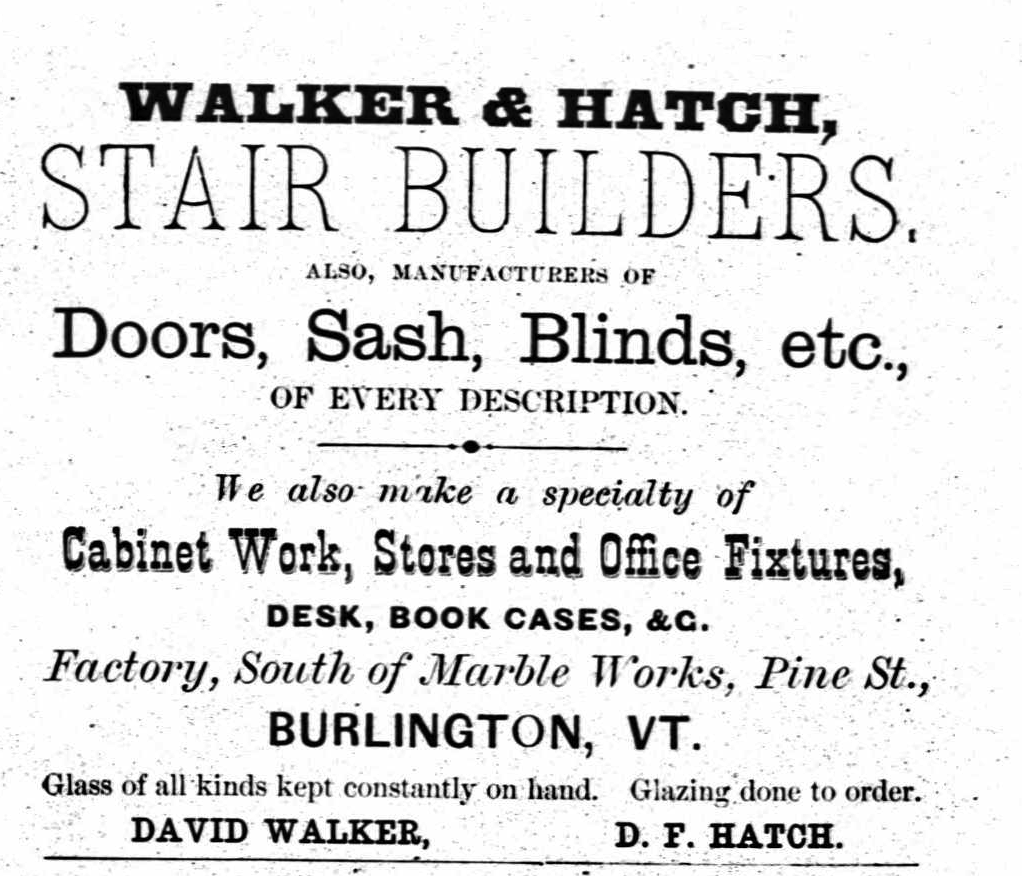
Another bit of data I uncovered was about their daughter Almyra Brooks who married Dillon Franklin Hatch in 1873. D. F. partnered up with his brother-in-law, David Walker, and they ran a furniture factory, the nature of which changed over time. Walker and Hatch was the name for the most part eventually adding another name when they partnered up with another man.

For a while D. F. and Almyra Hatch lived right next door to her parents, at 85 King Street. If you look at the address now, on Google maps, it is the King Street Center.

Above is the Hatch entry in the 1881 Burlington directory. They lived at this address for a few years before moving to 181 St. Paul [st.]. By 1900 the Hatch family had moved to Ohio.

Here is an ad for the furniture business from 1879:

Update to this entry: I was going over Almira’s probate record to day and saw that there were several Walker grandchildren receiving part of the estate, they were all children of Anna who married a Walker and died before 1901 when the estate was being divvied out.

A little corner shop

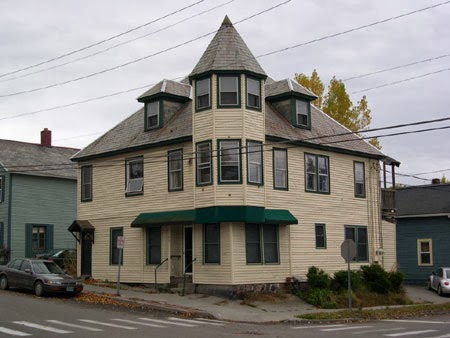
Brooks’ former store, King Street is the one going off to the left in the picture, Pine Street is the one going off to the right.

Sometime around 1855 Almira and John Brooks headed on over to Burlington, Vermont to live. At this time I am not sure exactly when the Brooks started their store in Burlington, but I do know that by 1868 they were living and working at this address which was called ‘corner of King and Pine’ it didn’t have an exact address until sometime between 1872-1882. In this picture it is currently clad in hideous vinyl. It would be nice to see it in its original dress. According to records in 1890 Almira is the owner of the building, and John is still alive. He didn’t pass until 1898. So now the question is why is she the owner of the building and not both of them. Hmmm. Inheritance? She also owed the building next door at 176/178 Pine Street. Which I believe they lived in or used as a home at one time  or another.

The Historic Burlington: University of Vermont website describes the house as:

“This 2 1/2 story, wood frame building, which is clad in vinyl siding and has a pyramidal, slate-clad roof and a 2-story octagonal oriel on its northwest corner, was probably built between 1877 and 1886, although it may be of an earlier date.”

The family actually lived at 79/81 King Street for a year or two, according to city directories. Which is part of the building, see the door off towards the left with the small awning. According to the Historic Burlington: University of Vermont website a birdseye view of Burlington in 1877, apparently, clearly shows no buildings at that location, and the ‘massing’ of the 79/81 King Street building make it doubtful that is was built in the 1860s. I am not sure what we can say about that other than land records would likely clear the matter up along with tax rolls. The address would be considered 174 Pine Street if one numbered it from that side of the streets.

The building was used as a commercial business for a large portion of its life, the lower part being used as a shop of some kind or other, the top being used as apartment rentals. It wasn’t until sometime after the 1970s that the bottom was boarded up.

You can still see the building using google street view. Not very pretty, but it is one of the few remaining older buildings in the town.

I even have an update.

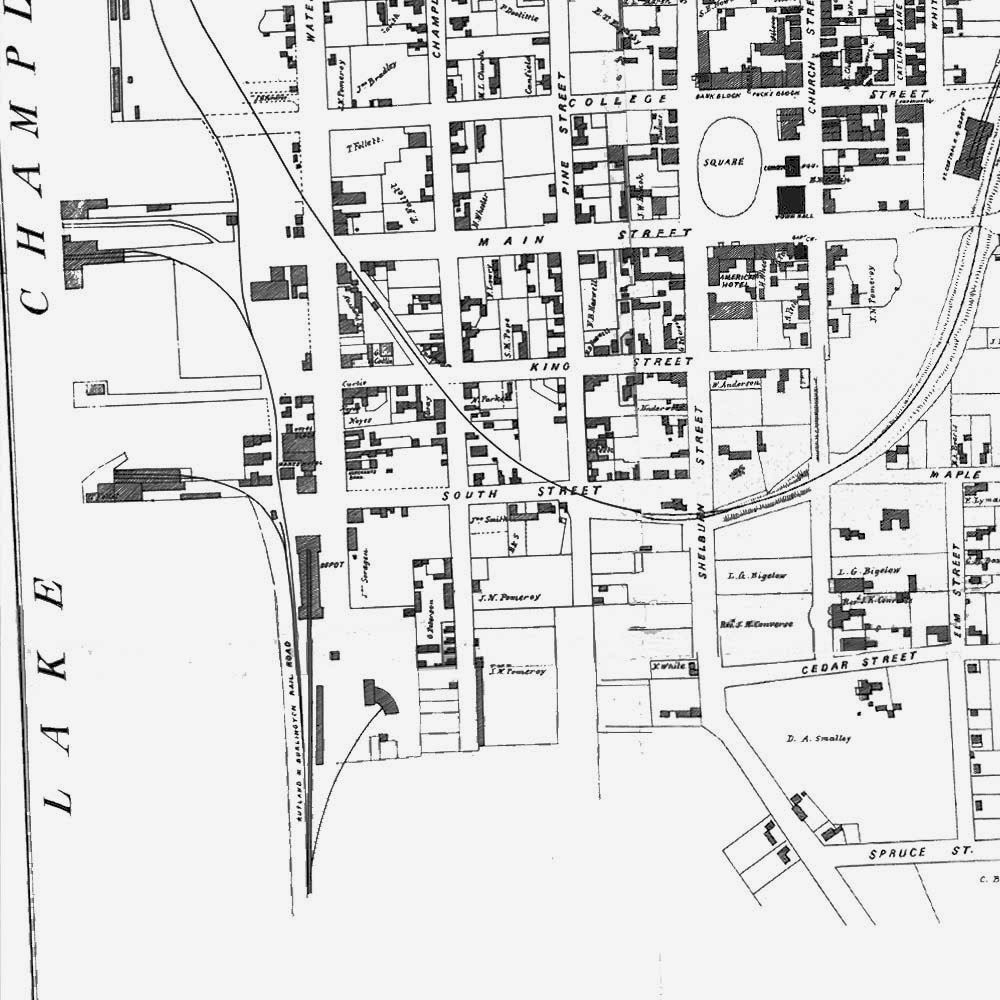
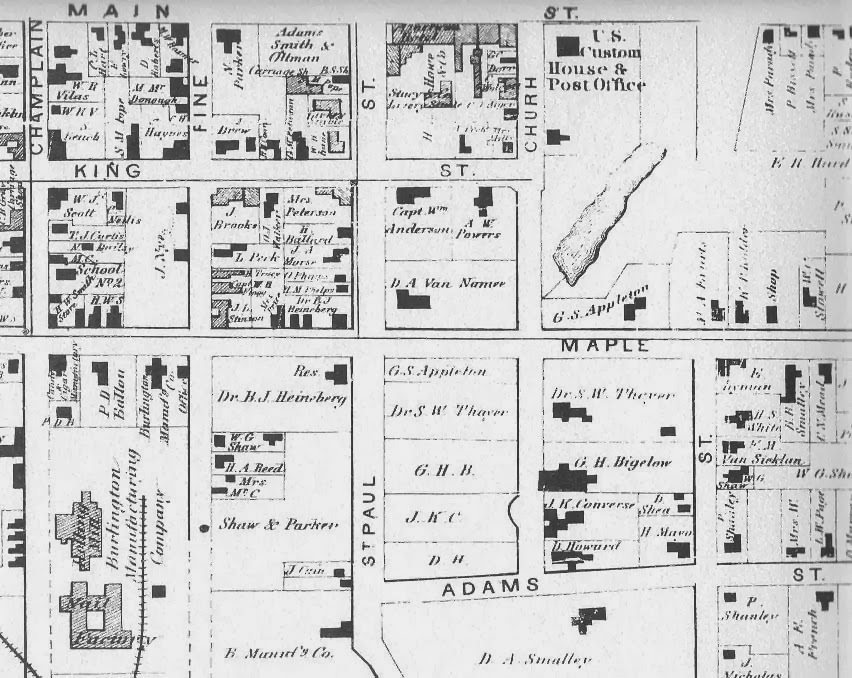
In looking over the website mentioned above, I found two plat maps that have the home listed on them. Which is curious because according to the University’s research the building isn’t there in the 1877 birdseye view map. That may be so, but it shows up on these two:

This plat is from 1853. The family is probably not living here at the time, but as you can see the building is there on the corner of King and Pine.

This map is from 1869. The family is definitely there now, as can be plainly seen by the J. Brooks entry on the map.

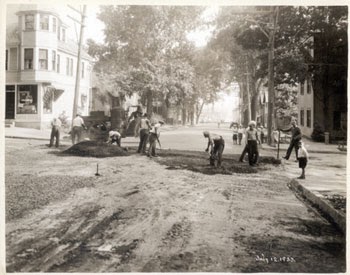
The building as it looked in 1933 just barely in the picture on the left edge of image.

Ahh Politics…

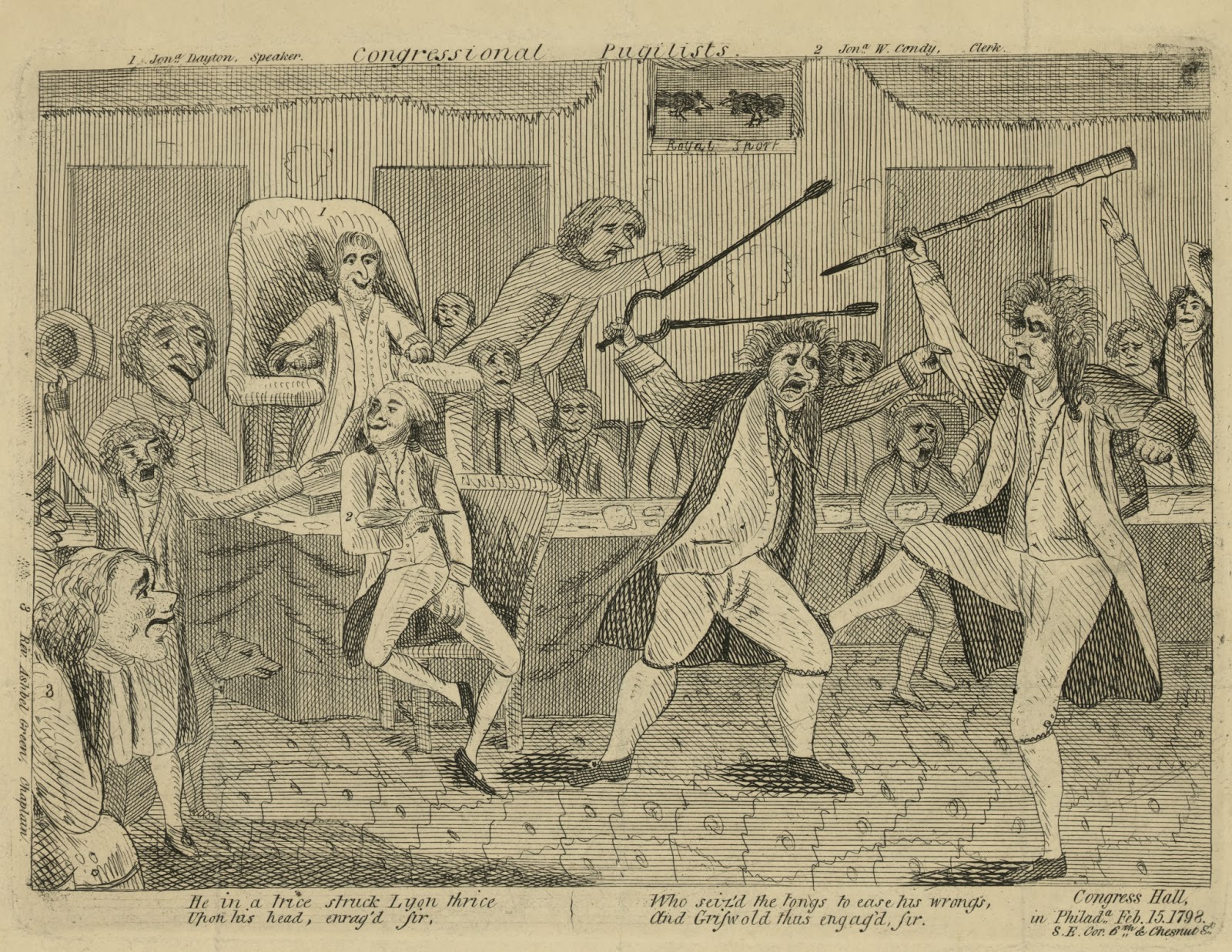
Who said fun couldn’t be had in Congress. Proof that the business of politics really is a circus.

Political Cartoon, 1798 

The above cartoon was created from an incident that occurred in Congress in February of 1798 Here is Mr. William Shepard’s testimony of the event:

Source: Breach of privileges. Communicated to the House of Representatives, February 20, 1798.Date: 1798-02-20; Publication: American State Papers 037, Miscellaneous Vol. 1; Report: Publication No. 104; page 176. Click on images if you need them bigger.

If you wish to read more about this incident, all you have to do is search for “griswold lyon” and you will find all you would need or want to know about it.

Who doesn’t like a famous tavern

While we can revel in the actions of William Shepard during the Revolutionary War, he is not the only ancestor of ours who played a major part in our freedom from British rule. There are quite a few of these ancestors on our Shaw side of the family. Today I am going to talk about Captain Stephen Fay my 7x great grandfather.

The Fay family was originally from Hardwick, Massachusetts. In 1766 they removed to Bennington, Vermont where Stephen, and his wife Ruth (Child), purchased a hostelry/tavern, Green Mountain House, in a town that was currently at the heart of political action in Vermont.

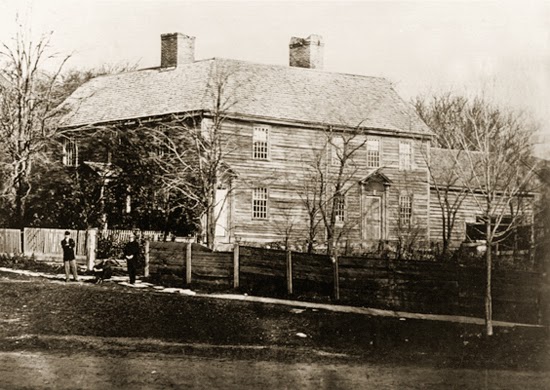
Green Mountain House, more famously known as the Catamount Tavern. (Image found on Wikipedia.)

The tavern also became known as the ‘Catamount Tavern’ because of the stuffed ‘catamount’ (a type of wild cat), that was mounted on the signpost. The teeth of which were bared in the direction of the state of New York. This teeth baring symbol expressed his sentiments regarding New York’s attempts to take over land in Vermont. One of their neighbors was Ethan Allen. Ethan and his Green Mountain Boys used the tavern as the meeting place to plan their opposition to the ‘Yorkers’ who were coming to the area and setting up homesteads. Stephen Fay and his son Jonas were appointed the official agents of the New Hampshire claimants who opposed New York’s highhanded actions. They headed to New York to meet with the Governor and try to settle matters.

The ‘Council of Safety’ which was responsible for the citizens well being during the Revolutionary War met many a night here. This was where they planned and carried out the successful battle of Bennington on the 16th of August 1777. A victory which resulted in British General Burgoyne’s surrender at Saratoga.

Stephen and Ruth had 10 children some went on to become famous others not so much. It must have been quite a time to see.

Stephen passed way in 1781, Ruth died in 1833.

Regimental Riflemen

John Brooks, Sr. was about 34 years old when he died of an illness at Black Rock, New York during the war of 1812. His death left behind a wife and five very young children. There are no family stories of why he decided to join in the war effort, at least none that this writer is aware of. Money, patriotism, dreams of wartime glory. We can only speculate.

While his death is not the stuff of wartime dreams, at least his service in the war was something he could be proud of.

The 4th Riflemen Regiment, which was John’s, was formed in March of 1814 possibly at Geneva or Utica, New York.
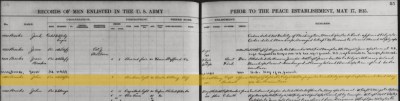
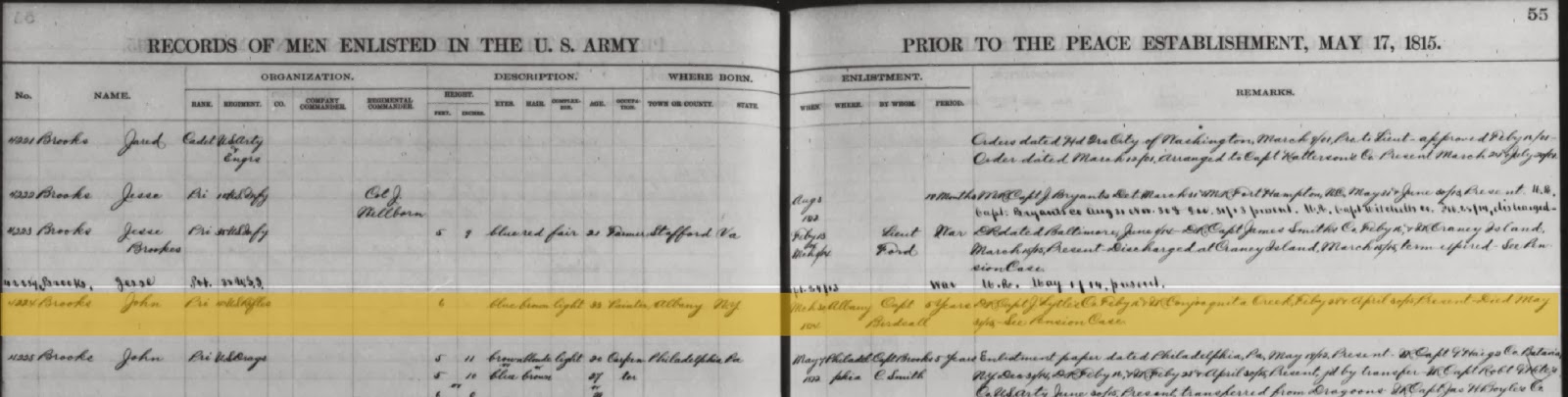
John Brooks, Sr.’s enlistment entry. There is a description of him along with where he was from, and his assignment. I will assume that he was assigned to the riflemen because he was good with a gun. But that is only speculation.

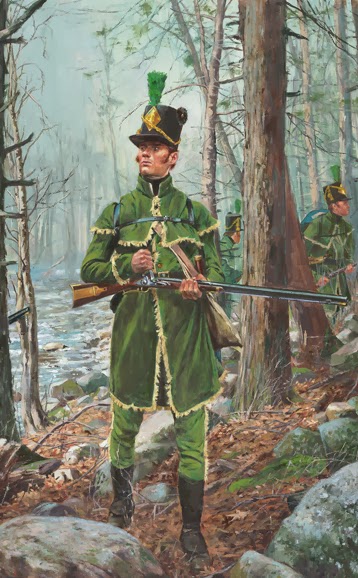
The formation of the riflemen was the military’s first conscious effort to create an elite corps of men. These particular regiments even had different uniforms than the regular army. The regular army wore blue and carried muskets, the riflemen wore green jackets with black collars and cuffs and they carried the new Harpers Ferry Model 1803 rifle. It was a short weapon that could shoot with deadly accuracy to 250 yards. The riflemen were the precursor to the special forces or Green Beret’s found in today’s military.

Within three months of John’s enlistment, sometime about June, the troops started their march to Buffalo, all 133 men. They marched through dense forests with thick underbrush, swollen rivers, deep mud, searing heat and other harsh weather conditions, but they did finally make it.
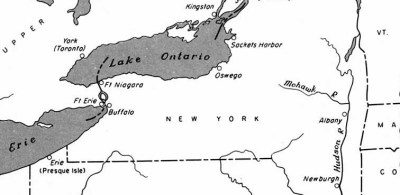
This map shows a larger view of the state of New York and the lake area.
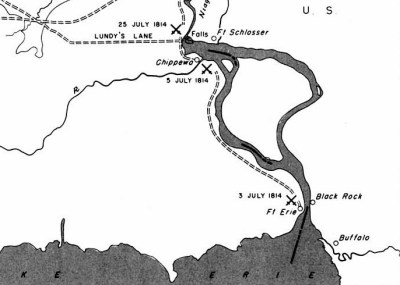
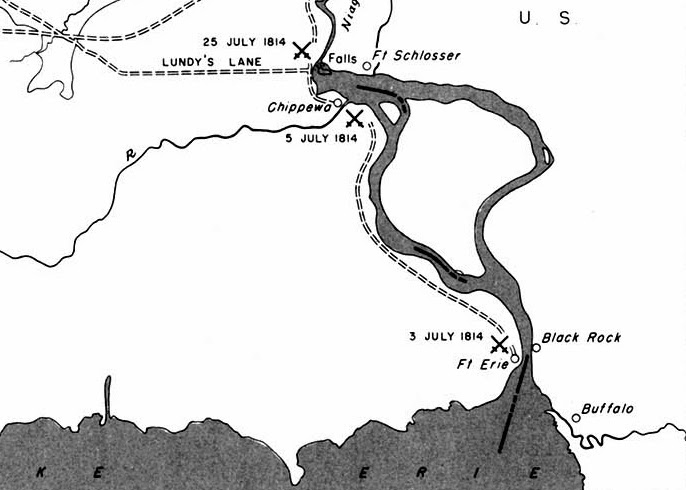
Close up of top of Lake Erie. You can see Ft. Erie, Buffalo and Black Rock in more detail. These are the areas where John spent a bit of time during the war.

The first engagement of the 4th was at Conjocta Creek, a battle that was apparently never fully appreciated by American’s historically. As described by Maj. Kearsley, a force of about 1300 British men had landed on the American shore below Conjocta at about 1:00 in the afternoon. Having been appraised of the British landing on Squaw Island before heading to the American shore, Maj. Morgan had silently marched the riflemen through the woods to a bridge that crossed the Conjocta. The bridge was quickly made unusable and a breastwork was created with logs. The riflemen then continued on to Black Rock, still hiding from the enemy. Once they arrived at Black Rock, the men then made for Buffalo making as much noise as possible using musical instruments and loud voices, all to attract the attention of the British troops. The intent of course to convince the British that Buffalo was their final destination. Once they arrived in Buffalo, they had a quick meal then secretly headed back to the breastworks at the bridge on the Conjocta. There they hunkered down and awaited the British.

The British arrived at the bridge about 12-1 in the morning. Seeing its demise, men were sent forth of replace the planks that had been removed by the riflemen. Because the night was clear with no moon, the riflemen were in an excellent position to see and not be seen. Once the British arrived at the bridge to repair it, the signal was given by Maj. Morgan. With the blow of his whistle, every rifle was discharged with precision and the head of the British advance was ‘literally decapitated’ with not a British soldier in view left standing.

The British fell back and returned fire, but the riflemen did not reciprocate, this happened twice more. Each time the riflemen did not return fire. The reason being that because of the small force of riflemen, it was possible that the British would discover their location. And because the British had already fallen back twice, they were now out of targeting range. The final consequences of the skirmish was a retreat of the British back to Squaw Island, not knowing the enemy’s strength and being at a disadvantage at the bridge they felt is more prudent to end the conflict. This decision was of major import to the American soldiers at Fort Erie, because the supplies and provisions they needed came from Buffalo and it was the British intent to cut off this supply line. So the defeat of the British at Conjocta saved the entire American Army and prevented the fall of Niagara.

The 4th remained in the area and engaged in transporting the supplies needed for the soldiers at Fort Erie to a place of greater safety near the lake shore and above the mouth of Big Buffalo Creek. It was believed that the British would renew attempts to destroy the supply line so they were making sure the provisions were safe. They spent three days transporting the supplies across the river in a flat boat or scow and during the night they slept in the marsh without tents and in the grass, or worked on removing the bridge completely.

About the first of August they headed to Fort Erie to join back up with the 1st Riflemen. Shortly after their arrival the commanding officer, General Gaines, issued an order for an attack upon one of the pickets and batteries of the enemy, which had been annoying the American pickets. And so commenced a series of warmly contested skirmishes, which continued almost daily. Thus were the riflemen engaged for many days. The result being many good men were dying everyday for no good cause. It enabled General Gaines to appear to be gallantly defending the Fort that was being constantly besieged by the enemy.

The riflemen were ordered to “feel the enemy” by shooting, at their own discretion, into the British lines that were hiding in the woods around the fort. No reinforcements were sent to support the riflemen and they could not advance further forward. With the larger force on the British side, they were fighting against impossible odds.

The whole American force in Fort Erie was 1500 men, the British were 3 times that. The men were in constant expectation of a British attack and it was on the night of August 15th that their expectations were finally met.
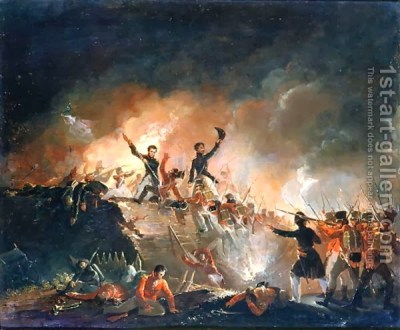
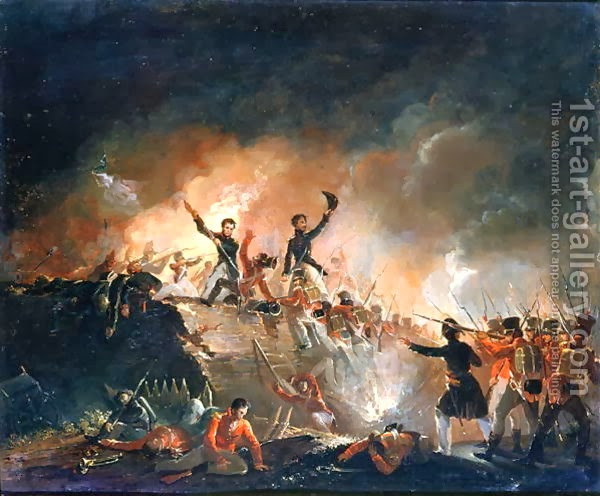
Repulsion of the British at Fort Erie, August 1814.

The riflemen were stationed behind the breastwork near what was called ‘Towson’s’ battery. Because of the constant firing of their guns upon the British who were trying to get through line, the riflemen created a lighting affect that became known as ‘Towson’s Lighthouse’. Any British who attempted to land and penetrate the line were met and killed or taken prisoner by the riflemen. After the fighting had been going on for about 20-30 minutes the British sounded the retreat of one of their lines and the riflemen were ordered to move in support of the infantry there. Their new position was attacked multiple times by the British. It was a barrage of retreating, reforming lines and attacking.

The battle ended when the British Col. Drummond gained hold of an American gun position and in attempting to turn it around to fire on American troops, accidentally set the munitions ablaze with a slow match that had been laying in the wrong place at the wrong time. Immediately upon the explosion the riflemen entered the fort through the gates which were opened. They removed the unwanted British soldiers. The battle was now pretty much over.

The nature and frequency of the conflicts in which the riflemen are engaged in the last 2-3 months left only 38 men still alive in the 4th riflemen the next morning. John Brooks was one of those men. We do not know if he was injured in the fighting.

Later that day the riflemen were ordered by Gen. Gaines to again ‘feel out the enemy’ and with the infantry at their backs proceeded into the forest to head to the British line. However, once the infantry entered the dense woods, they became lost and confused and were ordered back to the Fort. The riflemen received no such order and proceeded ahead. They came upon the British and commenced firing while waiting for their infantry backup to arrive. Shortly, they began hearing guns back at the Fort. Maj. Kearsley was afraid the British had found out about the attack and had headed to the Fort expecting to take it over. So he ordered a retreat, and upon arrival back at the Fort the riflemen learned that the American infantry was merely discharging their guns by firing their shot. A lesson in the bouts of incompetence that showed up quite a bit during this war.

The riflemen were considered one of the few American military formations capable of beating the British units on the field. The 4th proved it in several decisive battles.


Ah…the tropics!

Right about now I am almost be temped to kill to get to a warm clime. The weather lately has been crazy cold. Winter has definitely not been shy about letting itself be felt this season.

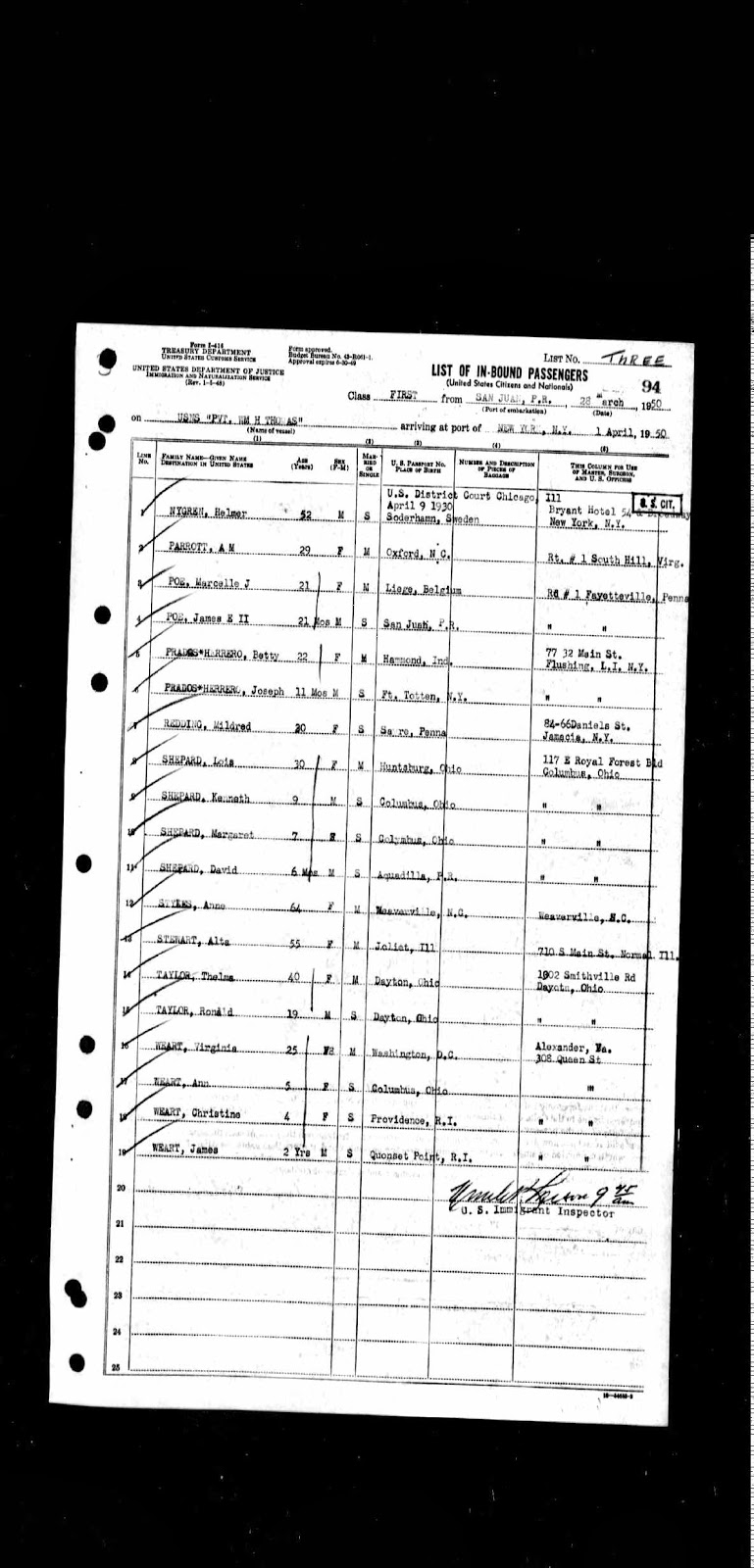
So to bring warm thoughts I am posting this fun document for my mother. It is a passenger list of her and her siblings along with her mother arriving in New York from Puerto Rico in 1950.

Margaret Shepard is my mother in this passenger list, her mother is Lois. You can see that David, the youngest, was born in Puerto Rico. The image is from Ancestry.com [Year: 1950; Arrival: New York, New York; Microfilm Serial: T715; Microfilm Roll: 7812; Line: 10; Page Number: 94].

Is there a Doctor in the house…

In the past month or so, I posted a few pictures I found on Ancestry’s site that were uploaded by users. They were of Franklin Robinson and his wife Susan Landon, both of Grand Isle, Vermont. Well I have never done any research on Franklin, and I don’t have any excuse or reason for that, it just never happened.

So over the holidays, and my lovely two weeks off, I decided to focus on researching Franklin’s side of the family. In my records the information I had on Franklin was from over 10 years ago and mostly gleaned from our cousin who put together the Shaw family book. Not much was said about Franklin, just his parents being listed as Abijah Hall and Beulah H. Billings.
My first thought was why on earth is his father listed as HALL when he is a ROBINSON. I have to admit that is was probably just an error in data entry on someone’s part and as I was just entering the data mindlessly, I didn’t really analyze it at the time.
I do know that Beulah married Abijah in 1796 when Franklin was about 4-5 years of age and he wasn’t adopted by Abijah because he went by ROBINSON his whole life. Local histories indicate he was a descendant of the Robinson’s of Bennington County, Vermont, but there are, as of yet, no records that tell just which ROBINSON that was. So, for now, his father is still a mystery.
His mother on the other hand was the daughter of a BILLINGS and a FAY, and there was much information on her and her family to be found online and in books. And it is through the FAY line that we run into Richard PALGRAVE (apparently an official descendant of Charlemagne, but that’s not important now).
Richard was born about 1593. He arrived in Charletown by 1629, which we know because his signature on a document signed by all the inhabitants of the town at that time is quite clear, it shows up third in the list:

Signature of Richard Palgrave

He is the first doctor I have come across in my research on our ancestors and will probably be the only one. The author George A. Moriarty wrote that “[h]e was a quiet man who minded his own business, got into no trouble, and buried himself in his profession.” According to his inventory of property after his death in 1651 he was worth £313, which made him well to do. The quality of his signature also indicates a good education.

His daughter Mary married Roger WELLINGTON. Their granddaughter married into the FAY family.
Richard’s other claim to fame is also being the ancestor of the Bushes. Our second link as cousins – shudder.

And the answer is…

Last month FamilyTreeDNA had a huge sale on their testing kits. Not being rich, it took me a short while to decide on which upgrade I was going to invest. I decided on the familyfinder test for my husband. This is the test that shows ones ethnic breakdown.

Well, the results came in today. It appears he is 100% European – Orcadian. Orkney is part of Scotland. Imagine my surprise, after all he is half German and half Polish, what the heck?

Ahh, but Scotland was invaded by Vikings and apparently tests of the genetic make-up of the males currently living in Orkney indicates a strong Scandinavian influence.

So while his genetic make-up is Orcadian, the reason is most likely because of Vikings.

I am including a link to an interesting website that talks about Orkney’s genetic heritage. http://www.orkneyjar.com/history/vikingorkney/genetics.htm

Say Cheese…

Ancestry.com lets folks who are members upload their family pictures. Which is wonderful for those distant cousins who don’t have those images in their family’s collections. Strangely, many, not all, of those same people have a bizarre notion of ownership of these same images – well the ones that are very old anyway.

I am not one of those people. I have uploaded every image of our ancestors that our family has in our possession to flickr for anyone to view and download for themselves, all high quality and large. These images are not for hoarding in our closet. After all genealogy is about sharing.

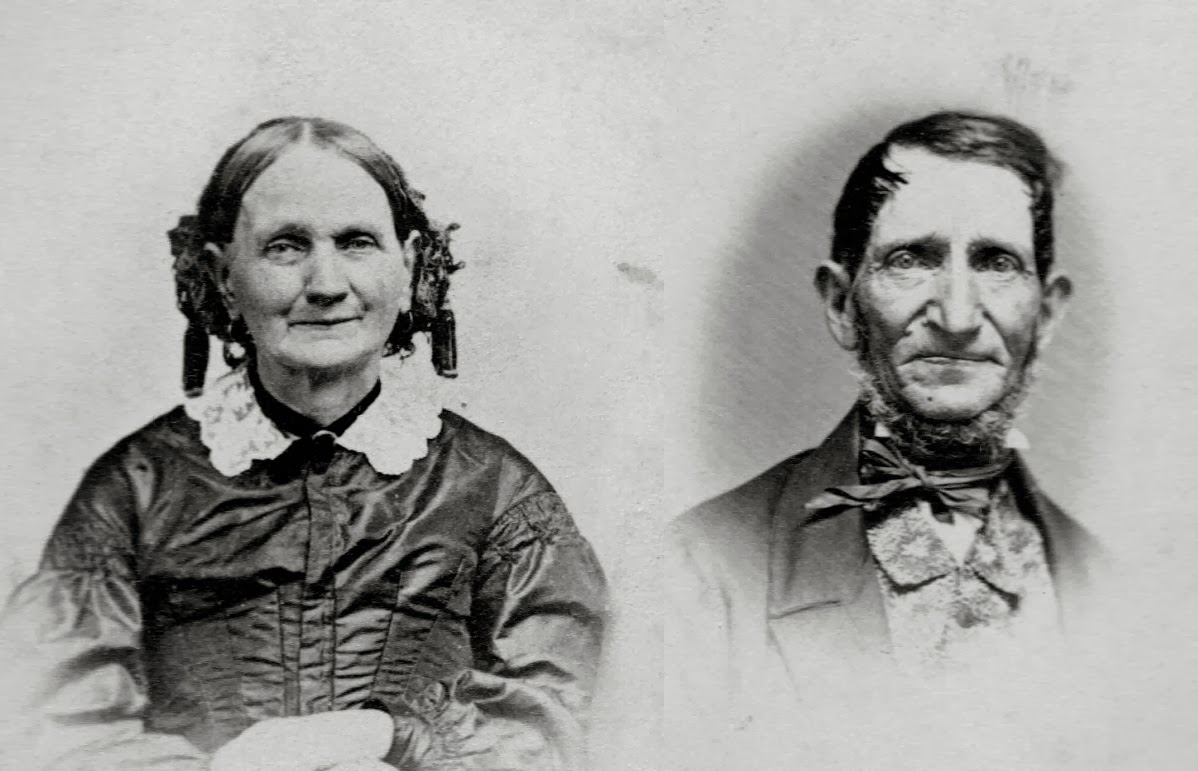
The two images you see below I found at Ancestry. They are said to be of our ancestors Franklin Robinson and Susan Landon Robinson, their daughter Olive Robinson married Oscar Ebenezer Hatch.

Susan Landon married Franklin Robinson September 16, 1817  in South Hero, Grand Isle County, Vermont. This image was probably taken not long before her death in 1862. Franklin died in 1885.

Pay attention…

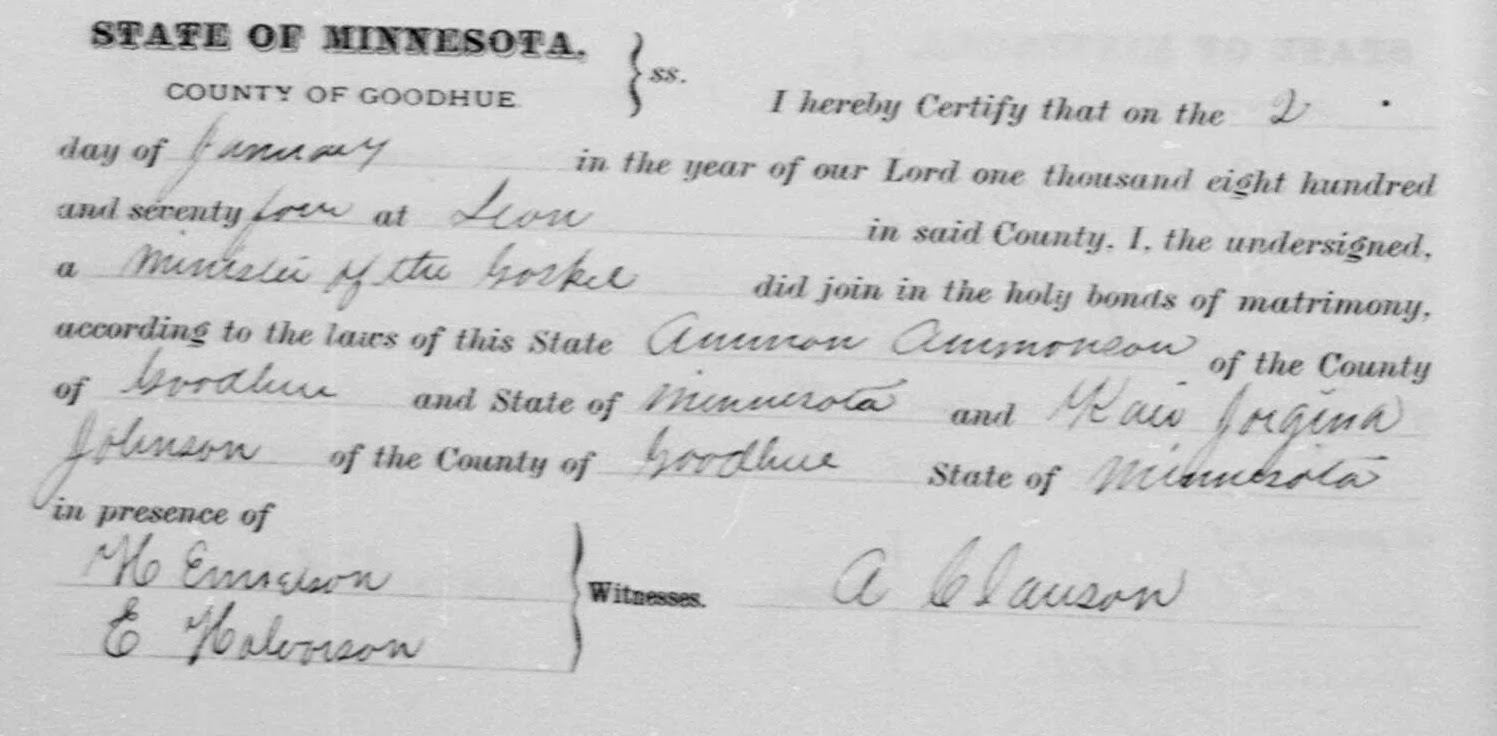
It’s not that I am unsure of the connection of Kari Jorgina Johnson to John Stianson and Kari Gunlichsdatter, the evidence and coincidences are too many to be in doubt, but in researching Jorgina and her family, I have yet to find a definitive document that specifically connects Jorgina Johnson Amundson to who I believe to be her parents. The marriage record and her death record both give a good record of a connection, but her father’s surname is hard to read and her mother’s name is wrong on her death record, and neither of her parents or Amund’s are listed on the marriage certificate, but her last name of Johnson helps push the connection to the yes category, as does the fact that her birth is the same as the Jorgina born in Norway to this family. When doing genealogical research the preponderance of the evidence is usually enough to prove a connection. So in order to cover all my bases, I am still looking for more evidence.

I have filled in most of the gaps of Jorgina’s sibling’s families using the Holden Church and online Norwegian records, and I was trying to think of another record that might help in that regard. That’s when I smacked myself on the head when I realized that the marriage certificate has witnesses listed.

And there was the fourth connection that says yes to Jorgina being the daughter of John Stianson and Kari Gunlichsdatter – H. Einertson and E. Halvorson are the witnesses to her marriage. H. Einertson is her sister Ingaborg’s husband – Halvor, (E. Halvorson is possibly her cousin, a son of Ingaborg and Halvor, I’m not really sure yet).

I am still trying to find a church record for Jorgina and Amund’s marriage. I might have to wait until I get to Salt Lake City to look at the Lutheran Church records on microfilm there. But maybe an email to a good source before then will answer the question unequivocally.