Bet you didn’t see this coming…

HAPPY FATHER’S DAY DAD (just a little early).

Over the years the research on my JOHN side of the family has brought to light our German, Norwegian, Dutch and Irish heritage and has been quite an interesting trip. And now, thanks to recent in-depth research on my great grandmother Gertrude (Cain) John’s ancestors, we can also add English and Welsh to this side of the tree. In fact, thanks to the English ancestry on this side of the tree, we can add another gateway ancestor, AKA a Royal Line (I am still waiting on my tiara). Which also means that I have found a common ancestor for my parents: Henry I.

“What!? How than this be?” You ask. Well I’ll tell you.

Gertrude’s parents were John Cain, our Irish line, and Carrie Rosa. Carrie’s father Abram adds Dutch on the Rosa (originally Roosa) side, however, his mother Clarrisa Cross is where the English pops in. It is believed very likely,  (but not 100% proven, although the evidence is pretty compelling), that Clarissa’s parents were Joseph Cross and Zerviah Warner, both of whom’s ancestors can be traced back to New England, where they can be found mostly in Massachusetts and Connecticut.

Today’s focus, however, is on one of Zerviah Warner’s great great great grandfathers, Rev. William Skepper/Skipper, (the name is seen both ways).

William was baptized in Boston, Lincolnshire, England on the 27th of November in 1597 the son of Edward and Mary (Robinson) Skepper. When he was about 14 years old he attended Sidney College in Cambridge, graduating after 2 years, having acquired a seminary style education. Due to, most likely, family connections he became a Rector of Thorpe by Wainfleete. Ten years later he is found as a curate and/or vicar of the same.

William was married twice, the name of his first wife is not known and they had several children together. His second wife, my ancestress, was Sarah Fisher. They had only one child, a daughter Sarah, who was born about 1640, it is assumed in Lynn, Essex County, Massachusetts.

1639 is believed to be the time period that the Skepper family moved to New England with other folks from Boston. A large contingent from the area at that time was making the exodus from England. William didn’t live long in the new world though as he died before 1650, which we know because a son-in-law was in court in 1650 petitioning that the estate be divided.

William’s grandmother Joan Legard was the 7xg grandchild of King Edward III and Queen Philippa Hainault (see images above). Not only did she have English royal blood, she also had French and Scottish royal blood in the mix. My favorite great grandmother is Eleanor of Aquitaine, who is such an awesome chick, and who I was very disappointed wasn’t one of my grandmothers in Mom’s royal line. (Descent on Mom’s side is through an illegitimate son of Henry I, whereas on Dad’s side it is through a legitimate daughter of Henry I, who marries and proceeds to birth the future Henry II.)

It is easy to think dismisively that this is ridiculous, every genealogist wants to be descended from royalty. (Insert eye-roll here). But actually it is pretty easy to believe, these folks had kids, some lots of kids, not every child was going to be king or queen, so the younger kids married, had kids, and so on, in each successive generation the oldest inheriting the most and the youngest getting less and less, and so on down the line. Until, you have the not so landed gentry ending up down here with us common folk. Personally, I have never done my research with the intent of finding famous ancestors. I have always been surprised if I did and mostly just thought, Cool! And, as a reminder, there are hundreds of thousand of descendants that can claim the same royal ancestry as me.

Still. Cool!

Here we go again:
Pipin the Short=Bertrada of Laon
Emp.Charlemagne=Hildegarde
Emp. Louis I=Judith of Bavaria
Emp. Charles II=Ermentrude of Orleans
Judith=Baldwin I, C. of Flanders
Baldwin II, C. of Flanders=Elfrida of Wessex
Arnulf I, C. of Flanders=Adela of Vermandois
Baldwin III, C. of Flanders=Matilda of Saxony
Arnulf II, C. of Flanders=Rozela of Italy
Baldwin IV, C. of Flanders=Ogive of Luxembourg
Baldwin V, C. of Flanders=Adela of France
Matilda of Flanders=King William I of England
King Henry I of England=Matilda of Scotland <–daughter of King Malcolm III Scotland
Matilda=Geoffrey Plantagenet, C. of Anjou
King Henry II of England=Eleanor of Aquitaine <–MY FAV
King John of England=Isabella of Angouleme
King Henry III of England=Eleanor of Provence
King Edward I of England=Eleanor of Castile-Leon
King Edward II of England=Isabella of France
King Edward III of England=Philippa of Hainault <–daughter of King Philip IV France
Lionel of Antwerp, D. of Clarence=Elizabeth de Burgh
Philippa of Clarence=Edmund de Mortimer, 3rd E. of March
Elizabeth Mortimer=Sir Henry ‘Hotspur’ Percy
Elizabeth Percy=John Clifford, 7th Ld. Clifford
Mary Clifford=Sir Philip Wentworth
Elizabeth Wentworth=Sir Martin de la See
Joan de la See=Sir Peter Hildyard
Isabel Hildyard=Ralph Legard, Esq.
Joan Legard [royal line enters our JOHN tree]=Richard Skepper, Lord of Ingoldmels Manor
Edward Skepper, Lord of Ingoldmels Manor=Mary Robinson
Rev. William Skepper/Skipper=Sarah Fisher
Sarah Skipper=Walter Fairfield
Sarah Fairfield=Thomas Abbe
Tabitha Abbe=John Warner
Daniel Warner
=Ann Pember
Zerviah Warner
=Joseph Cross
Clarissa Cross=Garrett Rosa
Abram Rosa=Jennie/Janett Smith
Carrie Rosa=John Cain
Gertrude Cain=Victor John
Clarence John=Myrtle Hamm
Victor John=Margaret Shepard
ME <– 10 greats to the Rev., 21 to Edward III
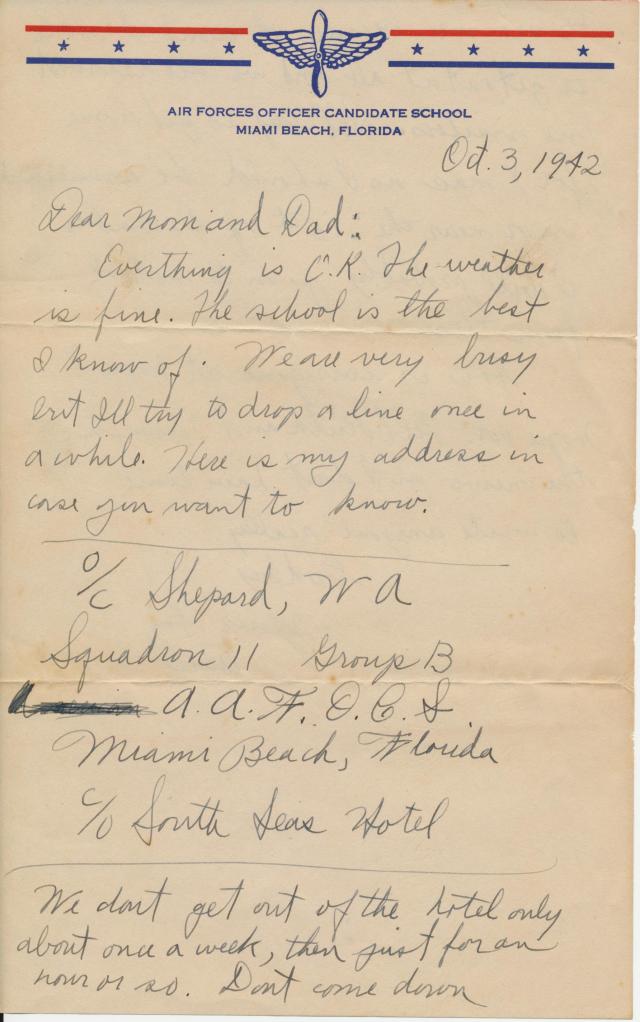


October 3, 1942 William Shepard to home…

4075644117_83989432c8_o

October 3, 1942

Dear Mom and Dad:

Everything is O.K. The weather is fine. The school is the best I know of. We are very busy but Ill try to drop a line once in a while. Here is my address in case you want to know.


O/C Shepard, WA
Squadron 11 Group B
A.A.F.O.C.S.
Miami Beach, Florida
C/O South Seas Hotel

We don’t get out o the hotel only about once a week, then just for an hour or so. Dont come down

4075646995_f796b30b43_o

to see me because I wont be able to get out at all and we are allowed no visitors. Ill try to get home for Xmas as I should be commissioned on or near the 15th of December. I will probably go on to school from there.

How is everyone at home? Hope O.K. Tell Ruth and Herman the news as I dont have time to write anyone really.

Goodby
Your son
Bill

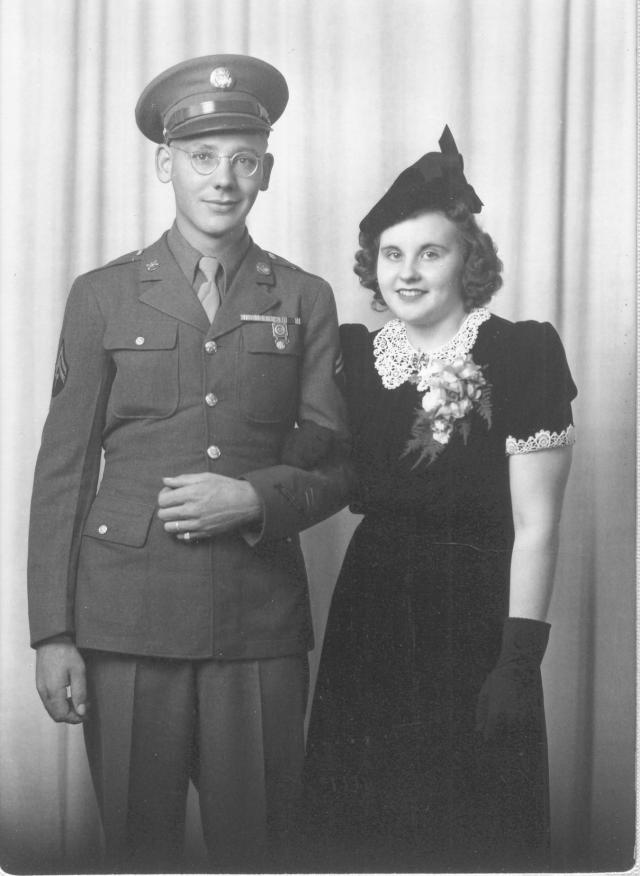
Sgt. Hamm and “The Go Devil’s”…


For Memorial Day, in memory of the three relatives I know who died in war: John Brooks (War of 1812), Wallace Rosa (Civil War POW) and Raymond Hamm (WWII).

I will have to confess that it really annoyed me that I couldn’t find anything regarding Raymond Hamm’s military record during WWII. But when I kept hitting brick walls, I had to shelve that particular research for later. Which means that I moved on to my next question, “Where was Raymond buried?” I didn’t think it likely that his body had been shipped home, so, wouldn’t that mean he was still in North Africa? If so, where were the men who died in the Tunisia campaign buried?

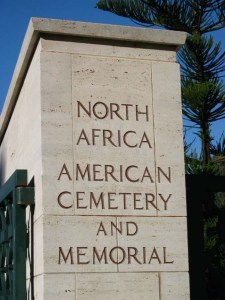
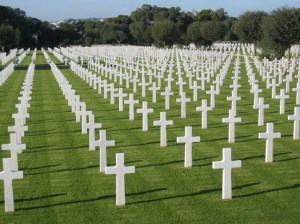
The answer is the American Cemetery and Memorial in Carthage, Tunis, Tunisia, North Africa.

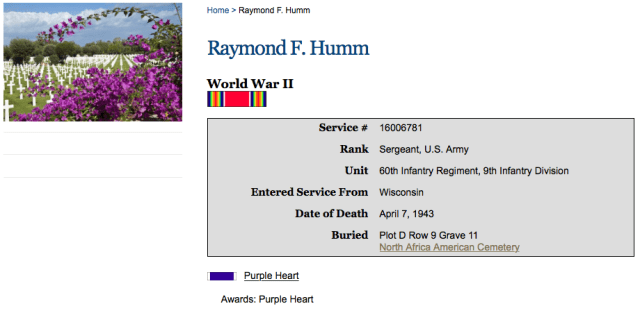
The answer, of course, didn’t just magically appear when I started my search, although finding the cemetery itself was a pretty easy keyword search. However, when I first checked the cemetery’s online database I was unable to find Raymond. I did see that they provided a link to findagrave‘s database for the cemetery, so I checked their listing too. Still no Hamm. Hmmm, lets try just his first name ‘Raymond’. Whew! Sure enough, there he was, listed under Raymond F. Humm (no that’s not a typo, that is the name he is listed under.)

I went back to the cemetery’s official website and found him using ‘Humm’, along with the bonus, previously elusive, reference of his service number and unit. So cool! Now I had two questions answered. Also included in his entry are any medals he received, in his case he had received a purple heart, something that I didn’t know before either, although that should have been a given.

CEM46514200_108725623390   CEM46514200_108725581224

Screen Shot 2016-05-23 at 11.53.55 AM

The cemetery is set on 27 acres in Tunisia. There are just over 2800 burials of the military dead from the United States. There is also a chapel and a memorial court where one can find mosaic maps showing images of the military activities that occurred during the US military’s movements across the continent.


THE GO DEVIL’S
Raymond was assigned with the 9th Infantry Regiment, 60th Infantry Division aka ‘The Go Devil’s’. (There was no entry for what company he was in but I am not complaining, as this is way more information than I had before.)

So armed with this information I now have a clearer picture of Raymond’s movements and activities from when he left Fort Bragg, North Carolina in November of 1942 until his death in April of 1943 around El Guettar Pass in Tunisia.

9th-division-wwii
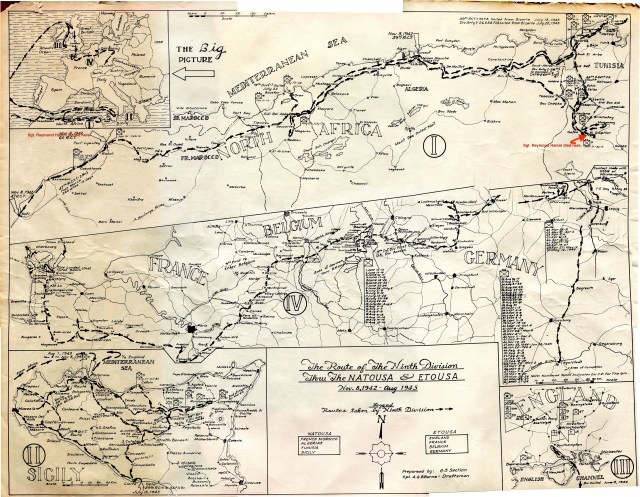
Here is a great map showing the movements of the 60th across Africa during Operation Torch. I have marked where Raymond landed in November and were he died the next April.
ww2-97
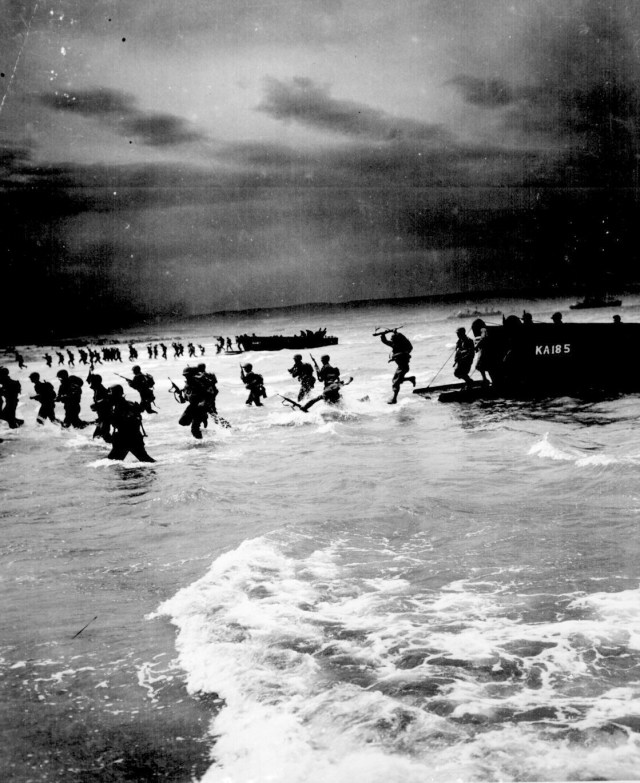
Image from NARA website of American soldiers debarking on the shores of North Africa.2

When Operation Torch went into action Raymond and his fellow soldiers in the 60th landed on the beaches of Port Lyautey, Morocco. Their job was to seize the ‘Citadel’ known as the ‘Kasba’, and they did.

In March of 1943 Major General Patton assumed command of II Corps. He was making plans to secure Maknassy Pass and get to the Tunisian plains through the El Guettar pass. The hope was that Rommel would retreat or be cut off.

The 60th which was now motorized and attached to the 1st Armored Division, advanced through the 21st German panzer division and took the hill called Djebel Goussa. Several days later they captured the town. But they still hadn’t gotten through the pass.

At El Guettar, the 9th Infantry Division was now under the command of Major General Eddy, who had been involved in a car accident and was now leading the troops on crutches. To complicate matters, the enemy possessed air superiority and were very well entrenched in the surrounding hills and gorges that provided a natural defense.

The 9th and 1st Divisions’ objective was to seize opposite sides of the El Guettar Pass, thus enabling the 1st Armored Division to roll through without being fired on. At 6 A.M. on March 28th 1943, the 47th Infantry Regiment was in position to take Hill 369. Although the objective area was reached quickly, darkness and poor maps had led them astray to El Hamra Ridge.

There was no need to worry the commanders thought: 2nd Battalion of the same Regiment had been sent on a flanking movement and would get the job done. However, 2nd Battalion was caught in a murderous crossfire and 1st Battalion of the 39th Infanry Regiment became lost in the maze of hills.

So Hill 369 was still in German hands and the attack bogged down. American troops had previously been occupying Hill 772, but moved off when the offensive began, so the German’s decided to take it back. General Eddy soon realized that Hill 369 could only be taken by getting Hill 772 back.

For five days the battle raged in an attempt to break through the El Guettar Pass. Each attack was a coordinated push of an Armored Task Force and the 3rd Battalion of the 39th Infantry Regiment. When it seemed that the Germans were going to mount a major mechanized counterattack on April 4th, the 15th Engineers were sent to occupy defensive positions as Infantry.

However, two days later [April 6] it became apparent that the enemy was going to withdraw to head north for a last stand in Tunisia. The 9th Infantry Division attacked to seize Hills 772 and 369. “Benson’s Force” moved through the Pass and met the Eighth Army coming up from the South. Finally, the El Guettar Pass was taken!

After this battle, the men of the Ninth Division were given a two day rest period. A nice surprise came from General Patton who wanted to show his appreciation:  Steak dinner for the Ninth men!1

It was in the final day of this battle, April 6th, that Raymond was injured, badly enough that he died the next day. Unfortunately, I don’t think he was able to partake of his steak dinner. But he could be proud that he was part of a major victory for the Allies in the North Africa campaign.

infantry-move
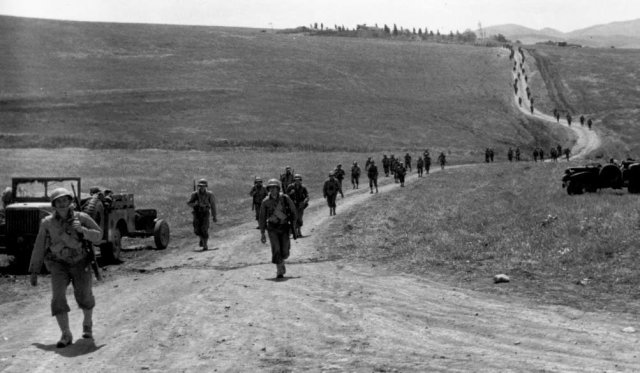
From 9thinfantrydivision.net website. American soldiers on the move in North Africa.1

If interested here are two documents that I found online related to the 60th: one is a gathering of maps and the other is a, now unclassified, regimental history of the 60th covering 1940-1942 (I will need to find the rest of this history that covers 1943 to see if there is reference to Raymond, it might include his company assignment too).

Source:
1. Battle of Tunisia – https://9thinfantrydivision.net/battle-history/tunisia-battle/
2. American troops leap forward to storm a North African beach during final amphibious maneuvers.” James D. Rose, Jr., ca. 1944. 26-G-2326. National Archives Identifier: 513171

Up in smoke…

Fire in some way or another has made its appearance often in my ancestor’s lives. The most devastating one being the Peshtigo Fire of 1871, a much nastier event than that little dust up they had in Chicago the same day. Most of the other fires seem to have been house or chimney fires of which I can count at least 6 having occurred to various ancestral families, so far. For the David Brooks family we have the following account.

David Brooks was John Brooks’ elder brother. He was born about 1812 in Albany, Albany County, New York. Both John and David lived with their mother until sometime after 1841 when we can find John at his own address in the city, as well as David.

David most likely trained or apprenticed as a tin smith in his early years, an occupation he continued throughout his life.

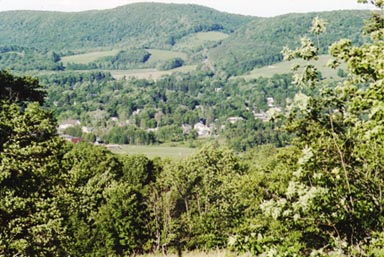
Sometime between 1855 and 1860 David and his wife Margaret packed up the tin smith business and the family jewels and headed to Otsego County, New York. Cherry Valley to be exact.CVSCAPE


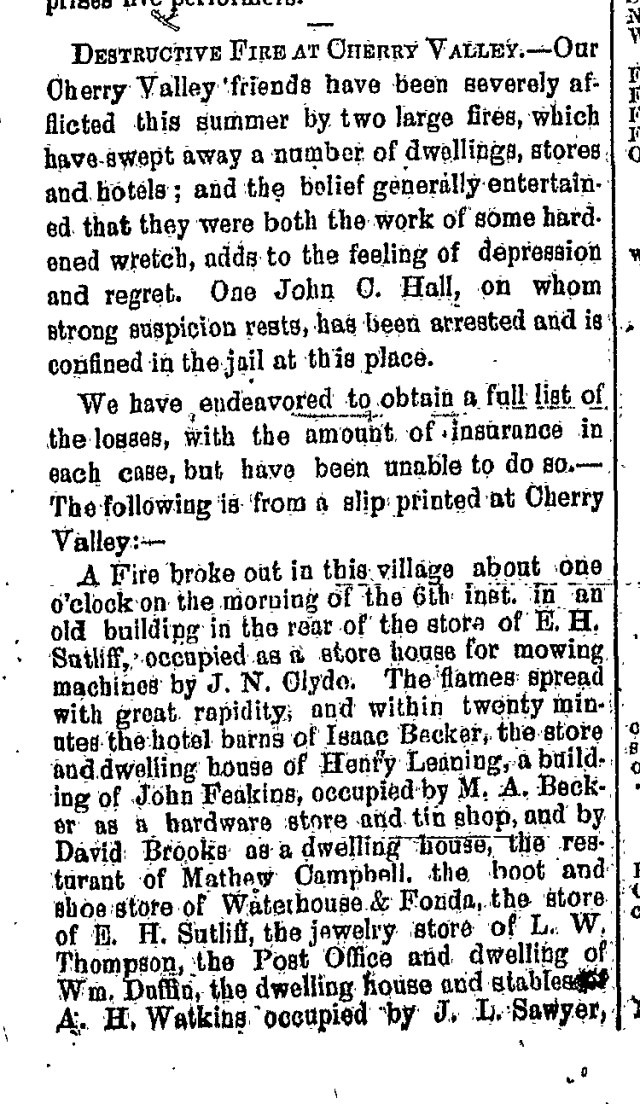
The family wasn’t in the area long before we find this newspaper article in their county paper:

fire
The Freeman’s Journal, July 13, 1866, Page 3.

It doesn’t appear that any lives were lost in the fire, but the family most likely did lose a goodly amount of their possessions and possibly even their tin business for a short time.

David and Margaret continued to stay and raise their family in Cherry Valley. Together they had at least 5 children. Their son Andrew is the only one to take on the tin smith trade.

I can find information on only three of their children. Andrew who married and had one daughter who died without any heirs. Sarah who married and had 9 children, all Woodwards. Benjamin married and had one daughter and has descendants from her. There appears to be no sons that carried on the Brooks surname in his line.

David died in 1882 at the age of about 70. Hopefully this was the only nasty event to occur to the family.

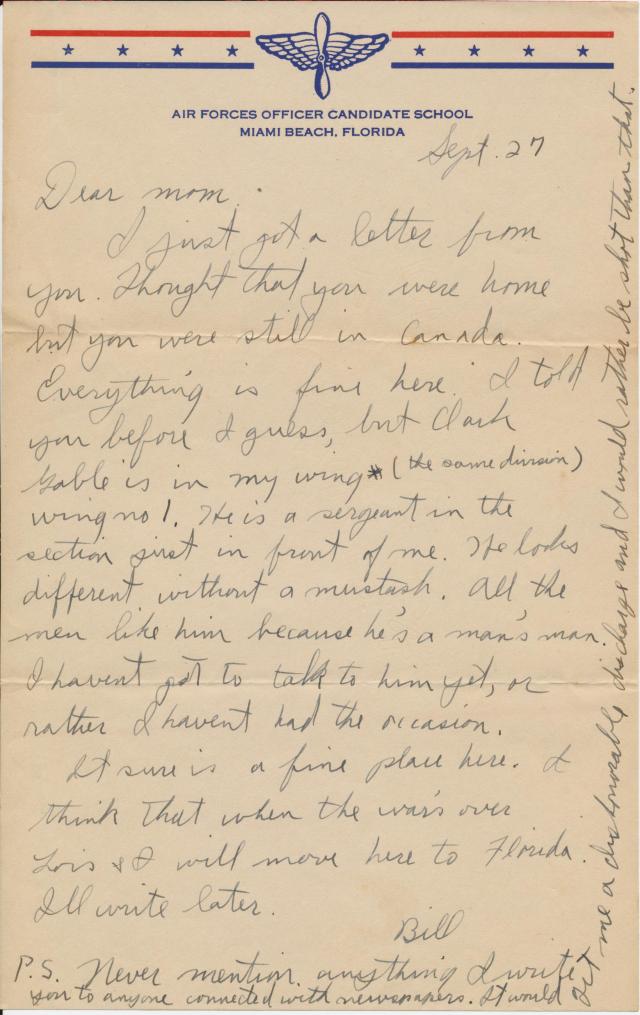
September 27 [1942] William Shepard to home…

4075641217_8b064ec332_o

Sept. 27

Dear mom

I just got a letter from you. Thought that you were home but you are still in Canada. Everything is fine here. I told you before I guess, but Clark Gable is in my wing #(the same division) wing no 1. He is a sergeant in the section just in front of me. He looks different without a mustache. All the men like him  because he’s a man’s man. I haven’t got to talk to him yet, or rather I haven’t had the occasion. It sure is a fine place here. I think that when the war’s over Lois & I will move here to Florida. Ill write later.

Bill

P.S. Never mention anything I write you to anyone connected with newspapers. It would get me a dishonorable discharge and I would rather be shot than that.

September 15, 1942 William Shepard to home…

4076389698_7dacbbb749_o

September 15, 1942

Dear Mom & Pop:

Im off to Miami. I expect to get there the 18th or 19th of Sept. Should get my commission by Jan 1. Ill probably go for flight training after I finish there.

Hope that your cabin is taking shape. Ill bet that you are having a swell time. Catch a lot of fish.

I don’t have much time so Ill have to close. I’ve just been rated a corporal so thats some extra pay.

I wrote you several letters but  they came back because I don’t get free mailing privileges in Canada.

Ill write later

Your son
Bill

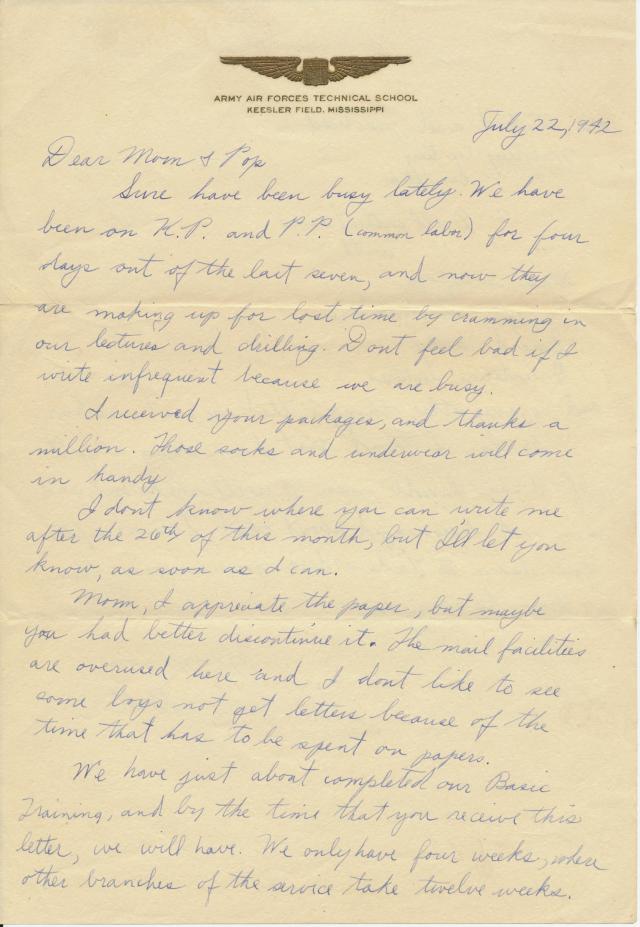
July 22, 1942 William Shepard to home…

4075628259_267d18a71e_o

July 22, 1942

Dear Mom & Pop

Sure have been busy lately. We have been on K.P. and P.P. (common labor) for four days out of the last seven, and now they are making up for the lost time by cramming in our lectures and drilling. Dont feel bad if I write infrequent because we are busy.

I received your packages, and thanks a million. Those socks and underwear will come in handy

I don’t know where you can write me after the 26th of the month, but I’ll let you know, as soon as I can.

Mom, I appreciate the paper, but maybe you had better discontinue it. The mail facilities are overused here and I don’t like to see some boys not get letters because of the time that has to be spent on papers.

We have just about completed our Basic Training, and by the time that you receive this letter, we will have. We only have four weeks, where other branches of the service take twelve weeks.

4075631935_b919a8e144_o

We studied and practiced:

Military Courtesy
”  Sanitation
” Drill without arms
” Drill with ”
Gas warfare
aircraft nonelomature [nomenclature – thanks dad!]
Guard duty
Orientation lectures
and many other things, that one cant mention.

So far I think that I am doing alright. If I can handle men I will make out, and I’m not discouraged about that, because after you learn to take orders you can give them.

Love to everyone

Your son
Bill

Operation Torch…

hammraymondSgt. Raymond Fred Hamm was the eldest child of Emma Paugel and Fred Hamm. He was born on June 9, 1919 in Minnesota. According to his obituary he was baptized in Phelps, Vilas County, Wisconsin and confirmed in Wittenberg, Shawano County, Wisconsin on September 30, 1934. His early years were spent growing up and attending school in the Wittenberg area. He moved to Vergas, which is in Otter Tail County, Minnesota where in 1940 he is living in the same county with his father and brother Arthur all working as farm laborers. Sometime around late 1940 all the boys had moved to the area of Green Bay / Door County. Soon afterwards both Raymond and Arthur joined the Army, although Raymond waited until September of 1942.
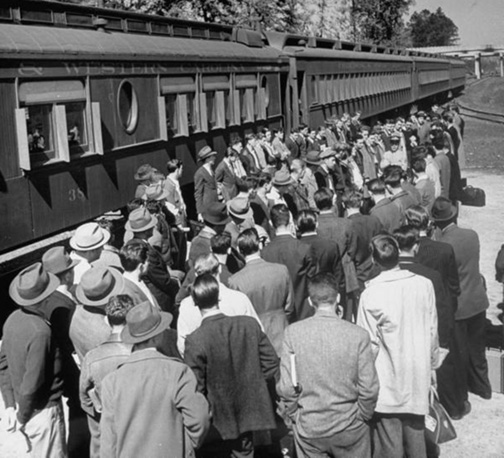
After Raymond’s enlistment he was immediately sent to North Carolina for seven weeks of boot camp training, of which two weeks were dedicated to intense rifle practice.

After he arrived at the barracks he would have been fed then hustled off to ‘sick bay’ where all the men were inspected and injected, then ejected out the door to pick-up their paperwork, dog tags, IDs etc. They also had the pleasure of a free haircut, clothes, rifles and other necessary gear.

bootcamp_5
Raw recruits arriving in North Carolina on the trains.1

When Raymond’s boot camp training was over he was sent to Virginia. This happened, probably, sometime in late October. The transfer to Virginia was most likely because he and his fellow soldiers were getting ready to head to North Africa in November of 1942. Operation Torch was preparing for action.

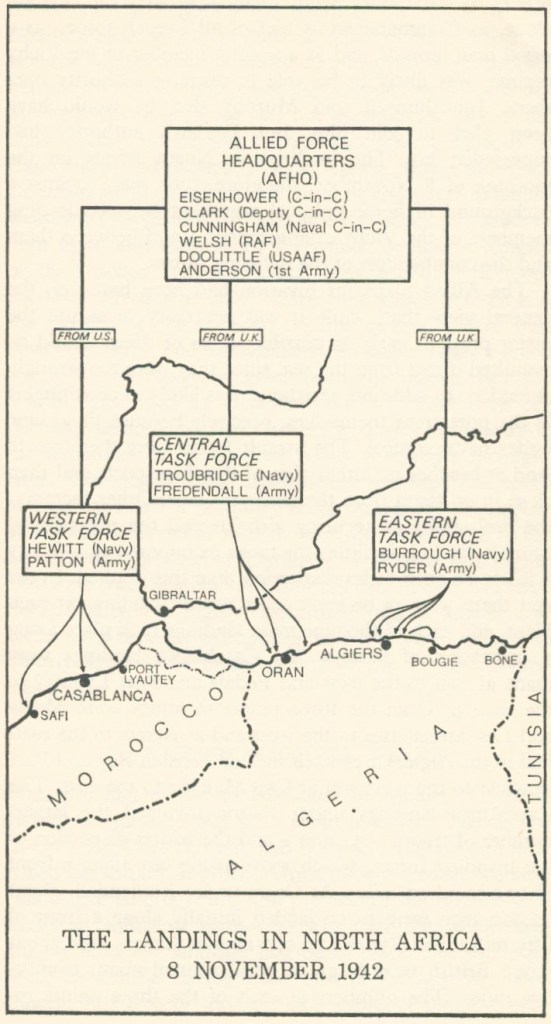
Operation Torch was the British planned invasion of French North Africa, with the help of their new American Allies. The end goal was to clear out the Axis powers from the area so that the Allied powers would have better control over the Mediterranean Sea to prepare for a 1943 invasion of Southern Europe.2

The trip by sea took a little over 2 weeks. As I can find no information on Raymond’s assignment in the Army he could have been on any one of the three task forces seen on the map below, as American forces were on all three, according to the Wikipedia summary.

landings

Whatever battles Raymond was involved in during Operation Torch, he survived to move with the Army to Tunisia, the next big event.3 According to the map below on the 6th of April in the southern part of Tunisia there was a battle that could possibly be the one Raymond was involved in where he was injured. (Unfortunately, at this time, I can find no record of Raymond’s service. None.)

Tunisia30Janto10Apr1943

If you have ever seen the movie Patton, the Tunisia Campaign is one of the major battles that they include in the story.

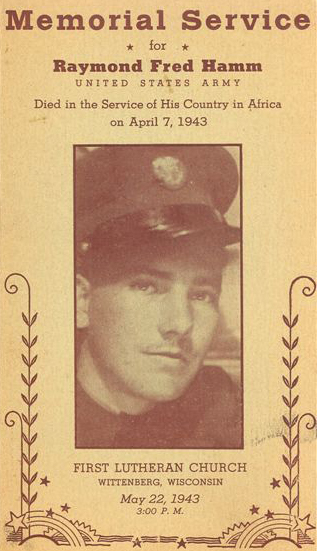
Raymond was seriously wounded April 6, and the next day, Wednesday, April 7, 1943 he died at the age of 24. He never married or had any children who can tell his story, as short as it is.

hammraymondmemorial

Because of the vast amounts of information on stories like this one, regarding Raymond’s North African service, I find it very difficult to condense them into a readable post, so be sure to check out the sources I have noted if you are curious about both the Tunisia Campaign and Operation Torch.

UPDATE: I have added a picture to Raymond’s brother Arthur’s post. I forgot I had it, so be sure to check it out.


Sources:
1. http://ww2gyrene.org/boot_camp.htm
2. https://en.wikipedia.org/wiki/Operation_Torch
3. https://en.wikipedia.org/wiki/Tunisia_Campaign

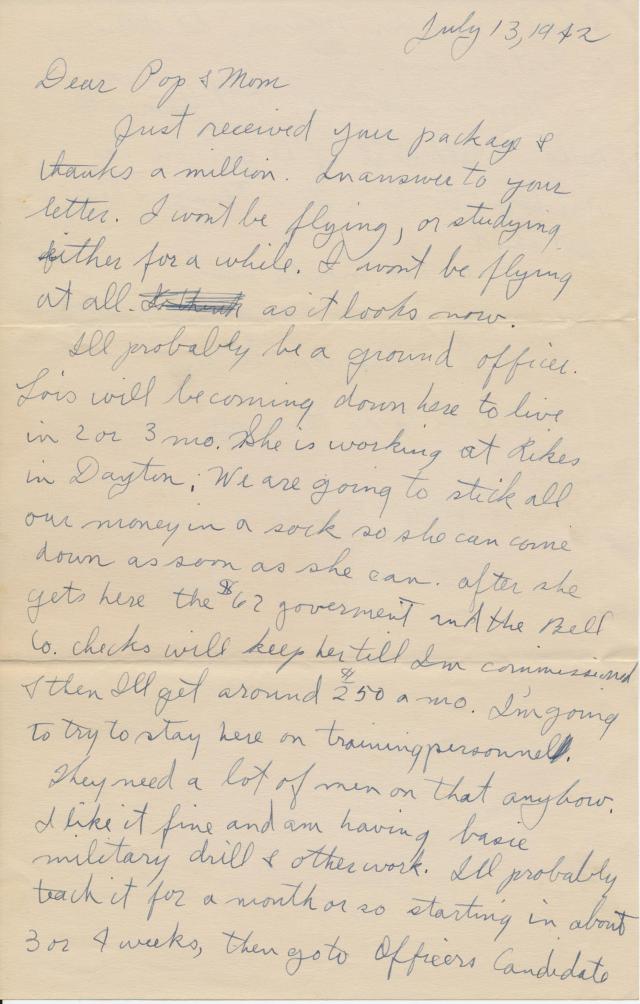
July 13, 1942 William Shepard to home

4076376286_30546c21bc_o

July 13, 1942

Dear Pop & Mom,

Just received your package & thanks a million. In answer to your letter. I wont be flying, or studying either for a while. I wont be flying at all. as it looks now.

Ill probably be a ground officer. Lois will be coming down here to live in 2 or 3 mo. She is working at Rikes in Dayton. We are going to stick all our money in a sock so she can come down as soon as she can. after she gets here the $62 goverment and the Bell Co. checks will keep her till Im commissioned & then Ill get around $250 a mo. Im going to try to stay here on training personnel.

They need a lot of men on that anyhow. I like it fine and am having basic military drill & other work. Ill probably teach it for a month or so starting in about 3 or 4 weeks, then go to Officers Candidate

4076379026_9cddfe8a7d_o

School in either Miama, St. Petersburg or Fort Benning.

How is everyone? tell them all hello. & tell Carl if he gets in the air corps to do a few things & he’ll get ahead

  1. Keep his mouth shut
  2. Keep his ass out of head quarters
  3. Do what they tell him

You have to do them all to.

Well Love to all and write

Bill

Like father, like son…

I am finding that newspaper research is becoming my favorite part of genealogy because I have been able to find so many family stories that have become lost, deliberately or just due to the passing of time.

So here I introduce Arthur Albert Hamm. Born in 1922, he was the middle child of my great grandfather Fred Hamm and Emma Paugel. All three of their children were illegitimate, or to be less crass ‘born out of wedlock.’ Fred and Emma did eventually married in 1931, but I am not sure what the hold up was as both were divorced from their previous spouses by 1921.

As per his modus operandi, it is doubtful that Fred was living with the family in 1935. That is the year their youngest son Clarence was killed in an automobile accident. According to the 1940 census, Fred was noted as living in Minnesota in 1935, so my gut is saying that he had probably left shortly after their marriage. Again. All previous research indicates that Grandpa Fred was a love-em and leave-em type of guy, so I don’t know why he would treat this wife any differently.

Fred’s sons, Arthur and Raymond, both joined the Army in 1942. Arthur joined up in January of that year. When Raymond (Alfred) was killed  in Africa in 1943 Art was sent home on furlough to be with his Mother and half-sister for the funeral.


newspaper_hammart_furlough


Sometime between 1941 and 1944 he had married, and had two children with Bernice Schultz.

3272157867_0d5b2a3838_o

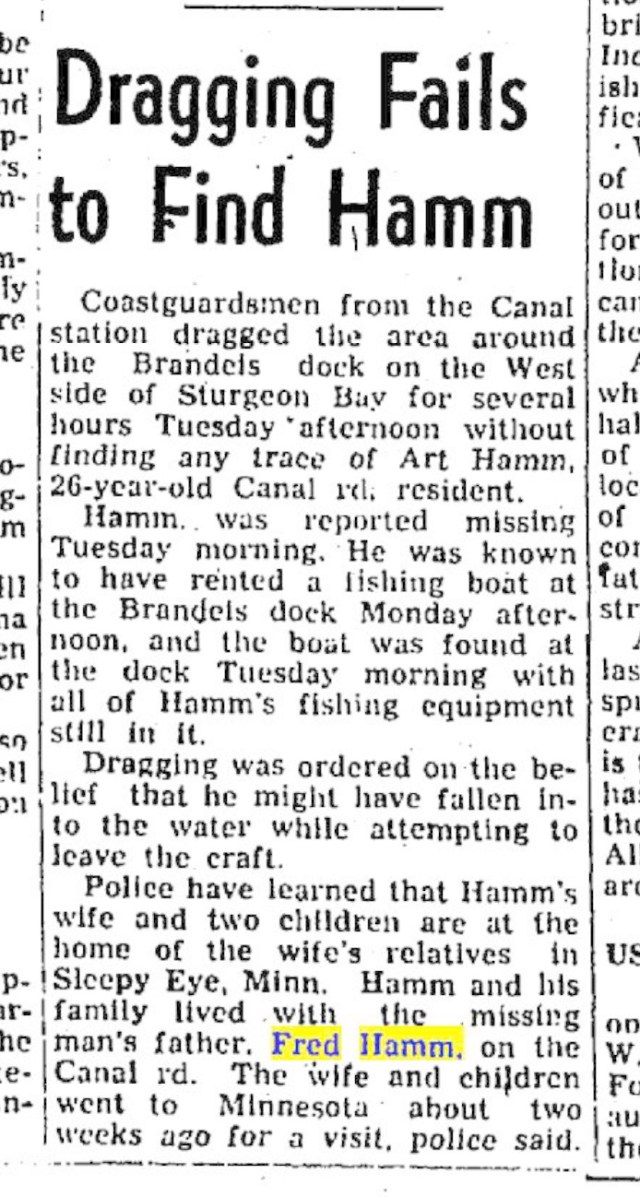
Arthur survived the war and came home to Door County and life went on, as it is wont to do, for a few years, then one day in April of 1949…


newspaper_hammart_disapears2

A few days later the paper reports…

newspaper_hammart_disapears1

Ah, but here’s the kicker. Arthur Albert Hamm died February 15, 1989 in Livingston, Park County, Montana. Prostate cancer and emphysema were the cause of death.

     Arthur A Hamm, 62, of Livingston died Friday Feb 15, 1989 in the afternoon at the Livingston Convalescent Center following an extended illness.
Graveside services will be held Wed. at 2pm at Mountain View Cemetery. Lowry Funeral Home is in charge of arrangements.
Mr. Hamm was born May 5, 1922 in Fairland, MN. He worked in Park County for a number of years as a logger and ranch hand. From 1974-1980, he worked on a seismograph crew in Tulsa, OK. He came back to Livingston in 1981 and had made his home here since. There are no known survivors.”

His wife (ex-wife?) Bernice had told the children he was dead. She later married a man who eventually adopted Art’s children.

I guess in Grandpa Fred’s favor is the fact that a no time did he pretend to die or go missing. As far as we know he pretty much just packed up and left, with no subterfuge. His son Arthur was apparently a bit more of a diva.