Carrie Sues the Railroad…

Carrie8 (Kari7, Kari6, Ingeborg5, Kari4, Agnete3, Auslauf2, Kari1 Persdotter Finneid) Amundson Hamm who married Frederick Hamm sometime around 1903, had had a child with a gentleman by the name of John Gustafson in 1900. It is currently unknown as to whether or not they were actually married. This child was named John C. Gustafson, (the initial ‘C’ is said to stand for Cornelius). We know very little about John’s childhood, other than the fact that in 1908, when Carrie took Fred to court for non-support of his family (which consisted of her and my grandmother Myrtle at the time), it was mentioned by Fred that her 8 year old son John was living with his grandparents Amund and Jorgina Amundson. Nothing is known about John’s father.

It appears that like my grandmother Myrtle, her half-brother John spent very little time living with their mother Carrie, certainly not when the census takers came around.1 The reason for Carrie’s abdication of her motherly duties is never made clear to us, so any reasons we would give would be mere speculation. I believe that she was simply incapable of doing so due to mental health.

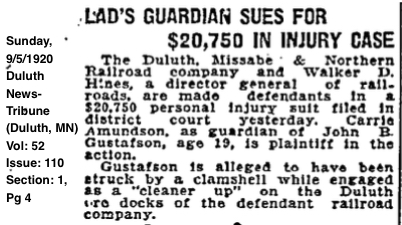
Because Carrie’s mother Jorgina had died in 1907 and her father Amund in 1917, John was now no longer living with his grandparents, and likely on his own at the age of about 17 working to feed himself and possibly helping his mother out. We do not know how close their relationship was, or even if they had one. But in 1920 when he was injured on the job Carrie stepped up to the plate to help him get monetary compensation from his employers:

amundson_carrie

newspaper_amundsoncarrie_1920 copy
News-Tribune newspaper article about the court case. His mother Carrie is on the left.


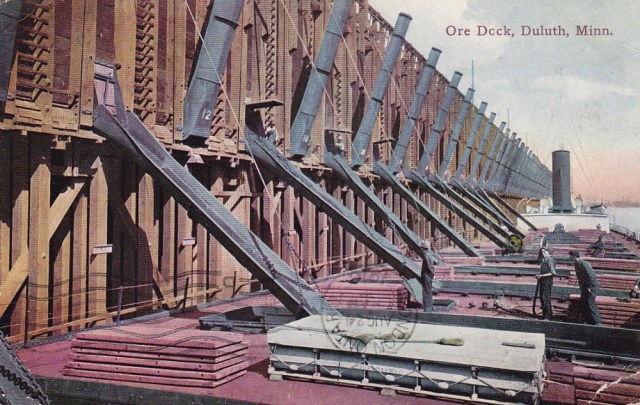
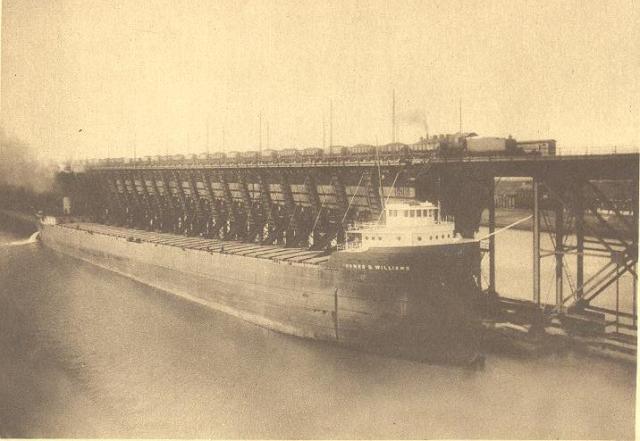
John’s grandfather Amund, and step-father Fred, had both worked at the ore-docks of the Duluth, Missabe & Northern Railroad company in Duluth’s harbor in the early 1900s, information which is found in the city directories. John most likely got the job because his grandfather had been there for many years, so he had an ‘in’. The image below is what the docks looked like at the time of his accident.


ore_dock
Ore docks of the Duluth, Missabe & Northern Railroad where John was injured.


According to the personal injury case (#43788) dated September 4th of 1920, Carrie was filing as John’s guardian against the DM&NRR railroad because of permanent injuries he had suffered while working at the ore-dock. Carrie brought the suit as John’s guardian because he was only 19 years old and therefore still considered a minor, as such he was unable to bring a lawsuit on his own. If indeed that was what he wanted.

The complaint stated that John had been working for DM&NRR for some time on the ore-docks, performing duties related to unloading the vessels. A description of how the unloading of the ore was also provided in the record as follows.
Ore-Dock-Duluth

mentoreight37

The ships containing the ore in which John worked were unloaded with complicated machinery. This type of vessel had a number of large compartments each separated by large beams running across from side to side. Each compartment was equipped with a large hatchway that ran across the deck of the ship and allowed access to the hold. Hoisting rigs were arranged along the dock so that they could be moved to a point above any of the hatchways. These rigs consisted of a horizontal track suspended at a great height above the ship and ran from a point above the hatchway back over and upon the dock. Attached to the rig is a carriage which moves back and forth carrying a heavy steel cable from which a clam shell bucket was hung, this bucket was dropped down into the hold to grabbed the coal and pull it up to the dock where is was then deposited into a big pile.

The people who operated the rigs were called hoisters. The rate of speed with which these rigs ran was ‘terrific’, and the speed also caused the clam shells to swing and sway from one side to another striking against walls of the hold, which made it pretty dangerous for the employees who were working in the hold where the ore was being removed.

On this particular day John’s job was as one of the ‘cleaners up.’ They shoveled the coal left in the hold, that the rigs couldn’t reach, in a pile to the center where it could then be lifted out. This work was tiring and required undivided attention of the ‘cleaners up’ to avoid getting ‘eaten’ by the clam shells. It was while one of these clam shells was being carelessly manipulated by a hoister, according to the complaint, that John was struck by the device and injured. In fact he was injured so badly that his right foot had to eventually be amputated above the ankle.

Of course, the railroad answered that they were not responsible for his loss and a court date was set. Unfortunately, I don’t know what happened with the case from there, as there is nothing further in the records regarding its progress.  I will assume that the parties settled, but the case could have been dismissed too. John was now a 20  year old young man out of a job and disabled.  I can only imagine how long it must’ve taken him to recover from having his foot amputated and then trying to find work after that.

By 1923/4 John was married a woman slightly older than himself, by the name of Lillian Jarvella (or Lania/Lavis/Lavia, records are quite varied regarding her last name). They eventually had 9 children together*, some I am sure who are still around as they were born in the 30s and 40s. According to census records John was working as a farmer in the 1930s and a paper hanger in the 1940s. He died in 1985 in Minneapolis.

* John and Lillian named one of their sons Clarence and one of their daughters Myrtle. After his half-sister and her soon to be husband? Hmmm.

1 Myrtle did live with her mother from birth, 1906, to at least 1908. But by the 1910 census and thereafter, until her marriage, she was permanently residing with her Hamm grandparents in Wisconsin.
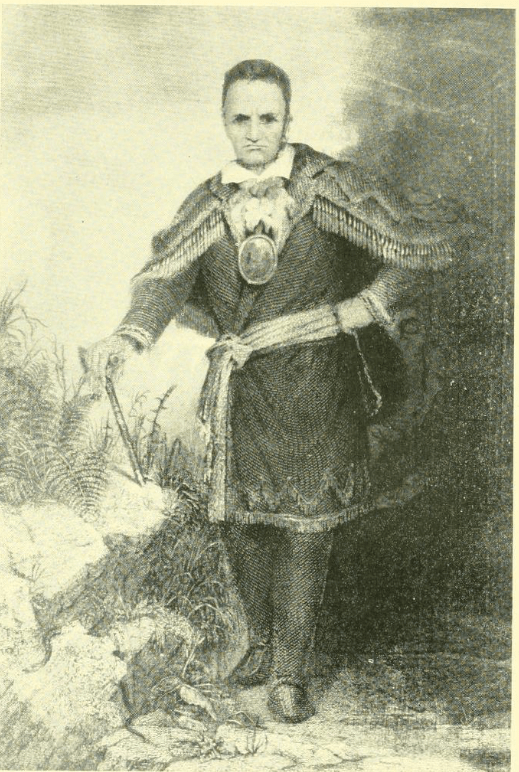
Treaty of Big Tree

My ancestor William4 (John3, John2, William1) SHEPARD was fortunate in that during his lifetime he partook in three major historical events in the history of our county and helped to affect their outcomes. He was one of the major players in the Revolutionary War, Shay’s Rebellion and the Big Tree Treaty, (which resulted in America’s legal possession of the western half of the State of New York).

The Treaty of Big Tree is not a well known event. I certainly don’t remember learning anything about it in my history classes, but its outcome helped to greatly enhance America’s land holdings and was possibly the incentive for many of my JOHN ancestors continued westward migration through the state of New York, on to Michigan, eventually ending in Wisconsin.

This particular treaty came about because Robert Morris needed money, badly.

Robert Morris was considered, apparently by many, to have been the richest man in America at the time. He had acquired a large majority of his riches by stealing them from the British during the Revolutionary War, although being a privateer during wartime was considered legal theft. His money making schemes after the war were relegated to land speculation, enough so that he ended up losing the majority of his wealth and ended up greatly in debt. This treaty was to be his last ditch effort to pay back those debts and get himself back on his feet again. Due to his ill health and his age he sent his son Thomas in his place to negotiate.

In 1791 Morris had acquired the rights to buy land from the Seneca, from Massachusetts, but the sale was contingent upon clearing the land title from the Senecas. It wasn’t until 1797 that he was ready to open negotiations to do so because he had sold much of the property to a group of Dutch bankers, but could not get his money until he cleared the land title.

After much correspondence with government entities, the date of August 20, 1797 was set for the start of this momentous event. The location, Big Tree, a small indian village, was chosen only because of its convenient location as a meeting place for everyone involved in the negotiations. The meeting place itself was in a large temporary shelter, that had been built for the occasion, in a meadow between Wadsworth’s cabin and a gigantic oak by the river.

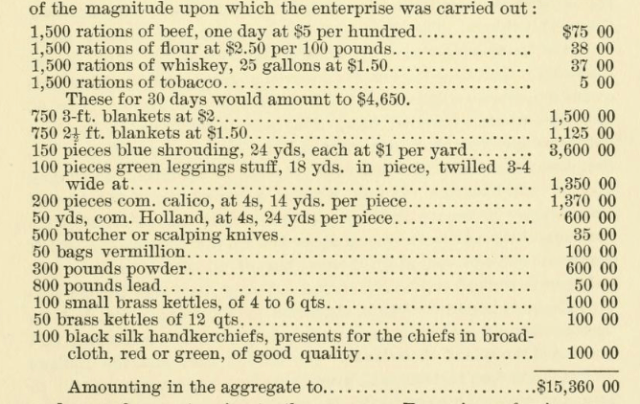
A list of instructions was provided by Morris to his son proposing how the negotiations should start. One of the items on the list was: “the business of the treaty may be greatly propelled probably by withholding liquor from the Indians” but, it went on to suggest, “with the promise of its procurement after the treaty was signed.”1 [p18]

To prepare for the event provisions had to be made, and due to the large contingent expected to be at the treaty grounds,  a large herd of cattle, along with a huge amount of supplies needed to be on hand, all of which had to be transported to Big Tree over very bad roads.

Screen Shot 2016-02-19 at 11.35.36 AM
Items in provision list.1[p19]
A large majority of the American negotiators arrived late due to the inclement weather. Among this group was General William Shepard who had been appointed by the state of Massachusetts to represent the commonwealth.1[p20] They were all housed in log cabin that had been built by the Wadsworths.

There were over three thousand Seneca in attendance most of whom were reluctant to give up any more land to the “white man”, but they were looking forward to the “big kettles that would be hung”, that would provide “a feast of fat things”and the free rum. Many were merely curious about this extremely wealthy white man Mr. Morris who was to be there. They had been told he would be handing out many lavish gifts. Also in attendance was one of their leaders, Chief Red Jacket, who was regarded as the greatest orator of the whole six nations, and would be speaking on behalf of the Seneca along with several other notable Seneca chiefs and the Clan Mothers of the nation.

Screen Shot 2016-02-19 at 11.40.33 AM

On the first day Thomas Morris opened the negotiations by speaking first then William Shepard made his address, which went as follows:

     “Brothers, Your brother, the governor, and the executive Council of the state of Massachusetts, desirous that justice should be done to people of every color, and particularly to their brothers of the Seneca nation, have sent me with power to attend this treaty on their behalf.
And I shall make it my business to see that the negotiation between you is carried on upon principles of justice and fairness. Brothers, I am an old man, much accustomed to do public business for the state to which I belong. I have always observed when thus employed, that a spirit of harmony and conciliation was attended with happy effect among us, therefore, brothers, I hope that your mind will be united, And that the voice of one will express the sentiments of all. Brothers, I have now said all that I have to say to you at present. May the Great Spirit take you under his protection, and give wisdom and unanimity to your councils.”1

Over the course of the negotiations Wadsworth was generally in charge of the events of the day, however, on the 10th William Shepard oversaw the negotiations as Wadsworth had become ill and could not attend.

Because the Senecas had been cheated in questionable negotiations in an earlier treaty when they sold most of their land east of the Genesee, they were resolved that this wouldn’t happen again. Many people spoke and debates on both sides were instrumental in the negotiations became stalemated. A break was eventually called. The next day Morris offered more money, but Red Jacket made clear that the Indians had already lost much of their land and no amount of money could make them part with any more. Red Jacket continued to remain a sticking point in the negotiations as the rest of the Senecas listened to his silver-tongued oratory against any land giveaway. Another Chief, Cornplanter, asked Morris to check his Bible to see if the White Man’s Great Spirit directed them to intrude on Indian property.

Discussions stalled again when Red Jacket, and several other chiefs refused to sign the treaty. Morris then tried a new tact, outright bribery, and appealed to the Clan Mothers by promising to give Seneca women 60 cows, and annuities to some of the chiefs. This was a major motivator in ending the negotiations. After over two weeks of, sometimes, heated back and forth negotiations in the end it was bribery that sealed the deal, the treaty was signed September 15, 1797. [link to web page with transcription of treaty]

With the signing of the Treaty of Big Tree, Morris transferred the cleared land title to the Holland Land Company. The final result?

It “opened up the rest of the territory west of the Genesee River for settlement and established ten reservations, perpetual annuities and hunting and fishing rights for the Seneca in Western New York.”2

Now that the negotiations were finally over William Shepard went back home to the comfort of his hearth. Robert Morris died a short time later still poor. His greed led him to make bad speculations, which lost any profit he might have made on this endeavor.

There is much more of interest regarding this event, which I have, of course, heavily edited, including the book “A history of the Treaty of Big Tree…” see link below, which I used as one of my sources.

Sources:

  1. A history of the treaty of Big Tree, by Livingston County historical society, Genesco, N.Y. [from old catalog]; 1897:Publisher [Dansville, N.Y.] Livingston County historical society.
  2. https://en.wikipedia.org/wiki/Treaty_of_Big_Tree.
  3. http://www.oswego.edu/library2/archives/digitized_collections/granger/bigtree.html

A musical interlude…

Screen Shot 2016-01-19 at 2.09.11 PMThanks to my very generous nephew-in-law and his musical talents – I have an excellent update I can make to my Albany Burgesses Corps post.
As I mentioned in my little history of the Corps, they had a quick step written for the organization and played it at many a celebration. I approached my niece and her husband, because they do ‘music’, and I have zero musicality – although I am told my voice won’t break eardrums. Troy was finally able to make time in his busy schedule to put this ditty together for everyone’s enjoyment.

Bateaux’s Quick Step

 Of course now I want to know what the steps were to this little piece.

Thomas Cain, still a mystery…

For Christmas last year I took advantage of a sale going on at FTDNA and upgraded my cousin Robert Cain’s DNA results. I upped his yDNA to 111 markers, added the FamilyFinder test, (which will help find cousins), and had some refining marker tests done to suss out more precise information on his haplogroup.

Because Robert passed away a few years ago, his DNA is all we have left of him. And in honor of his memory. and generosity in helping us to find the origins of the CAIN line through DNA, (along with the possibility of his DNA going bad due to time), I wanted to do these tests.

Robert has many yDNA matches, however none of them are less than 5 markers off and none of them are the same surname. So our common ancestor is way, way, way back in time. His updated refined haplogroup designation is:

R-FGC20561

I added Robert’s yDNA results to the R1b Haplogroup Project a few years ago. Recently one of the group’s administrators provided me with a chart that shows Robert’s new place in this project. All the green cells show how his DNA is being refined until we get to the latest test results. Over time yDNA testing will get even more precise.

What does all this mean? Because the haplogroup R1b is such a huge pool of humans, refining the tests helps group results so that DNA matches are more manageable and more accurate. You can see that none of the group of men with Robert have the same last name. It is assumed that the common ancestor of these men was around about 1100AD, before last names really existed in historical documents. So we know who our CAIN ancestor is, just not his name or where he was from or anything else for that matter, just what his yDNA tells us.

robertsydna
To see the chart more clearly click here.

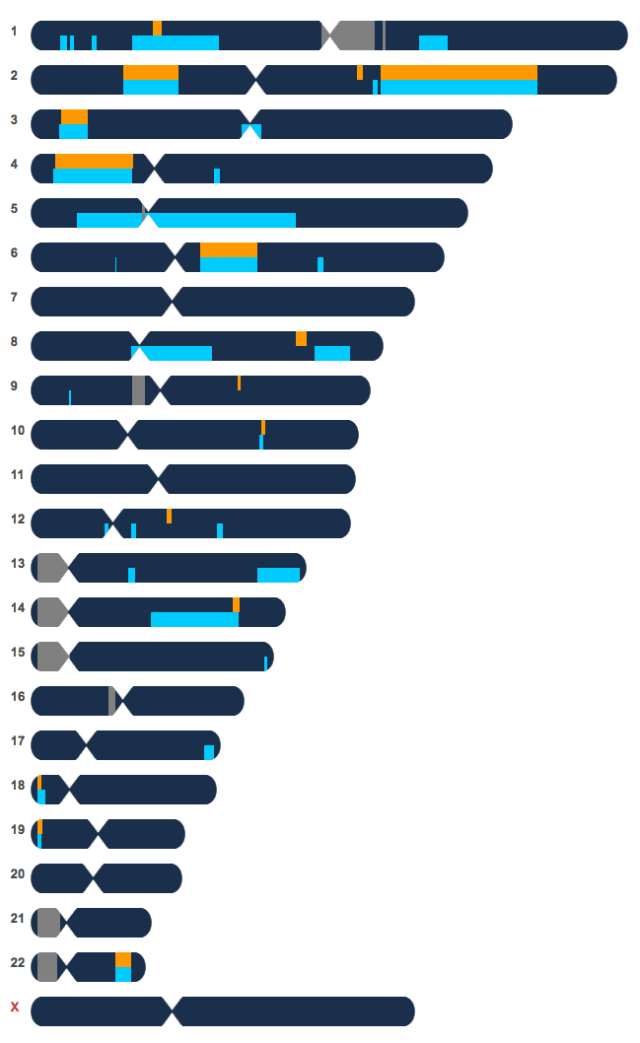
The FamilyFinder test, which finds cousins and other relatives, I had done on Robert’s DNA so that I could see where our DNA was matching. This also helps when comparing it to other relatives and cousins to see where we are matching on our Smith/Cain/Rosa lines. Here is an example:

Screen Shot 2016-02-10 at 11.13.59 AM

The solid blue/black is Robert, he is the base DNA being compared to. The orange is myself and the light blue is my dad. So you can see what DNA I inherited from the CAIN line that my Dad didn’t, and vice-versa. Ignore the gray bits.

I am not sure how many more tests I will be able to subject Robert’s DNA to, but for now this is a nice improvement on his results. So in a nutshell, we still don’t know the specific origins of Thomas Cain, but we are getting closer.


Nazis and secret bases in Greenland…

During WWII my grandfather Clarence Fredrick John was too old to join as a soldier, being about 45 years of age. However, his expertise in road building, that he acquired working for the Forestry department in CCC camps in Wisconsin, was put to use in Greenland where he helped build runways for the military.

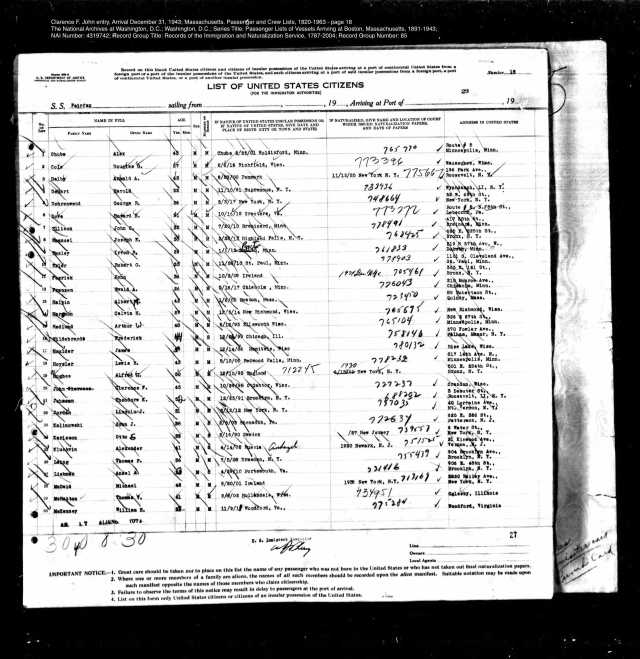
Clarence left his wife and 3 children for about a year to do his part to assist in the cause. Below is his SS Fairfax passenger list entry, after its arrival back in the US, at Boston at the end of December 1943.

ship_johncf_arvBoston1943

During his time in and around Greenland he took, and had taken, many pictures to remember his time there. (Because of all the snow it is difficult to see the details in many of them.) He put together a photo album so that he would have something to show the students in the Crandon Grade School, when he gave a talk to over 400 students, with whom he shared his adventures.

john_album2_pg04

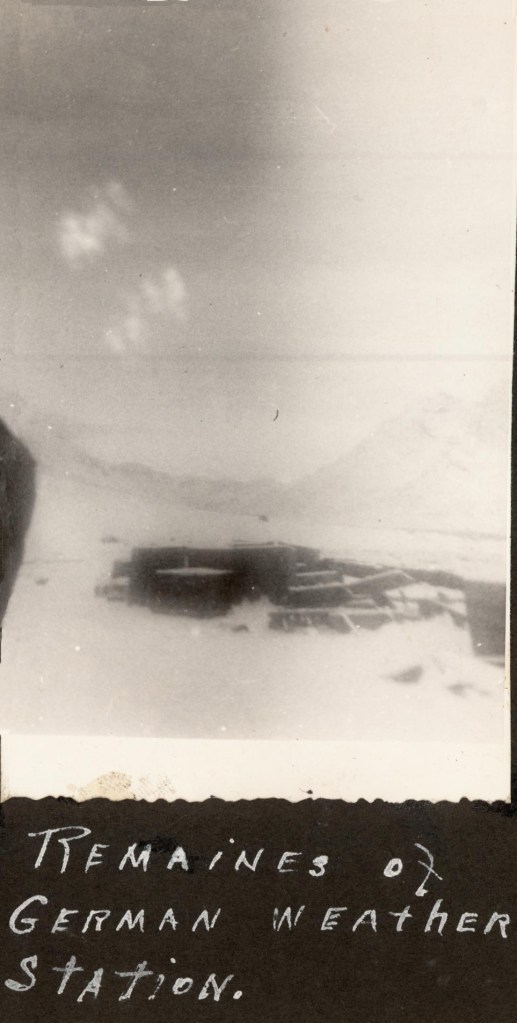
Along with all the wonderful indigenous artifacts that he brought back with him, and the stories of all he saw, there is one picture that he took that is important because of its historical military significance:

naziweatherstation
Photo taken by Clarence John.

The mission was boringly named by Germans as the “German Greenland Expedition,” and it wasn’t their first attempt to establish radio stations in Greenland.

The US Navy haunted the coast of Greenland with the purpose of hunting down and destroying secret radio and weather bases that were being set-up by the enemy in various remote locations around Greenland. And, it wasn’t until  many months after this particular event occurred that the US Navy revealed what had actually happened, no doubt for security reasons.

Early in 1943 this secret base had been discovered, in May it was bombed by Army Air Force planes, and in September it was finally wiped out by a Coast Guard-Army expedition. The Germans occupying the small base had evacuated. But two German soldiers were eventually taken prisoner, one who had been captured and one who stumbled, accidentally, into the hands of the Americans.

The base was on an uninhabited small island off the east coast of Greenland, and had a small contingent of men from the German Navy. It was discovered by a sledge patrol consisting of Danish hunters who kept an eye on the coast for the US Navy while hunting. The two groups engaged in a battle and two Danes ended up being taken prisoner, another was killed. However, there were survivors who managed to get away and report the discovery to the US soldiers. After the battle the Germans banded together a party and headed north with the intentions of attacking the Danish weather station there. With machine guns under the cover of night, they attacked, but most of the Danes managed to escape.

The German commander attempted to get one of the Danish prisoners to collaborate on a mission up the coast, but at the first opportunity the Dane overpowered the Nazi and after a 40 day trip back, delivered him to the Americans.

Not much was left of the base when the Americans were done bombing it, as can be seen in the pictures.

The Germans were pretty persistent and continued making attempts to establish bases, as the Navy encountered several German air patrols and engaged them over the next few months.

Clarence must have been along for the ride when the US soldiers made a trip to the base to make sure it was destroyed. At no time is an exact location given, but it must have been pretty remote for it to take 40 days to get a prisoner back to your allies.

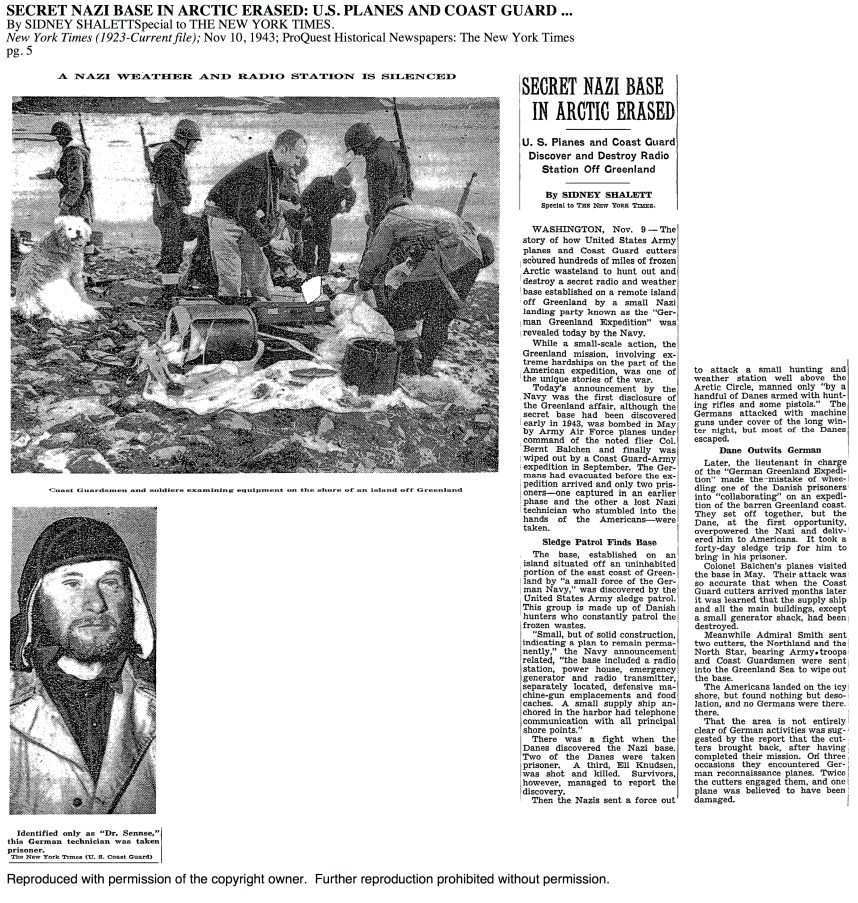
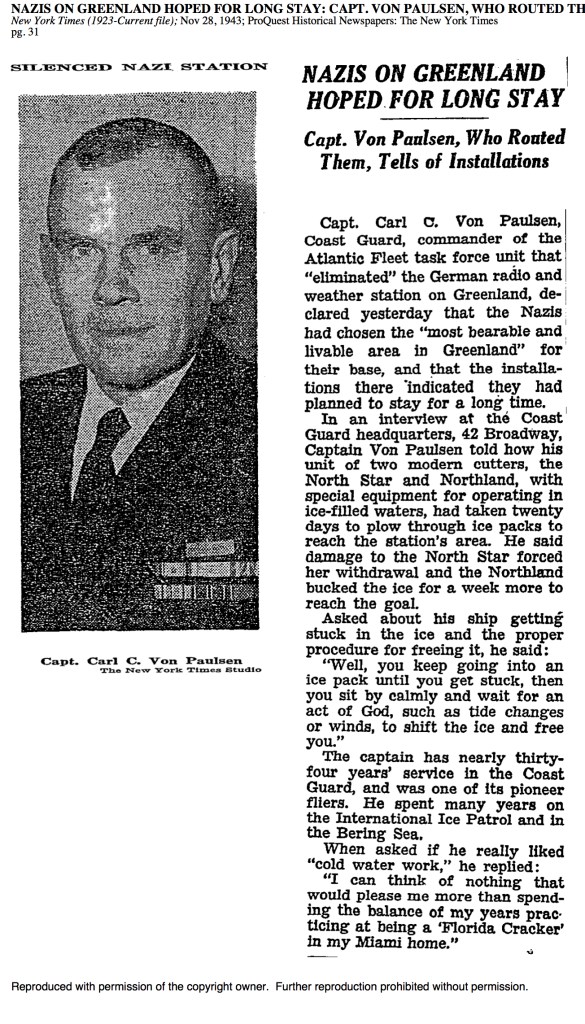
You can read the complete details in the article, which was published in November of 1943. Clarence had a small clipping of the event from another paper in his scrapbook. He didn’t see combat, but he did get to witness an exciting intrigue related to the war. Spies and secret bases oh, my!

newspaper_johncf_nazibase

newspaper_johncf_nazibase2

Elizabeth George lost sister no more…

This is the second time that land records have helped me finesse my family tree.

Sometime last year as I was transcribing GEORGE family land records into my database, I ran across a very interesting one:

Catharine Booker
Int in 78 acres – Sancho to
William C. Ash

This Indenture made this 23rd day of June in the year 1868 between Catharine Booker of the County of Wetzel in the State of West Virginia of the first part and William C. Ash of the County of Tyler & State aforesaid of the Second part. Witnesseth that for and in consideration of the sum of fifteen dollars the receipt whereof is hereby acknowledged, the said party of the first part, as an heir at Law of William George deceased in and to a tract of land lying and being in the County of Tyler aforesaid, situated on the waters of Sancho creek and being principally in the occupancy of the said party of the second part and being the same land heretofore charged to the estate of the said William George deceased on the commissioners land books of said county of Tyler as 78 acres the interest of said party of the first part which is intended to be hereby conveyed being the undivided one twenty eight part of said tract of seventy acres which said party of the first part derived as one of the children and heirs of Elizabeth Booker deceased, who was one of the children and heirs of the said William George died, and the Said party of the first part doth hereby covenant that she will warrant generally the property hereby conveyed. Witness the following signature and seal

Catharine [herXmark] Booker [seal] 

So in June of 1868, Catherine Booker, a child/heir of Elizabeth Booker, is selling land she inherited from Elizabeth, deceased, who was a child/heir of William George, deceased.

All of the online trees I have seen in my GEORGE family research have no mention of a daughter Elizabeth. Which tells me that these folks have not done their research properly. And because they hadn’t done their land record research, look what they missed!

So, Catherine is a previously unknown grandchild of William and Margaret George. It is doubtful that when William died he was giving land to nieces and nephews, he had at least 4 children and 4 times as many grandchildren that were around to inherit.

Elizabeth, the child of William and Margaret, appears to have married a man named Booker, (possibly a Henry) and she died sometime before her father, William George. Because of the date of birth of Catherine, which is speculated to be about 1820, from a Wetzel County, 1870 census record (although, admittedly, it is not confirmed that this census record is the correct Catherine; it seems likely as she is the only one living in Wetzel County close to the place and time of the land deed record, dated 1868) the date of birth of Elizabeth has to be 1805 or earlier. As the birth years for the children of William and Margaret are all in the very latter part of the 1700s, Elizabeth’s probable birth estimation would fit the time period.

So far the only record I have of the existence of Elizabeth is this land record. A sad state of affairs for many of my female relatives of old.


Source:
Land deed filed in Tyler County, West Virginia,  V2P371 [FHL film 855,954].

Interesting Connelly death…

I recently ran across an interesting entry in the Rhode Island death index at ancestry.com, (in my never-ending quest to find a death record for Martin Cain). The entry stated:

Name: Michael Canealy
Kin 1: Martin Cane
Kin 2: – Bagnall
Death Date: 9 Mar 1855
Age: 64 Yrs

So it looks like Martin and Winifred still had Connelly family living in Rhode Island other than one or two of Winifred’s siblings.

I believe that this gentleman is possibly Winifred’s uncle. It would be nice to see Irish church records to confirm this, maybe I can find a church record in Rhode Island. There are two facts that support the theory: first he is two years older than his possible brother Dennis (so the age fits nicely for them to be brothers), second the close seeming relationship of Michael and Martin, (after all Martin is providing the information for the death registration and his wife was a Connelly).

Of course this news isn’t mind blowing, but it adds a little more interest to the family tree. I would love to find out more about this possible brother. Dennis and Winifred did name one of their children Michael.

I’ve done some research into the Irish records that I have access to and so far no luck on being able to hone down any details on Michael. Rhode Island records are pretty sparse also, he doesn’t appear to show up in the 1850 census. Which means he could have arrived after 1850 and died shortly after making his way to America. This record also appears to indicate that he was single at the time of his death, otherwise I believe one of his children or his wife would be providing the information for his death registration, but that is mere speculation at this point.

I did notice that he is another Irish relative who died a little on the young side.


Source:
1 Ancestry.com. Rhode Island, Deaths, 1630-1930 [database on-line]. Provo, UT, USA: Ancestry.com Operations Inc, 2000.

Crawford’s Defeat

A continuation of the McQueen and Brown involvement in Indian wars.

After the massacre at Gnadenhutten the thirst for blood on both sides was high. All of this conflict was occurring towards the end of the revolutionary war largely because the American’s wanted to put a lid on any Indians helping out the enemy or causing trouble on the western frontier. So an expedition was organized, to be led by Crawford, to destroy any enemy Indian towns along the Sandusky River in Ohio Country.

The expedition was a disaster from the start, partly because the Indians and British knew they were coming, and were quite prepared for the coming battles, and partly because of the poorly trained miliamen, bad leadership and poor planning on the part of those in Crawford’s organization.

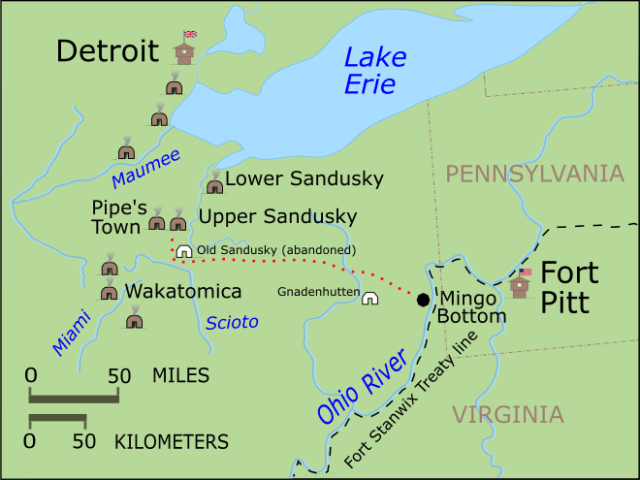
Crawford_expedition
Crawford Route (Image from Wikipedia page).
Sandusky_sites
Significant battles (Image from Wikipedia page).

The McQueen brothers and George Brown were all part of this campaign. George was married to Elizabeth McQueen (their sister; and my 5xgreat grandparents). George had his own company of which he was a captain, brother-in-laws James and Benjamin McQueen were part of this company.

Between May 20th and 24th of 1782 the frontiersmen all met at Mingo Bottom and on the 25th the expedition left and begin their 150 mile trek to the enemy, the enemy that watched their every move. It wasn’t until June 6th that anything of importance happened. They had run across the deserted villages along the Sandusky where they expected to find villages full of people to exterminate. The miliamen upon seeing this, became very impatient to return to their homes as there was nothing of interest to continue pursuing. It was decided by the officers in charge to march one more day and if they didn’t find anything, to abandon their course and return home.

No sooner had they made this decision than a scout showed up to inform them of an advancing party of Indians about 3 miles away. The army eagerly moved to meet the enemy and proceeded to attack. The melee went on all day with heavy fire on both sides. But the Indians didn’t outright attack during the day, although they appeared to be increasing in numbers at an alarming rate, becoming so noticeable that the American officers decided they would have to begin a night retreat in an effort to save the army. The Indians who were aware of their plans, attacked at sundown. The frontiersmen (comprising about 1/3 of the army) retreated into different directions in small groups hoping that the Indians would follow the main body of the army. But they didn’t.

George Brown’s company was one of those that split off. Another McQueen brother, Thomas, who was with a different company, also left. The Indians had no intention of letting the enemy go so easily and spent several days pursuing and killing any straggling parties they found.

George was shot in the arm or thigh (depending on which telling you read) and the bone broke, he managed to escape on horse, but had to hide quite often before he could make it home. He had spent time trying to find others in his company before he was shot and gave up to head home. Two weeks later he showed up at his door much to the joy of his wife Elizabeth. His brother-in-law Thomas McQueen was not so lucky, he was caught when a fellow traveler decided it was a good idea to shoot a raccoon for dinner and the shots were heard.

“My brother Tom was taken in Crawford’s campaign…and [they] made Tom run the gauntlet. There was not a sound place in [his] head when he got through. But a squaw gave, I forget how many buckskins for him. The 3 had been separated from the rest of the army. Got way down on the Ohio, and being nearly starved, the lieutenant would shoot at a raccoon in the tree, & the indians heard them and took them. The British had him in irons a great while for saying something about Simon Girty…”2, 3

Thomas did eventually make it home, although in later years he was nearly blind due to the trauma to his head during the gauntlet.

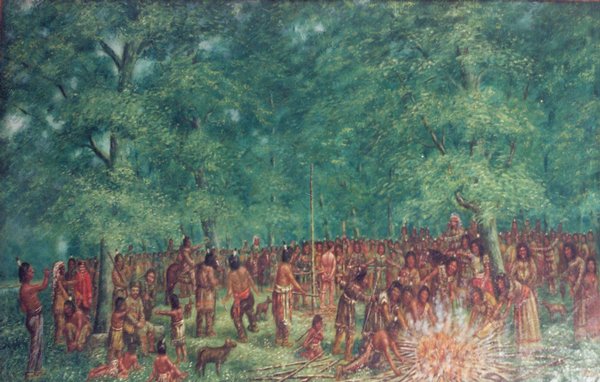
So this particular campaign on the part of the Americans to annihilate the Indians was a bust. And, because of the Gnadenhütten massacre, the Ohio Indians had resolved to kill all American prisoners who fell into their hands. The number of Americans executed is unknown. Crawford’s execution was especially gruesome and I don’t have the stomach to tell it, you can read all about it at the wiki site.

Burning_of_Colonel_Crawford
The burning of Crawford.

Sources:
1. https://en.wikipedia.org/wiki/Crawford_expedition
2. “Metes and Bounds I: Dugal McQueen and Some Descendants”, by Donna Hechler. Wyandotte, OK, The Gregath Publishing Company: 1999.
3. The story of Simon Girty

John DNA relative found?

3274299875_615a879761_o
Friedrich Wilhelm Jahn, aka FW John.

Shortly before Christmas I received an email from a gentleman whose DNA was matching my cousin Ron Hinz, and was searching for other people who might be related. Their connection appeared to be the Jahn surname. And he is trying to find out more about his ancestress Charlotte Jahn who was born in Pozen, about 1802, and married Johann Gottlieb Wocknitz. Who are her parents? Where did she come from? The usual.

The couple do have two children that show up in German church records (Germany Births and Baptisms, 1558-1898: Kolmar, Posen, Prussia):

Friederike Charlotte Wocknitz
birth: January 1829; christening: 8 February 1829
father: Johann Gottlieb Wocknitz
mother: Charlotte Jahn

Carl August Wacknitz
birth: August 1826; christening: 3 September 1826
father: Johann Wacknitz
mother: Charlotte Jahn

I have to admit I am a little excited by this news, because I never thought that we would have any luck finding DNA cousins on the JOHN line, other than children of Frederick William or his brother August.

The possible connection for us is that Charlotte is an Aunt of FW, but of course that is merely speculation at this point. Her being born about the same time as Ludvick Jahn could make them siblings, or cousins. We won’t really know the answer to that unless we can find more church records. Which will be difficult because they are probably in Poland, if they still exist at all.

So here’s hoping the New Year brings us progress on this intriguing connection.

And here’s wishing everyone a great New Year!

Charlemagne

I decided to focus on a happier subject for the Christmas week. So, I am posting this link to an article on Charlemagne written by one of my DNA cousins, as we are both his descendants.

MTE1ODA0OTcxMjczMzI0MDQ1
Charlemagne, although probably painted many, many years after his death.

Roberta Estes has an excellent blog on Genetic Genealogy that I read, and happened to post this very interesting bit on our many times gramps. In our case it is through Dr. Robert Palgrave, on Lois Shaw’s side of the family.

Enjoy! And have a wonderful Christmas. We will be heading to the parents.

via Charlemagne (742/748-814), Holy Roman Emperor, 52 Ancestors #103 | DNAeXplained – Genetic Genealogy.