I was going through my ‘address book’ making sure that I sent out holiday cards to everyone and I ran across Cecil’s entry in my book. Cecil is a Stackpole cousin whom mother and I met when we went out to West Virginia for a Hays reunion many years ago. He helped us find a couple of cemeteries in the area, as he and his family had lived there all their lives.
I thought I would check up on him to see how he was doing. Not so well as a matter of fact. He passed away this last August. So I thought I would post his obituary as entered in this online memorial:
Obituary for Cecil N. “Diddy” Stackpole
Stackpole, Cecil N. “Diddy”, age 81, of Postlethwait Ridge Road, Littleton, WV, formerly of Pine Grove, WV, went to be with the Lord on Monday, August 10, 2015 at his home.
He was born April 27, 1934 at Pine Grove, the son of the late Cecil Earl and Eva Morgan Stackpole.
He was a retired heavy equipment operator and a member of Wetzel Lodge #39 where he was a Past Master. He was a loving husband, father and Grandpa.
In addition to his parents, he was preceded in death by a brother, Wallace Stackpole; a sister, Mary Martha Stackpole; and a grandson, Brendan Mathew, who was waiting on his Grandpa.
Survivors include his wife of 54 years, Sue Stackpole; two sons, Rob Stackpole of Postlethwait Ridge and Pat (Sharmion) Stackpole of Hastings; four grandchildren, Patrick Neil Stackpole, Jr. “PJ”, Tiffany Lenay Stackpole, Krysta Stackpole and Keera Stackpole; two sisters, Patricia Howell and Janet Goodwin; and a sister-in-law, Glenda Stackpole.
My condolences and sympathies to the family.
‘Diddy’ and I had a good time comparing notes when I first started researching the Stackpole line. Including chortling over a Stackpole researcher who keeps putting up totally incorrect information about Thomas Stackpole, no matter how many times we told him he was wrong.
While we celebrate our thanksgiving and feel all proud and smug about being American’s, well maybe not so much these days, most folks try to forget that the country we live in today came at a very great cost to those who had settled here long before the first European arrived.
I can claim many ancestors on my mother’s side of the family, and a few on my father’s, who were what we considers ‘frontiers folk.’ They hacked, literally and figuratively, their way across this country building new lives for themselves many times over in the wilderness that once was. Along the way they also hacked down a few of the first settlers who were in their way.
One of those frontier families were the McQueens, who in the course of their years as settlers had developed a keen and decisive hatred for the indigenous people who were living on the land they wanted. This hatred no doubt was fueled by all the killing that occurred on both sides of the fence – as one wanted to keep the land that was theirs to begin with, and the other wanted to take it from them, rightly or wrongly, the large majority of frontier folk didn’t much care.
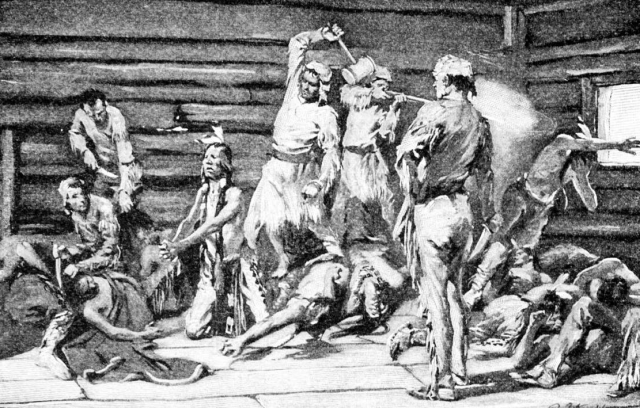
In March of 1782, a group of Pennsylvania militiamen under the command of Captain David Williamson attacked the Moravian Church mission at Gnadenhutten consisting of Christian Indians. Because of ‘evidence’ that was most likely planted by the Shawnee, they believed that they were revenging for the deaths and kidnappings of several white settlers that had occurred in the area earlier. However, the Delaware had only recently arrived back at their village to forage for food and had had nothing whatsoever to do with the earlier killings and kidnappings.
Accusing the Delaware of the attack on the Pennsylvania settlements, the soldiers rounded them up and placed the men and women in separate buildings in the abandoned village overnight. There was a council of war held by the militiamen, with a few voicing their distress at the idea of murdering all the prisoners as punishment, but their voices were not heard as the majority vote was to execute their captives the following morning. One of the men who was not keen on the idea was my ancestor George Brown, a brother-in-law to Thomas McQueen (an ancestral uncle) who was all for the decision to put them to death. George, a minster at the time, had more compassion and did not feel that death to all the Delaware prisoners was a proper punishment for their supposed crime.
Informed of their impending deaths, the accused spent the night praying and singing hymns. The next morning the soldiers dragged the prisoners in pairs by the ropes around their necks to a slaughter house where they were knocked down with a cooper’s mallet and then scalped and murdered all 28 men, 29 women, and 39 children. There were only two survivors left to tell the story.
Folks who didn’t live in the frontier were appalled and horrified at the massacre, those living on the frontier mostly felt the Indians got what they deserved, and there was even talk of mounting another invasion against the Indians. The result of this massacre was more Indian reprisals and raids, fueling more hatred of the ‘red-skinned’ enemies. Eventually all this activity led to Crawford’s campaign. (Both George Brown and all the McQueen boys were involved in the Crawford campaign, in fact George had his own company. More on this in another installment.)
This is not the first occurrence of ancestors of mine murdering Indians, although it is probably close to the last. Of course the Indians got their licks in, as I have surprising number of ancestors who died under the blade, arrow or bullet of ‘the enemy’ too. I harbor no resentment. Even though it was never officially declared, the European invaders were always at war in one way or another with the people who were on this continent first, and sadly we won. Too bad we couldn’t have shown our better quality.
This image is from a scanned newspaper image, so it is not the greatest.
When Abram Rosa came back from his time in prison after the Civil War, he came back to an empty home. His wife, Jennie, had left him, taking their two daughters with her. At this time we are not aware of an actual divorce having taken place between the two of them, but they both did marry to other people a few years later.
Abram’s second wife was a woman by the name of Harriet Emerson. They married in October of 1869. Over the 4oish years of their marriage they had two known children, both boys, Alby and John Nelson. So now my gg grandmother Carrie had two half brothers, both of whom she never met or knew about, as far as we know.
John Nelson did marry, at least 3 times, but never had children. His brother Alby married several times also, but he did manage to have two daughters with his first wife Dora Ritter, Erma and Loral. Erma never married. Loral married a gentleman by the name of Willis C. Servis in 1921 in Benton Harbor, Michigan. They had one son Dean C. Servis before they divorced, Loral married again to Ethemer Emery in 1932 and together they had about 6 children.
So what does all this have to do with speed?
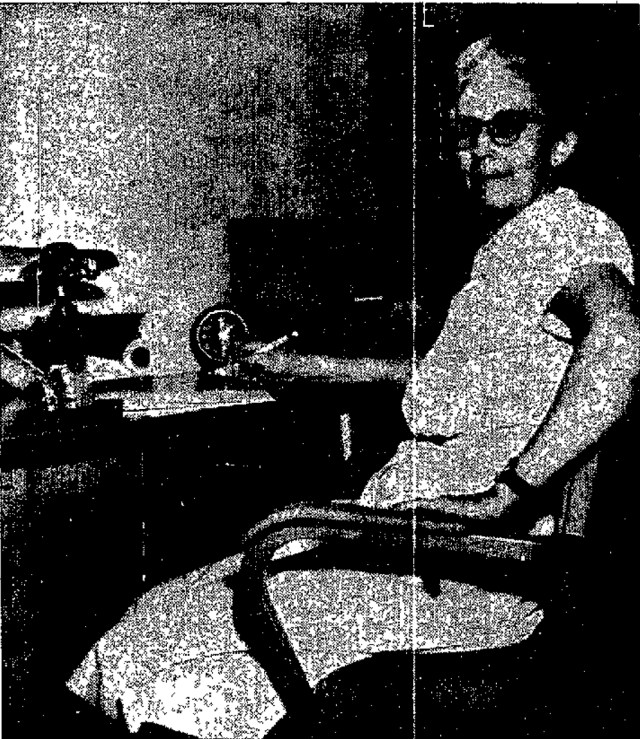
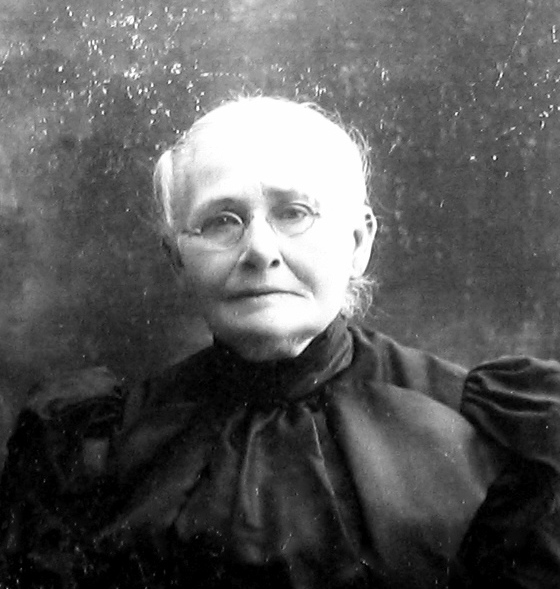
Loral, the actual subject of this post and pictured above, was not your usual grandmother type. Somewhere in her genes was a speed demon waiting to come out.
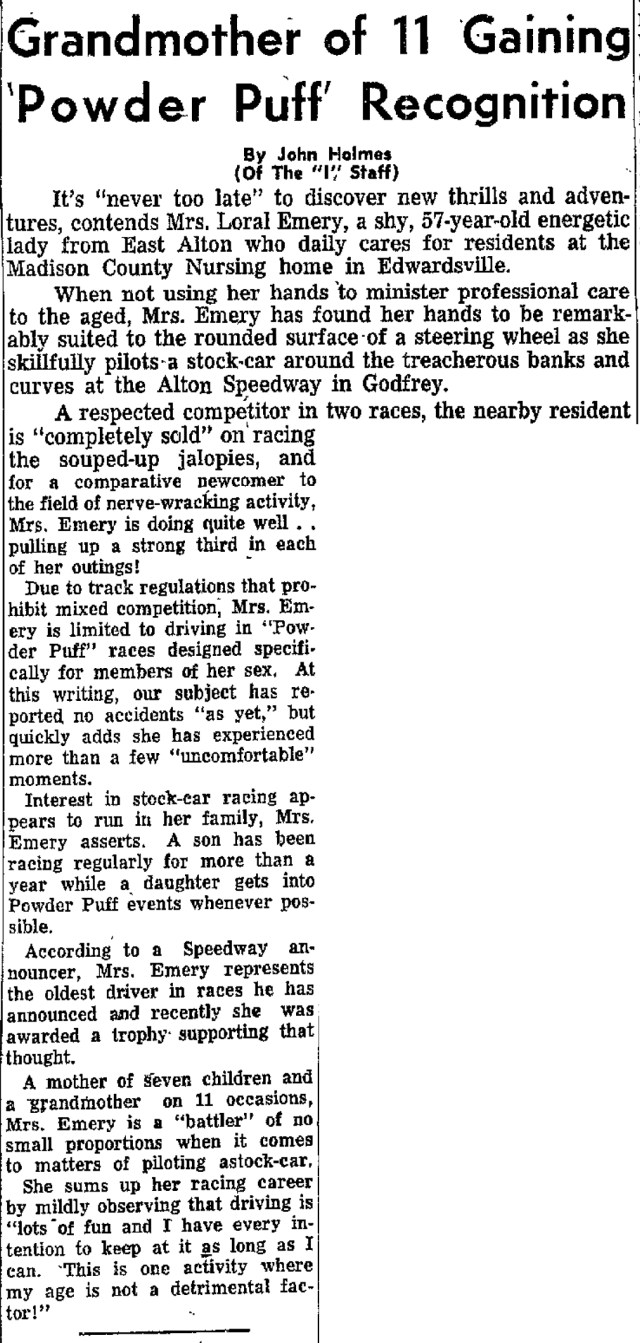
While trying to find out more about the Abram’s second family and his descendants, I found this awesome newspaper article:
Edwardsville Intelligencer August 2, 1958 page 6.
The caption that is with her picture above reads:
Equally at ease in matter pertaining to ministering professional care for the aged at the Madison County Nursing home in Edwardsville or when behind the wheel in stock-car racing is Mrs. Loral Emery a resident of East Alton who contends she is “completely sold” in piloting jalopies at the Alton Speedway in Godfrey.” The 57 year old grandmother of 11 was recently presented a trophy symbolic of being the eldest driver at the nearby oval.
I wonder if her interest in racing was influenced by her first husband, Willis, who was a garage mechanic? She definitely had cool written all over her.
Racing, like all sports where men are involved, was a vey sexist sport. In the 1940s, when racing clubs were first starting in the U.S., a woman’s role was as either ‘eye-candy’ or ‘sandwich and coffee provider’ for all the manly men doing the racing, or working in the pits. This continued into the 1950s, although now there were a few women starting to get their game on and competing in their own right. So when Loral was heading out to the track to satisfy her speed need, she was doing it at the time women were coming out of the woodwork and showing the men they had what it took to race, contrary to popular belief. (Although, there are still plenty of dumb bunnies out there today who are satisfied being nothing but eye candy.)
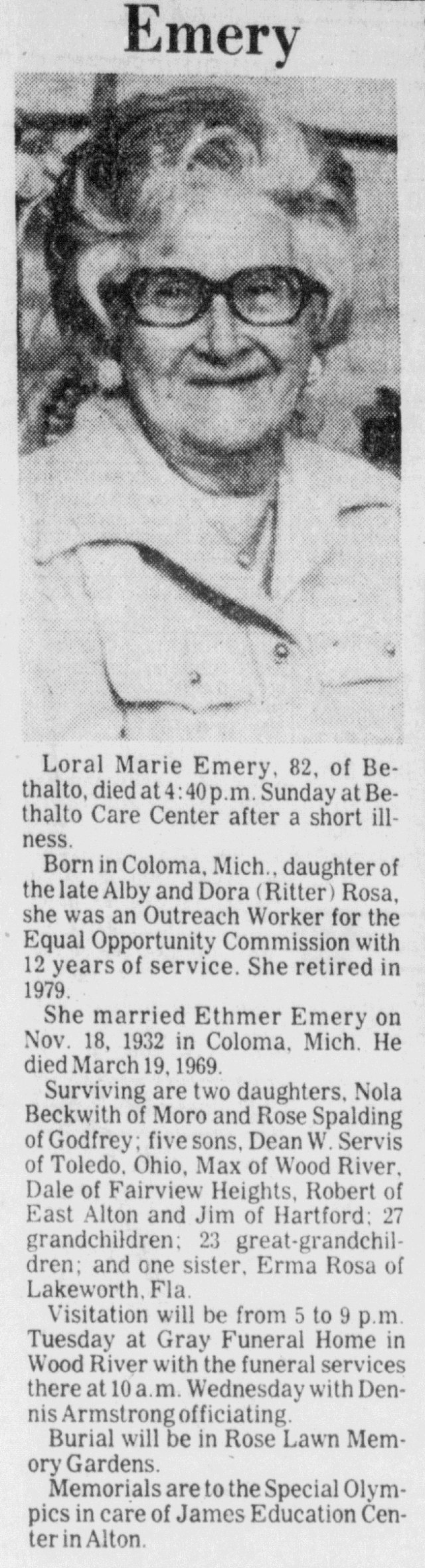
After this article was published in 1958, Loral went on to live another 25 years. She passed away in 1985:
Loral appears to have been a pretty interesting lady. (She was my half 1st cousin 3 times removed.)
Henrietta Völks1 is not a relative of mine, although if the fates hadn’t been so cruel she might’ve been. She was my gg grandfather’s first wife whose life was cut quickly short by cholera.
Now fill your glasses to the brim, And drink with steady eyes, Here’s to those already dead And here’s to the next who dies!2
When the ship Eleanore docked at the port of New York on June 23rd of 1852, on board was the married couple Friedrich Wilhelm Jahn and his wife of several years Henrietta. There were no children with them on the passenger list, and we do not know if they ever had any together.
F.W. and Henrietta’s final intended destination was Wisconsin. It is unknown exactly how they eventually made their way there, although, it was probably by steamboat across lake Michigan which was quite a popular route at the time. They most likely arrived in Milwaukee sometime in late July, early August and stayed either with relatives, friends or at one of the many boarding houses that took in the large numbers of recent immigrants.
Milwaukee was becoming quite the large metropolis at this time in Wisconsin’s history. Immigrants were flocking in by the thousands weekly from England, Germany, Ireland. This huge influx of people along with the crowded conditions of the city, poor sanitation and bad water, helped to spread the disease that was part of the worldwide cholera epidemic of 1849, which continued in several outbreaks until 1854.
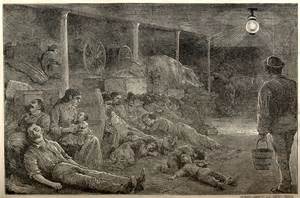
Image of cholera victims.
The 1849 Cholera epidemic is believed to have arrived in the United States from the German ships arriving in New York and New Orleans, and by the next spring it began its steady spread through out the interior of the country.
The scariest part about cholera for folks at this time was: not understanding how it spread, and the swiftness with which it struck. You could be talking to a friend one day and they would appear to be in the best of health, and the next day you find out they are dead. One of the symptoms of the fear people experienced, was that they fled like rampaging cattle from the disease, in effect making sure of its spread to unaffected areas. If you were a victim of the disease you can be sure that many a family member or friend would abandon you in a heartbeat and leave you to your fate, in the hopes that they won’t catch the disease.
Doctors still didn’t really know what caused it, or how it spread. Newspapers and rumors were quick to use the immigrants as scapegoats. While part of the blame could be placed on these folks who brought it over from Europe, general lack of knowledge about its cause helped it along.
The epidemic re-emerged several times until about 1854. The 1852 epidemic while not nearly as virulent still managed to kill Henrietta. According to family stories, by September (only a few months after she arrived at her new home) she was dead.
At death, the cholera victim was wrapped in a white garment and then put in a wood box, after which the group of men hired to take care of the dead were called upon. They would haul the body off to the sand trenches where all the other bodies were buried. In some cases when a whole family had died, the neighbors would just torch the house with the bodies in it. It is believed that some folks were so desperate to dispose of the victims that there were cases of people being buried while not quite dead.
There is no known headstone or burial place for Henrietta, maybe she is one of the many unnamed victims buried in a potters field in Milwaukee.
So this year, I give thanks for the advances we have made in modern medicine, science, and our understanding of the world around us. I will also raise a glass in honor of Henrietta, whose life was cut brutally and abruptly short.
———- 1 Henrietta’s last name has been seen spelled many different ways including, Voaks, Voeks, Voöks.
The Civil War in the United States was a tragedy of huge proportions for the citizens of this country. So many lives lost because of misplaced southern pride in outdated and appalling views on ownership, ‘states rights’ and slavery.
James Shaw, born Ohio in 1808, was an older brother of my ggg grandfather the Hon. John Shaw. By the early 1830s James decided to try his fortunes in Texas and moved his family to what is now Milam County. He had married one of the Riggs girls and had several children with her. One of those children was a son, Frank Shaw.
James embraced being a Texian wholeheartedly, even joining the military when they were fighting Santa Anna. He was in the decisive battle of San Jacinto that was one of the determining factors in the future of Texas as a state.
Sometime after the civil war started James’ son Frank, feeling the fever of youthful righteousness in a cause, joined up. On the side of the South. This decision had the unfortunate effect of ending Frank’s young life quite abruptly. His father wrote this letter to the paper, mostly likely as a way to help himself work through his grief:
A PIECE OF SAVAGE BARBARISM
Editor Gazette:
Permit me through the columns of your weekly paper, to make known to the civilized world and to Texian soldiers in particular, the death of my unfortunate son, Frank Shaw, a native Texian, who was brutally murdered by Federal troops in Louisiana, on the 3d day of November last. The circumstances are substantially as follows: My son was Orderly Sergeant in Captain Waterhouse’s Company, Lane’s Regiment, Majors’ Brigade of Cavalry. In the morning of the Borbeaux battle, his (Waterhouse’s) and Johnston’s companies, who had been on picket, a mile from the Federals encampment, marched up to a bridge on Bayou Borbeaux fronting the Federals, and were ordered to dismount and take trees. My son with two or three others, seeing a good position across the bayou, some eight or ten steps in advance of our line, ran to it, and after having fired three or four rounds each, the order was given to fall back to their horses, who having further to run by being in advance, they were captured before they got back.
At this critical moment Gen. Green and Majors came dashing up at the head of their victorious columns from the right, and repulsed the enemy, who after having taken my son some four hundred yards, fearing his recapture, brutally and inhumanly murdered him by shooting him in the head with a pistol!
I have not written this account hastily and from the impulse of the moment; but have waited patiently for the last four or five weeks hoping the first account of this sad affair which I received from my nephew, A. P. Perkins, might possibly prove incorrect as I could not believe, that there was a nation on the face of God’s habitable Globe, especially one professing to be foremost in civilization and Christianity, that would have acted so barbarously: notwithstanding the poet has long since said:
“But look for ruin when a coward wins, For fear and cruelty were ever twins.”
My son had met them honorably previously on many battle fields. Mr. James Holland, a member of the same company, has lately arrived at my house, with his horse and baggage. He was taken prisoner a short time previous to my son; but he saw while in New Orleans, before his escape, the prisoners who were captured with him, with whom he was well acquainted, and they informed him that they saw Frank shot in the cowardly manner described above, and for the only reason, that his feeble health would not permit him to keep up afoot, with their retreating cavalry.
I have been thus particular in detailing facts for this purpose of making it publicly known to our brave Texian troops in the field, that these same thieves and murderers under Gen. Banks, are now polluting our Southern borders with their unwelcome presence, and I now leave it with them to decide whether or not, so cowardly and dastardly an enemy deserved the treatment of a brave and magnanimous foe?
James Shaw
Lexington, Jan. 13, 1864.1
There is no getting around the fact that war is an ugly and violent affair no matter how you look at it and Frank was a casualty of that ugliness. The manner of his death, if accurately reported (remember we only have one version of what happened), is unfortunate and it is understandable that James’ view will be prejudiced. In my, admittedly prejudiced, mind his son was fighting to preserve slavery under the misguided guise of state’s rights. Where was the honor in that? But the fact is, one side had no more claim to honor and heroism than another, as both the North and the South committed acts of barbarism, compassion, and heroism at many times during the war.
1 Published in the [Texas] Galveston Gazette, January 13, 1864.
I thought I would add a little more spice to Ezekiel Cheever’s connection to the Salem trials. This was found in an old Goble Family Newsletter while I was researching a different ancestor, (the reason they wrote an article regarding the trial was because of the Corey connection to the Goble line):
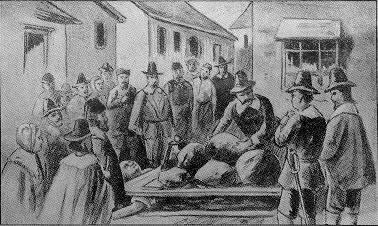
On 18 April Giles Cory was accused of witchcraft by John Putnam, Jr. and Ezekiel Cheever. On 19 April 1692 he was examined in Salem Village and on 19 September he was pressed to death under an old torture known as peine forte et dure, an ancient English procedure designed to force recalcitrant prisoners either to enter a plea (so their trials might proceed) or to die. Brown describes him as “Eighty-year-old Giles Corey, husband of the imprisoned Martha, was a powerful brute of a man and feared by many in the Village. Seventeen years before he had brutally murdered a servant (Jacob Goodale) on his farm and ever since had tangled repeatedly with the law.” Hansen tells us “Giles Corey had been ready very ready to testify against his wife, Martha, and to speak out against her out of court as well as in; he had told several people that he knew things that ‘do his wife’s business.’ Now he was admirably, if belatedly, protesting her innocence as well as his own. But he did it stupidly; he denied having said things which witnesses had heard him say and thus was several times caught lying. Since lying was a serious matter in Puritan Massachusetts and perjury is a serious matter in any age, Giles Corey must have made a very bad impression.”
Brown describes his death: “He was taken to a Salem field and there staked to the ground. A large wooden plank was placed over him. Upon it were piled stones one at a time. The authorities intended to change his mind with force. Tradition has it that Corey pleaded only for “more weight” so that he might die swiftly. ‘In pressing,’ a contemporary wrote, ‘his Tongue being prest out of his Mouth, the Sheriff (George Corwin) with his Cane forced it in again, when he was dying.’ His was a horrible death. Corey endured this punishment for two days before expiring.”
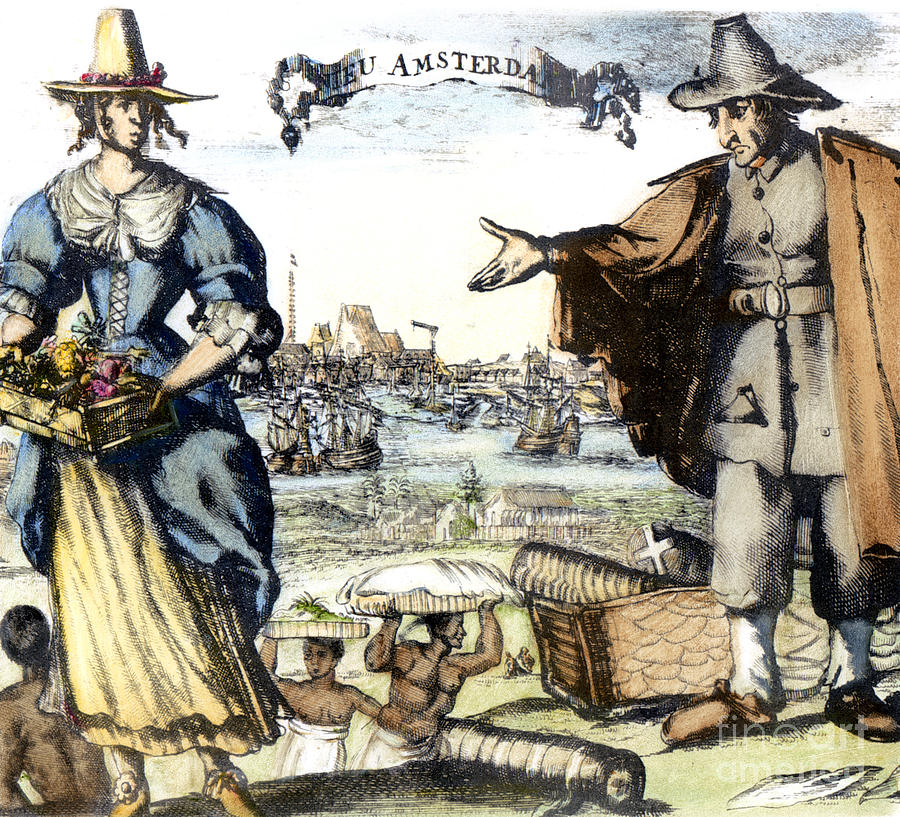
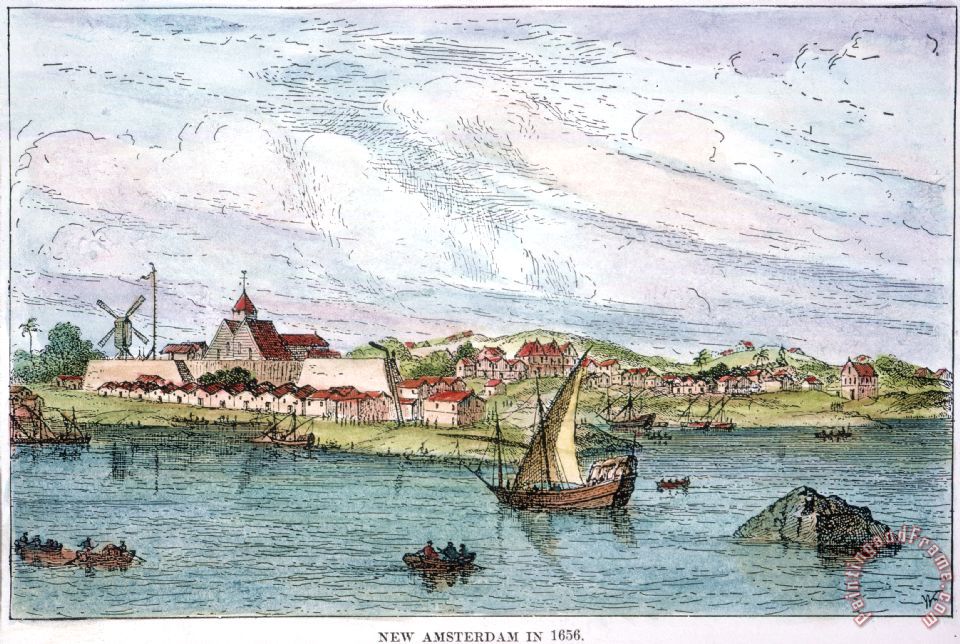
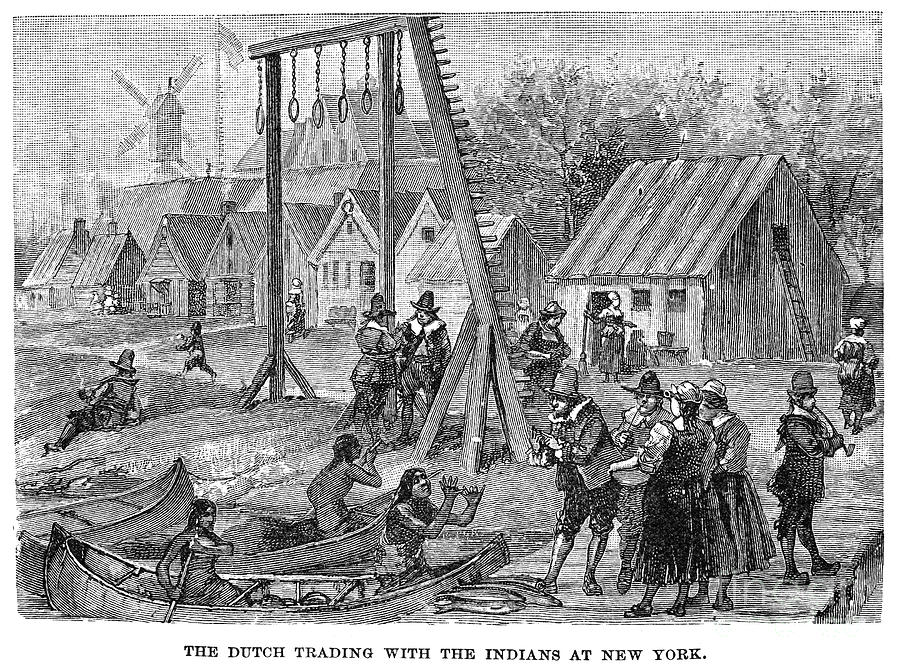
This tavern might not be as infamous as the Fay’s tavern, but it was certainly older. Welcome to Nieu Amsterdam!
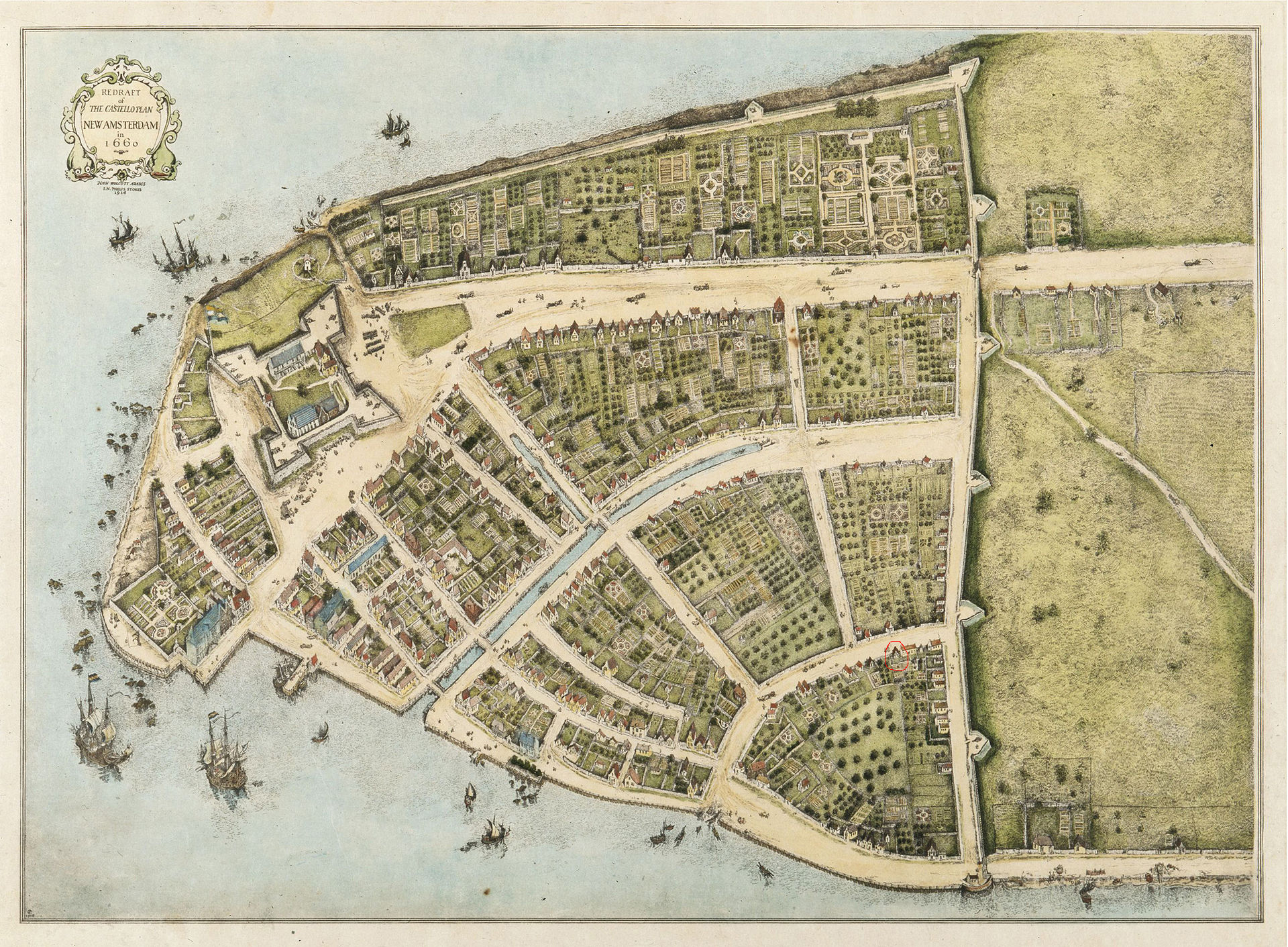
My ancestor on my father’s side, Andries Rees is believed to have arrived in New Amsterdam around the 1650s with his wife Celjite Jans and their son Willem. Andries was actually born in Lipstadt, Germany. His move to New Amsterdam was because his employer, the West India Company, required his, and his fellow soldiers, presence in the new settlement. By 1660 Andries and his wife Celjite were busy running a tavern, the location of which is circled in the map below in red. (Present day this is an office building, the funky wall going across the peninsula is now Wall Street.)
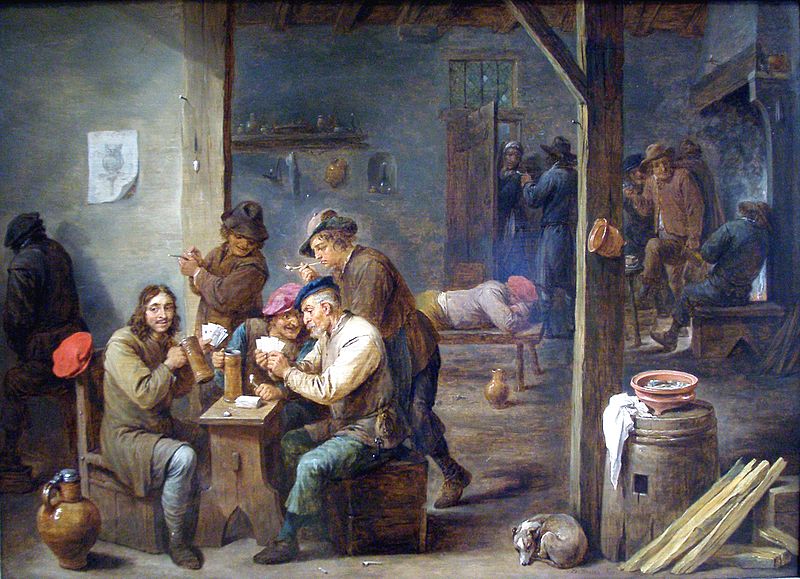
Redraft of the Castello Plan of New Amsterdam in 1660, redrawn in 1916 by John Wolcott Adams and Isaac Newton Phelps Stokes.A Dutch tavern scene. in the 1660s
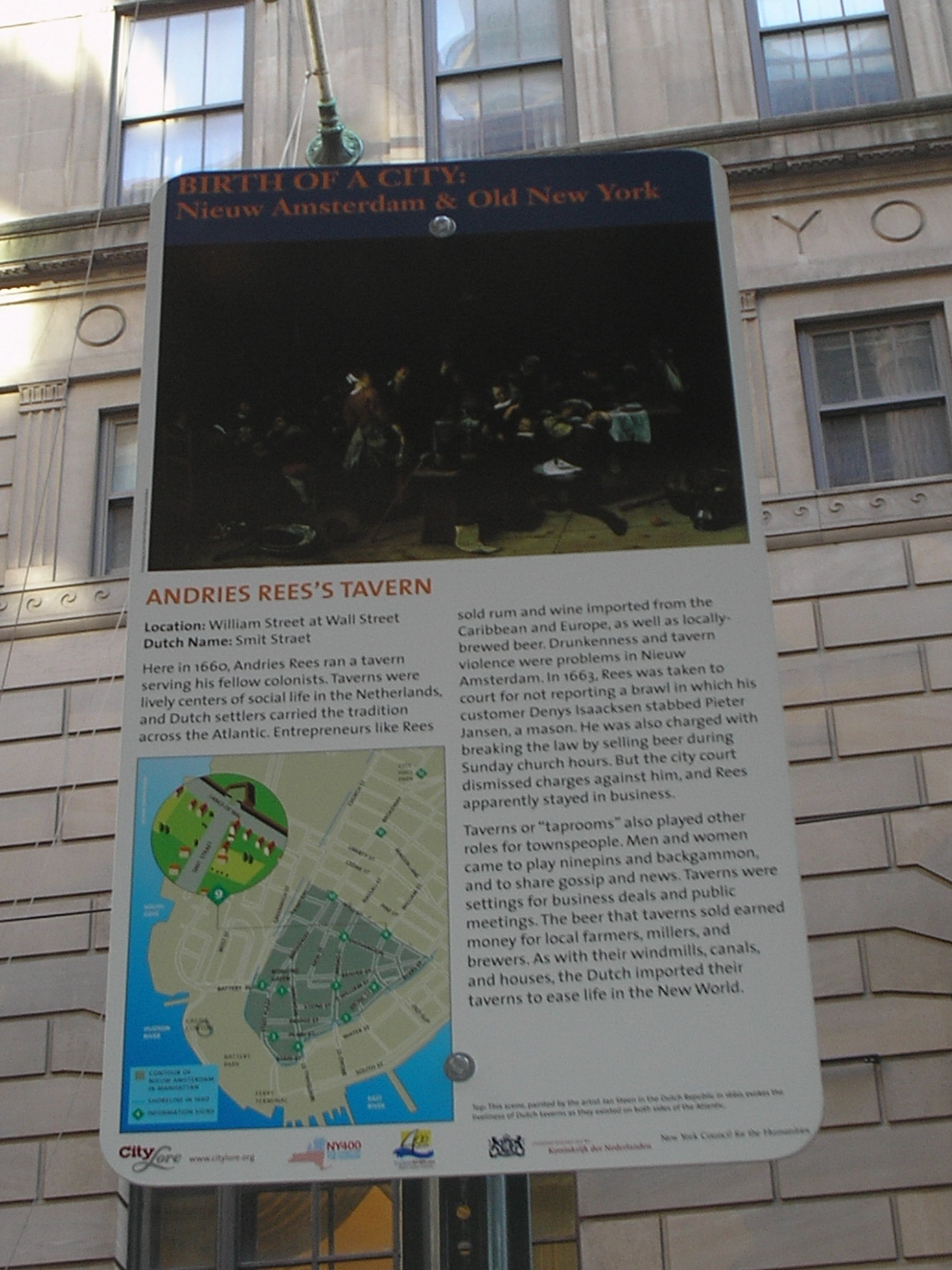
While the Rees’s tavern itself isn’t famous for who was there, it is a historical landmark because of when it was around as can be seen in the historical marker below.
ANDRIES REES’S TAVERN
Location: William Street and Wall Street Dutch Name: Smit Straet
Here, in 1660, Andries Rees ran a tavern serving his fellow colonists. Taverns were lively centers of social life in the Netherlands, and Dutch settlers carried the tradition across the Atlantic. Entrepreneurs like Rees sold rum and wine imported from the Caribbean and Europe, as well as locally-brewed beer. Drunkenness and tavern violence were problems in Nieuw Amsterdam. In 1663, Rees was taken to court for not reporting a brawl in which his customer Denys Isaacksen stabbed Pieter Jansen, a mason. He was also charged with breaking the law by selling beer during Sunday church hours. But the city court dismissed charges against him, and Rees apparently stayed in business.
Taverns or “taprooms” also played other roles for townspeople. Men and women came to play ninepins and backgammon, and to share gossip and news. Taverns were settings for business deals and public meetings. The beer that taverns sold earned money for local farmers, millers, and brewers. As with their windmills, canals, and houses, the Dutch imported their taverns to ease life in the New World.
It would have been great to have known about this while my sister an I were in New York visiting a while ago, we were in the area and could have checked it out.
According to histories regarding New Amsterdam, the fashion of the day in the seventeenth century was drinking and gambling. This included young as well as the old. These vices were, no doubt, popular in New Amsterdam because of the lack of other entertainments for the locals, as there were no books, theaters, museums or other distractions for one’s evening entertainment. When the official work or school day was done you either spent your time at home, in the sober environment of your parents, or spouse, or joined in the revelry at the local corner tavern. At the tavern there was drinking, dicing, card playing and many other questionable games to amuse. And apparently in New Amsterdam the licencoiousness was even more prevalent. In fact not only did the men indulge, but women and even the clergy were known to spend many an evening in drunken revelry.
One interesting result of this habit, in New Amsterdam, was that drunkenness was used as an excuse in court cases such as assault. The law also allowed men 24 hours to get sober, if after that time they wanted to denounce any transactions they entered into while they were drunk they were allowed to do so, with no repercussions.
In the seventeenth century ice was in use in taverns to keep their wines cooled. Customers drank from steins and horns, if it was wine, or pewter mugs and steins with lids if it was beer, poorer taverns served beer in wooden bowls. The common fare found in your local New Amsterdam tavern was wine, beer, ale, cider, rum, or gin, which was considered a poor class drink.
Major no-nos in New Amsterdam on a Sunday were, no drinking no gaming no gambling – in other words no fun. Celjite was in court being accused of having ninepins at her house on a Sunday. The can and glass, parts of the game, had been found on a table. Andries said he was not at home, but on watch, and he did not see any drinking at his house during the Sunday preaching. Celjite
“denies that there was any nine pins or drinking at her house, saying that some came to her house, who said that Church was out, and that one had a pin and the other a bowl in the hand, but they did not play. The Schout states that defendant’s wife said she did not know but Church was out, and offered to compound with the Schout.”
The court ended up fining her six guilders.
On June 19 of 1657, having fulfilled his duties as a soldier well Andries was promoted to the rank of Cadet. He and Celitje bought a house on Smits* Street (now William Street) in 1672. The family eventually ended up in Beverwick, now known as Albany. Their son Willem, my ancestor, had descendants that eventually married into the Jeremiah Smith line, Gertrude Cain’s great grandfather on her mother’s side.
In my research on my JOHN ancestors very little has been said about Johanna, which is not unusual, but certainly frustrating. Her being a woman automatically makes her of little interest when it comes to history, especially if she didn’t go out in the world and make a name for herself. But recent research in the Oconto newspapers, which are being thoroughly digitized, yielded this great story — told by F. W. of course:
ON THE SIDE.
F. W. John: Away back in the early days, Ernst Funke, Louis Pahl, O. W. Bloch, and William Klass used to come out to my place in the woods for a hunt. Upon one occasion we were shooting at a mark, for chickens, when Mr. Funke — who was the poorest shot in the crowd — asked if he would be allowed to furnish a substitute, which request was granted, when he placed his gun in the hands of my wife, and her unerring aim won him three chickens out of the lot.1
It is nice to know that Johanna was well known in the area for being a great shot, and was also well respected for it. She had probably honed this talent during the Civil War while F. W. was off fighting. Being the only parent around she had to be able to put food on the table for her and the children, Clara, Alfred, Henry and William (who ranged from about 10 to 4 years in age) and a fine job of it she did too. In fact, she was so good that she was able to provide meat for their neighbors too.
1 Friday, March 6, 1896; v25, issue 10; page ? col 4
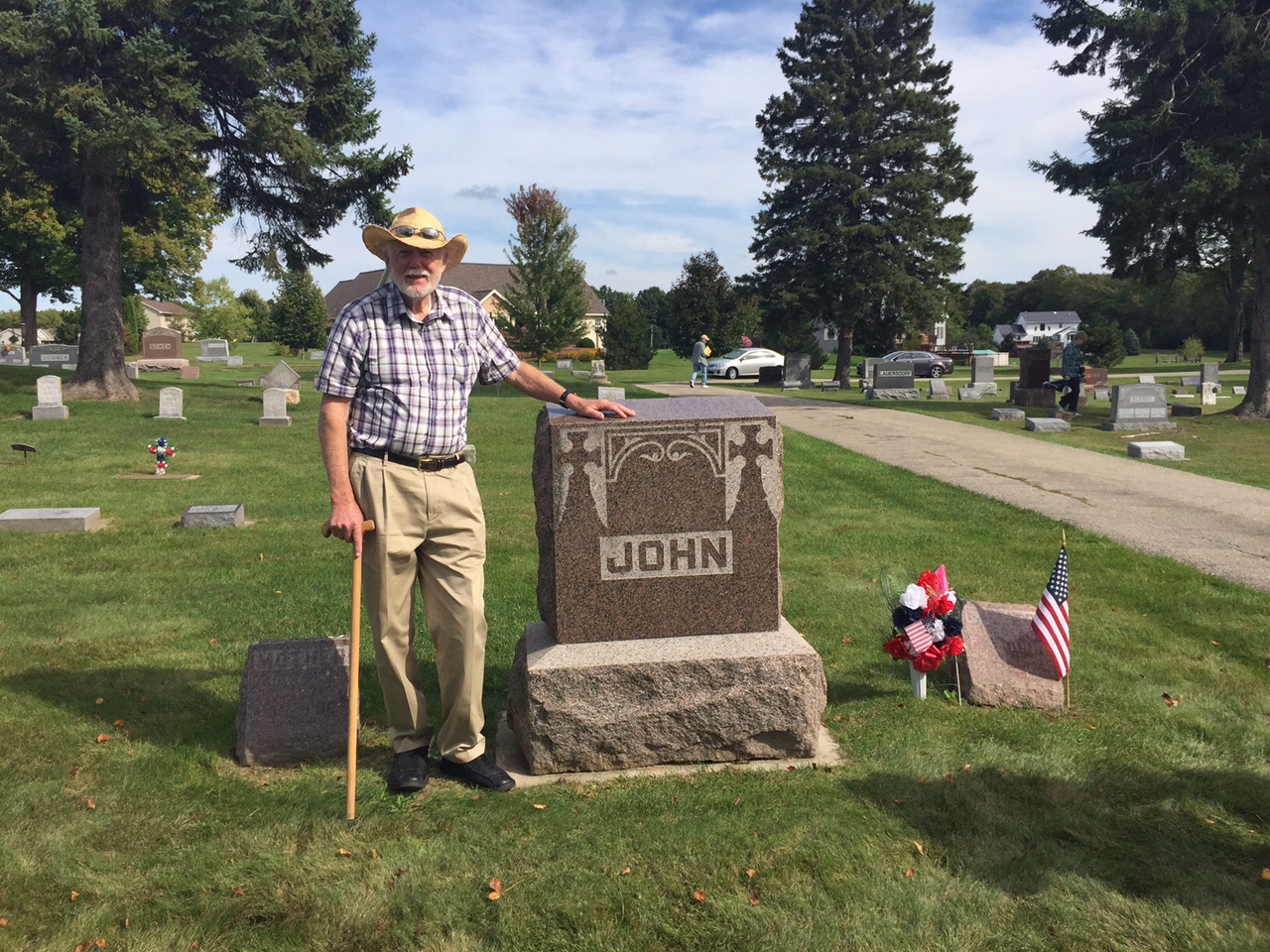
This last Sunday (September 20) the Gillett Historical Society held a cemetery walk with members representing 5 different citizens of the city of Gillett that were buried in the Wanderer’s Rest Cemetery. My father, spouse and I decided to attend as two of the persons being represented were relatives of the John family. The weather co-operated by being sunny and relatively warm to the delight of all.
Dad at the monument for F. W. and Johanna John.
Our cousin, Ron Hinz, played the part of Calvin John, and did a fine job of it too. After the ‘speeches’ everyone met at the Gillett Historical Society for some snacks and talk.
The coolest part of the day was meeting folks who knew Cal or F. W. or of them and the cousin we met who was a descendant of F. W. and Johanna. I am looking forward to more contact in the future.
So if you missed the walk, I have uploaded to our YouTube site the two videos I took with my iPhone of F. W. John and Calvin John. The first 1-10 seconds are missing from each talk, operator error, Enjoy!
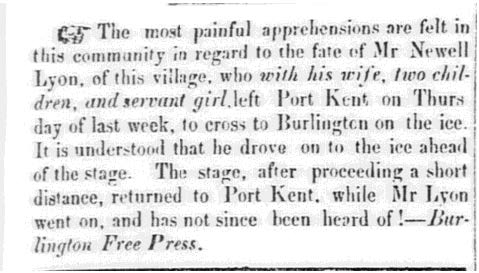
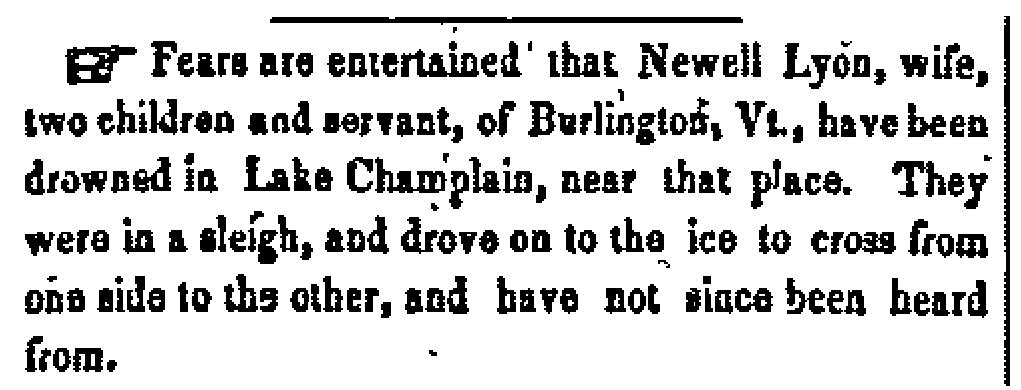
The Lyons of Vermont apparently didn’t know how to lead boring lives as can be seen in these two 1851 newspaper articles:
This article is from “The Vermont Journal”, March 1851.
This article is from “The Boston Daily Atlas” on the same date as above.
Newell my 5xgreat Uncle survived this harrowing adventure as did his wife Arrietta (Tiknor) and their two children, Asa N. and Edward, (who were about 2 and 1 years old respectively). We know this for several reasons, the most important being the 1860 census which shows everyone alive and well in Burlington, along with several other children that had been added to the family nest.
I can find nothing else out about the incident in the papers, possibly because the issues that are relevant to the story haven’t been digitized yet. The servant mentioned in the article could be one of two women who are found in the 1850 census record living with the family: Electa Stevens, a 20 year old Canadian; or Mary Sullivan, age 23, from Ireland.
Newell died in 1868. He was 62. Like his mother he suffered from some form of insanity, possibly alzheimers, as he died in an asylum. He had been a respected lawyer in Burlington until he, apparently, lost his mind. His wife Arrietta married again and died many years later in Florida. Their only surviving heir was Asa N. who died childless, but married, in St. Louis.


 jen's ancestors