Like father, like son…

I am finding that newspaper research is becoming my favorite part of genealogy because I have been able to find so many family stories that have become lost, deliberately or just due to the passing of time.

So here I introduce Arthur Albert Hamm. Born in 1922, he was the middle child of my great grandfather Fred Hamm and Emma Paugel. All three of their children were illegitimate, or to be less crass ‘born out of wedlock.’ Fred and Emma did eventually married in 1931, but I am not sure what the hold up was as both were divorced from their previous spouses by 1921.

As per his modus operandi, it is doubtful that Fred was living with the family in 1935. That is the year their youngest son Clarence was killed in an automobile accident. According to the 1940 census, Fred was noted as living in Minnesota in 1935, so my gut is saying that he had probably left shortly after their marriage. Again. All previous research indicates that Grandpa Fred was a love-em and leave-em type of guy, so I don’t know why he would treat this wife any differently.

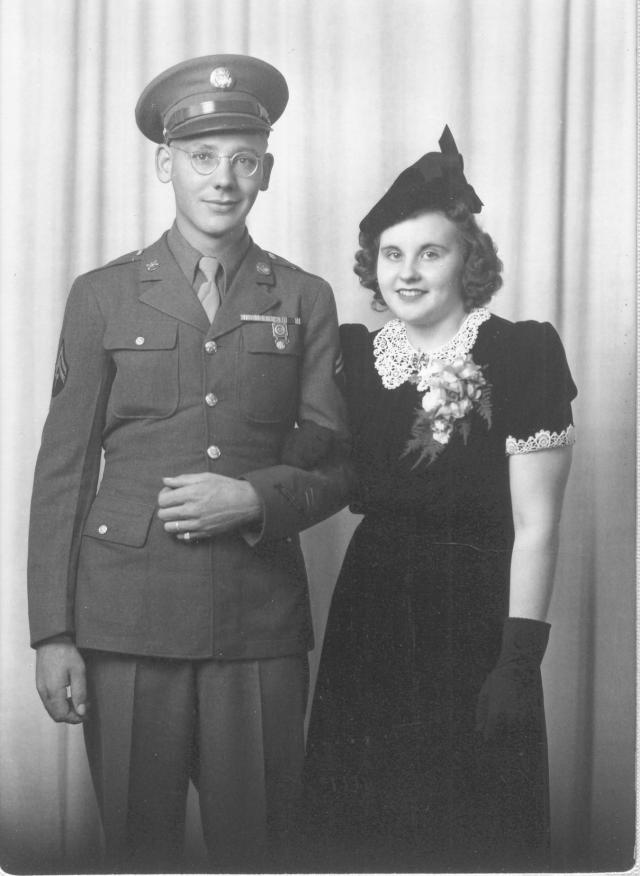
Fred’s sons, Arthur and Raymond, both joined the Army in 1942. Arthur joined up in January of that year. When Raymond (Alfred) was killed  in Africa in 1943 Art was sent home on furlough to be with his Mother and half-sister for the funeral.


newspaper_hammart_furlough


Sometime between 1941 and 1944 he had married, and had two children with Bernice Schultz.
3272157867_0d5b2a3838_o

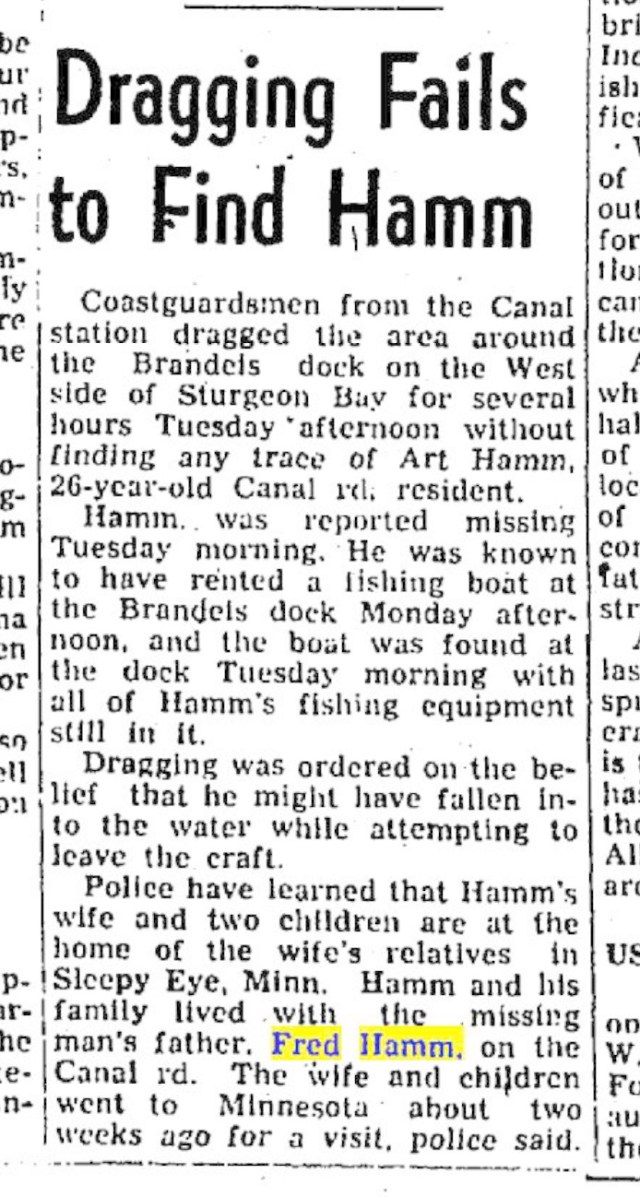
Arthur survived the war and came home to Door County and life went on, as it is wont to do, for a few years, then one day in April of 1949…


newspaper_hammart_disapears2

A few days later the paper reports…

newspaper_hammart_disapears1

Ah, but here’s the kicker. Arthur Albert Hamm died February 15, 1989 in Livingston, Park County, Montana. Prostate cancer and emphysema were the cause of death.

     Arthur A Hamm, 62, of Livingston died Friday Feb 15, 1989 in the afternoon at the Livingston Convalescent Center following an extended illness.
Graveside services will be held Wed. at 2pm at Mountain View Cemetery. Lowry Funeral Home is in charge of arrangements.
Mr. Hamm was born May 5, 1922 in Fairland, MN. He worked in Park County for a number of years as a logger and ranch hand. From 1974-1980, he worked on a seismograph crew in Tulsa, OK. He came back to Livingston in 1981 and had made his home here since. There are no known survivors.”

His wife (ex-wife?) Bernice had told the children he was dead. She later married a man who eventually adopted Art’s children.

I guess in Grandpa Fred’s favor is the fact that a no time did he pretend to die or go missing. As far as we know he pretty much just packed up and left, with no subterfuge. His son Arthur was apparently a bit more of a diva.

July 11, 1942 William Shepard to home

4076392738_f71cf9ce68_o

July 11, 1942

Dear Mother and Dad;
First time that I have had time to write for a long time. Please send me the following if you haven’t already,

  1. all if any of my white underwear
  2. 3 pr. new work sox, also my sweat sox.
  3. handkerchiefs
  4. house slippers
  5. Picture of the family and one of Kenny

Well thanks for the bother, I suppose I’ll get the swimming suit today, but the mail is a little bit erratic.
We have been drilling just about all the time and its getting hotter here. I think Ill go swimming tomorrow and cool off. Tell Charlie & Lydia I have 3 pals from Marion Theodore Ochs, Underwood and Burr. they are O.K. I also know quite a few fellows from Dayton.
Tell me about home when you write again & say hello to Dad and if he dont read this.
Ill have some time later if you come down. Aug 1 will probably be a busy time for me but I can get a few evenings off. Well Ill close now. Tell Ruth & Herm hello

Your son
Bill


Nazis and secret bases in Greenland…

During WWII my grandfather Clarence Fredrick John was too old to join as a soldier, being about 45 years of age. However, his expertise in road building, that he acquired working for the Forestry department in CCC camps in Wisconsin, was put to use in Greenland where he helped build runways for the military.

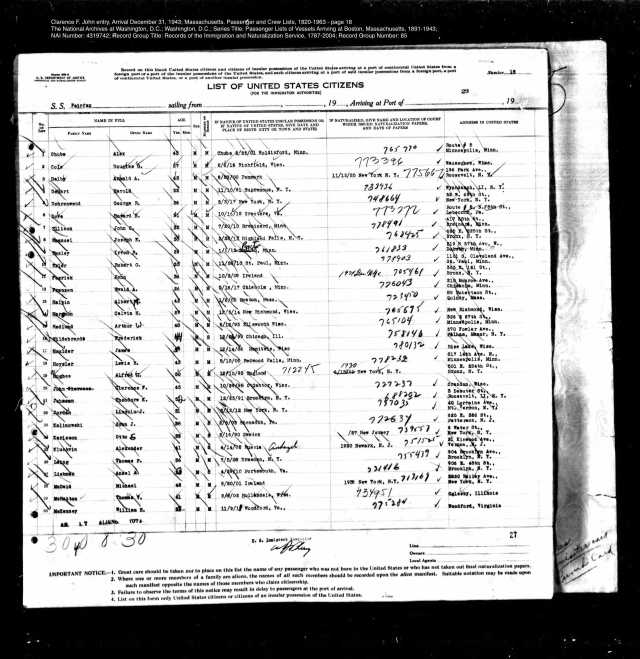
Clarence left his wife and 3 children for about a year to do his part to assist in the cause. Below is his SS Fairfax passenger list entry, after its arrival back in the US, at Boston at the end of December 1943.

ship_johncf_arvBoston1943

During his time in and around Greenland he took, and had taken, many pictures to remember his time there. (Because of all the snow it is difficult to see the details in many of them.) He put together a photo album so that he would have something to show the students in the Crandon Grade School, when he gave a talk to over 400 students, with whom he shared his adventures.

john_album2_pg04

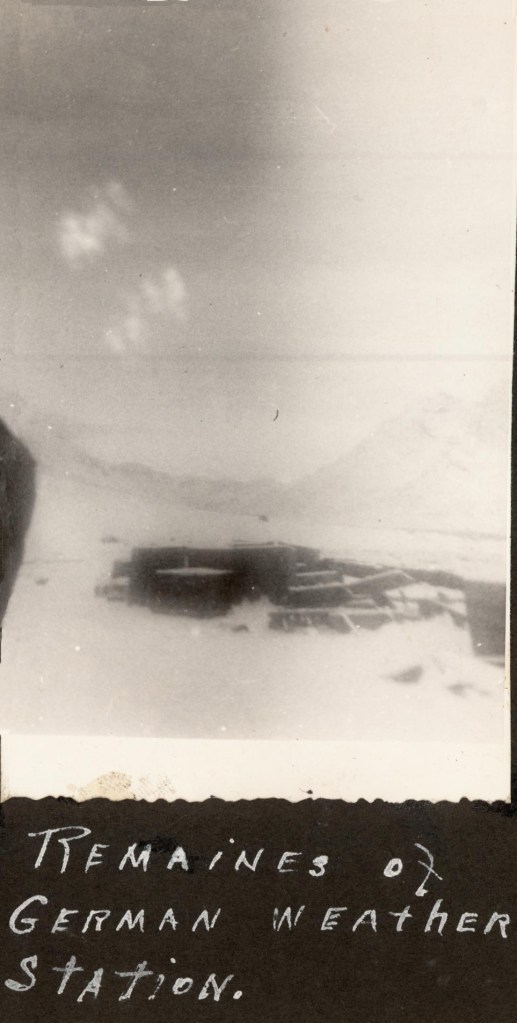
Along with all the wonderful indigenous artifacts that he brought back with him, and the stories of all he saw, there is one picture that he took that is important because of its historical military significance:

naziweatherstation
Photo taken by Clarence John.

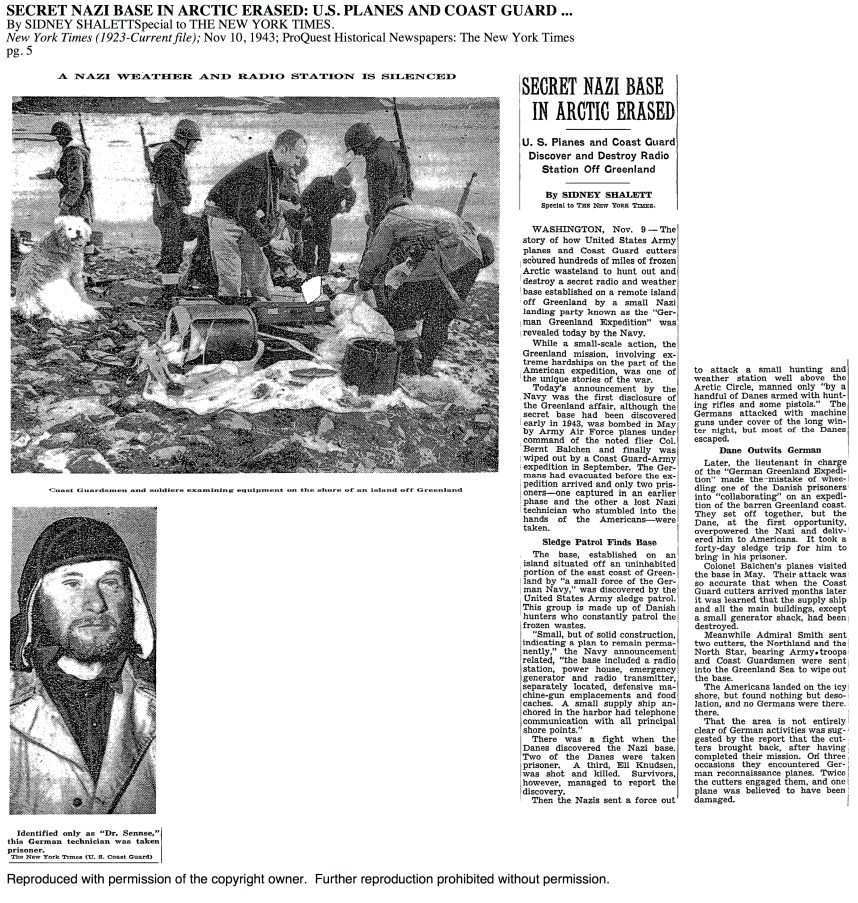
The mission was boringly named by Germans as the “German Greenland Expedition,” and it wasn’t their first attempt to establish radio stations in Greenland.

The US Navy haunted the coast of Greenland with the purpose of hunting down and destroying secret radio and weather bases that were being set-up by the enemy in various remote locations around Greenland. And, it wasn’t until  many months after this particular event occurred that the US Navy revealed what had actually happened, no doubt for security reasons.

Early in 1943 this secret base had been discovered, in May it was bombed by Army Air Force planes, and in September it was finally wiped out by a Coast Guard-Army expedition. The Germans occupying the small base had evacuated. But two German soldiers were eventually taken prisoner, one who had been captured and one who stumbled, accidentally, into the hands of the Americans.

The base was on an uninhabited small island off the east coast of Greenland, and had a small contingent of men from the German Navy. It was discovered by a sledge patrol consisting of Danish hunters who kept an eye on the coast for the US Navy while hunting. The two groups engaged in a battle and two Danes ended up being taken prisoner, another was killed. However, there were survivors who managed to get away and report the discovery to the US soldiers. After the battle the Germans banded together a party and headed north with the intentions of attacking the Danish weather station there. With machine guns under the cover of night, they attacked, but most of the Danes managed to escape.

The German commander attempted to get one of the Danish prisoners to collaborate on a mission up the coast, but at the first opportunity the Dane overpowered the Nazi and after a 40 day trip back, delivered him to the Americans.

Not much was left of the base when the Americans were done bombing it, as can be seen in the pictures.

The Germans were pretty persistent and continued making attempts to establish bases, as the Navy encountered several German air patrols and engaged them over the next few months.

Clarence must have been along for the ride when the US soldiers made a trip to the base to make sure it was destroyed. At no time is an exact location given, but it must have been pretty remote for it to take 40 days to get a prisoner back to your allies.

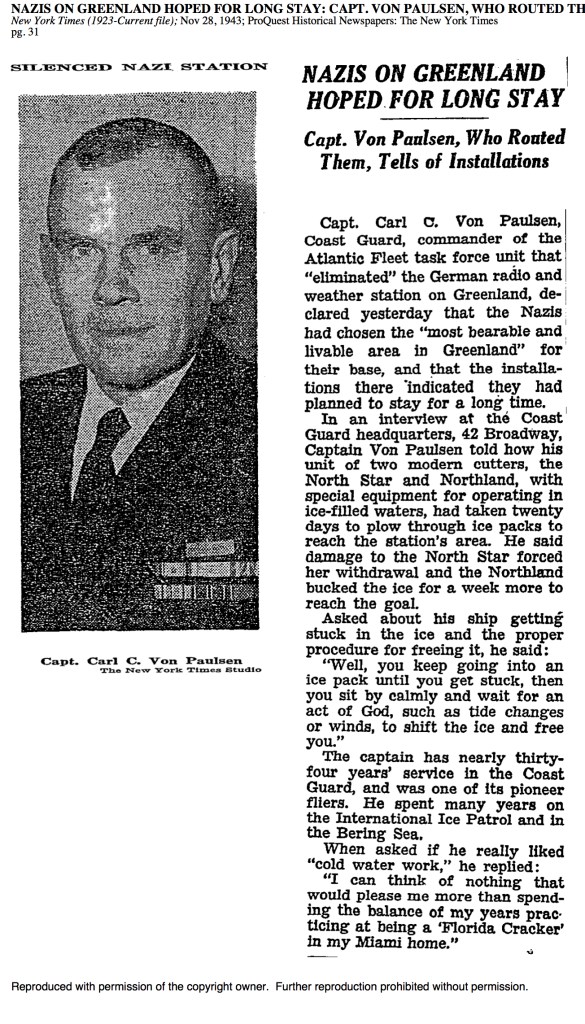
You can read the complete details in the article, which was published in November of 1943. Clarence had a small clipping of the event from another paper in his scrapbook. He didn’t see combat, but he did get to witness an exciting intrigue related to the war. Spies and secret bases oh, my!

newspaper_johncf_nazibase

newspaper_johncf_nazibase2